
On an unusually cool and rainy Saturday morning in Decatur, Georgia, dozens of people filed into a warehouse tucked at the back of a church parking lot, their arms full of what a less hopeful group might casually dismiss as junk. Some carried broken lamps, glitching electronics, or cracked pieces of furniture. Others walked in clutching heavy toolboxes, multimeters for testing electric currents, and cans of WD-40. Beneath a network of extension cords dangling from the exposed rafters, they sorted themselves into smaller, purposeful groups. The room buzzed with the specialized energy of volunteer electricians, tailors, luthiers, carpenters, and at least one cutler, or knife sharpener, who commandeered nearby worktables and drafted passing volunteers as needed.
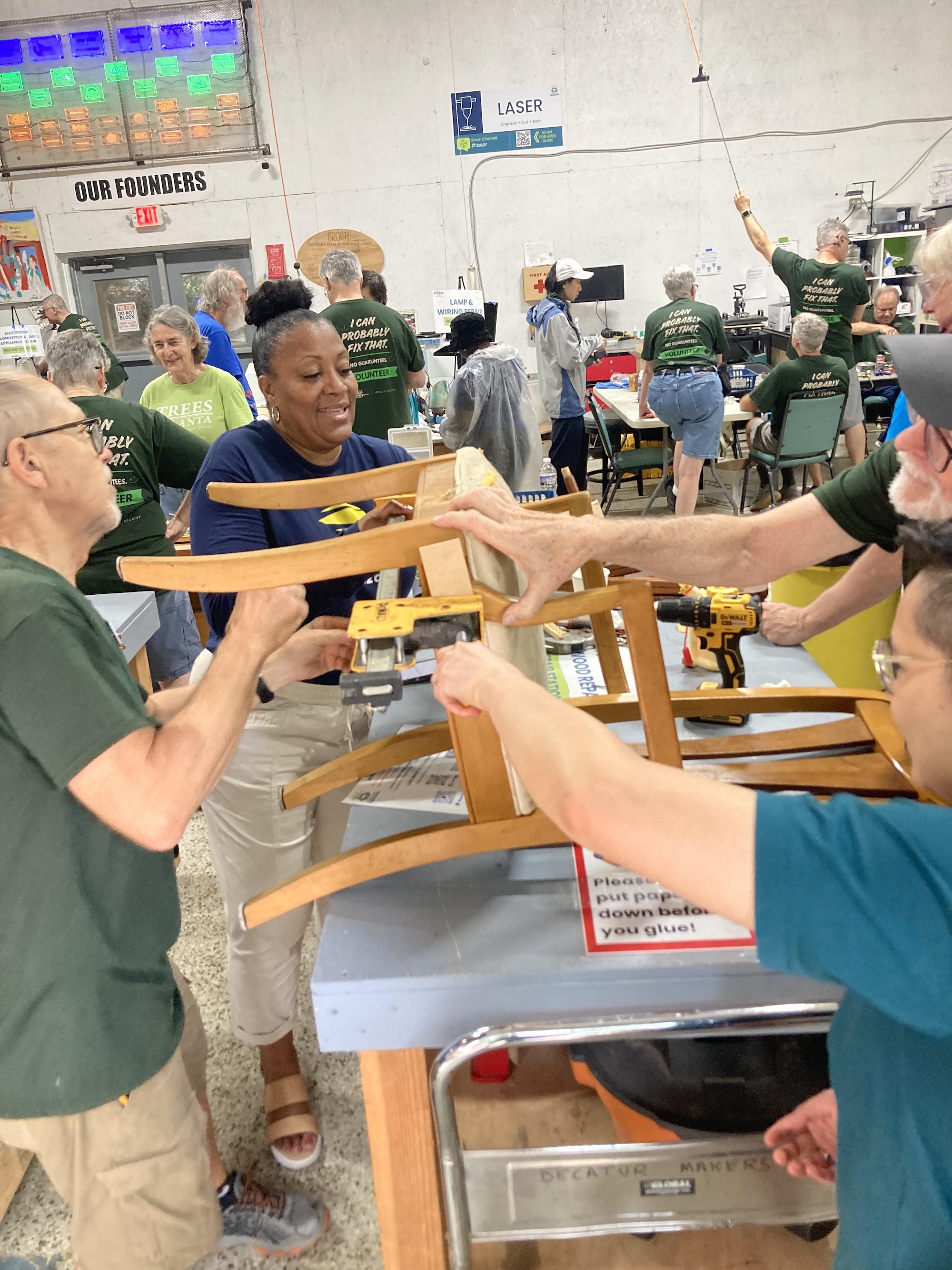
That community-driven atmosphere is how Lilly Pettus ended up shoulder to shoulder with three complete strangers, their hands all pressing together the pieces of her family’s cracked dining room chair while wood glue slowly hardened and a volunteer tightened a stabilizing clamp.
“This is so interesting,” a giddy Pettus said, inspecting for the very first time the structural joints—one of them broken—that held together the chair she had owned for decades. “You never even know how furniture is put together.”
This gathering was Decatur’s semi-regular repair café, functioning as one of a few hundred similar meetings taking place across the United States. Today, more Americans than ever are turning to these community gatherings to fix what they already own, actively resisting the pervasive influence of companies selling everything from hiking boots and smartphones to hot water boilers that constantly push for replacement over repair. One direct consequence of this entrenched throw-away economy is a steady increase in greenhouse gas emissions from manufacturing that threatens to intensify global climate change.
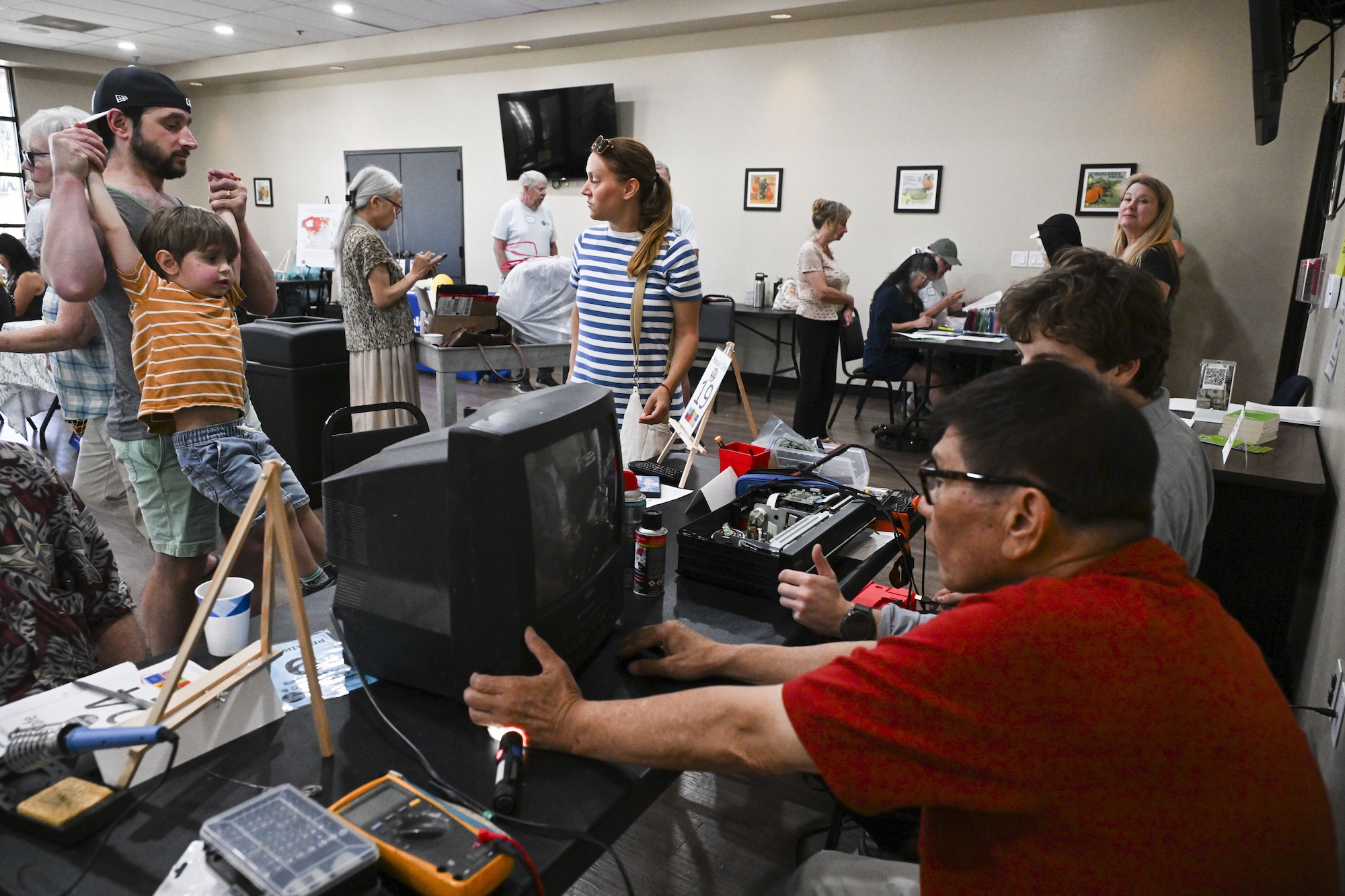
Yet, organizers and volunteers view repair cafés as far more than a relatively small climate solution. As inflation rises and wages stagnate, these meetups connect everyday people to a broader social movement with the ambitious, systemic goal of fundamentally changing the mechanics of America’s consumer economy.
At the Decatur repair café, volunteers wearing distinctive green shirts with “I can probably fix that” printed on the back offered their specialized skills completely free of charge as eager patrons observed the process. A young father, managing a toddler and a squirmy baby, watched intently as a volunteer carefully replaced a switch on a favorite mid-century modern lamp that had been worn out by the older child’s repeated clicking. Murmurs of excitement rippled around the building as the acrid, unmistakable smell of a spot welding project wafted through the air.
For Pettus, the broken chair held deep sentimental value and encapsulated her family’s unique story. Soon after she and her husband were married in 1996, they began an exhaustive search for a complete dining room set. Pettus wanted the chairs to be comfortable for her entire family, but the physical reality presented a unique challenge: one of her brothers is nearly 7 feet tall, and another is just a few inches shorter. “We are not a tiny family,” Pettus said. “We are a big family.”
The newlyweds eventually settled on a simple table and six chairs—two “host style” with arms and four without—purchased from a local Ethan Allen store. Over the years, the furniture came to feel far more like home than any of the physical houses where Pettus, her husband, and their children lived. They packed up the table and chairs, moving them faithfully with them from Florida to Connecticut, then onward to Indiana, Michigan, Texas, and finally to Georgia. “I don’t know anyone’s chairs that I like more than my own,” Pettus said.
However, after absorbing decades of joyful shakes of laughter during countless late-night games of Hearts, and absorbing the nervous fidgets of anxiety at family meetings regarding upcoming household moves, one of the chair’s wooden joints finally cracked under the pressure. “We had the chair just sitting in the corner,” Pettus said, “but no one actually sat in it.” She did not know how to fix the chair herself, but resigning it to a local landfill would mean throwing away a tangible reminder of her fondest memories from the last thirty years.
Pettus also thought of one of her children who had previously interned at the Environmental Protection Agency and shared deep concerns about pollution and climate change. Then, after months of the broken chair sitting as clutter in the family’s house, Pettus was running routine Saturday morning errands when she happened to drive past the Decatur repair café. She quickly drove the half-mile back home to grab the chair, deciding to give the heirloom a second chance at life.
“When a product breaks and you have to throw it away, it’s very lonely,” said Martine Postma, director of Repair Café International, a Netherlands-based network encompassing some 4,000 similar cafés worldwide. “It’s easier to just go on the internet and order a new item which will come to your doorstep in 24 hours, but that’s also a very lonely, disconnected activity.”
Postma, a former journalist with the calm, unflappable demeanor of a veteran librarian, founded her organization in 2010 after the birth of her second child magnified her growing fears about the planet’s long-term environmental future. “Markets are flooded with trash—with cheap products that we don’t need and that do not work,” Postma said. “They break, and they contribute nothing to our well-being. They just contribute waste.”
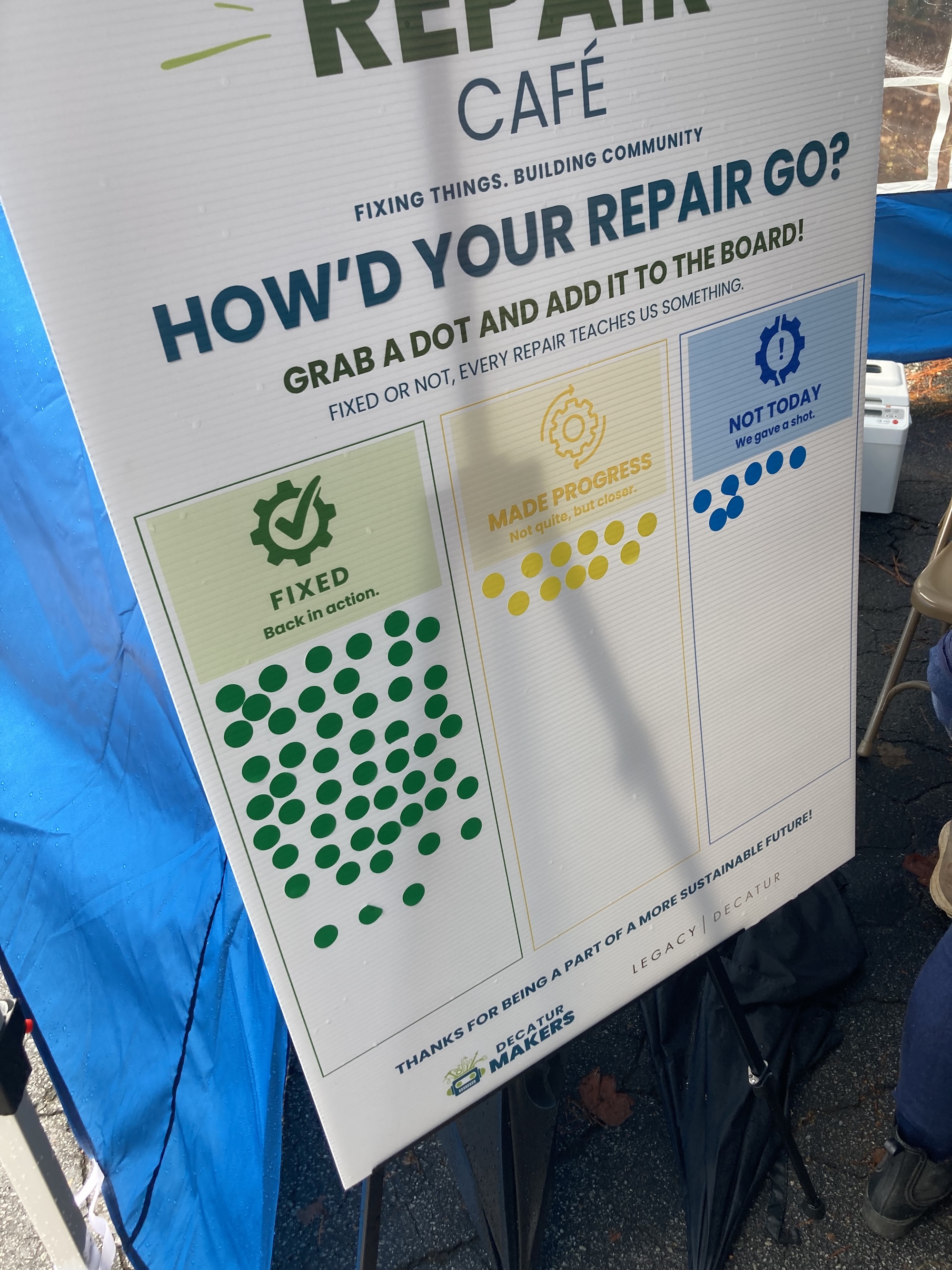
Repair cafés appear to be successfully inspiring people to use their belongings for longer periods. In 2025 alone, these global gatherings prevented nearly 2 million pounds of waste—the equivalent weight of more than 100 fully loaded Boeing 747 aircraft—according to data from Repair Café International. Furthermore, these efforts reduced greenhouse gas emissions to a degree equivalent to the average annual consumption of about 1,000 Dutch families.
Despite these localized successes, Postma, Pettus, and millions of other consumers often run straight into stubborn obstacles when attempting to fix their own possessions. Broken products are intentionally designed to be increasingly difficult to repair, according to a comprehensive report from the Federal Trade Commission titled “Nixing the Fix.” The report details how everyday Americans are actively incentivized to “replace products before the end of their useful lives” by corporations that decide to make repairs less safe, strictly limit the availability of replacement parts, lock critical software and firmware, or even systematically disparage independent repair operations.
In response to these hurdles, legislative momentum has begun to shift. In 2023, California, Colorado, Minnesota, and New York passed groundbreaking “right-to-repair” legislation explicitly meant to encourage product repair over immediate replacement. Just a year later, the European Union passed a similar sweeping directive. Postma and other grassroots organizers consider repair cafés to be a natural incubator for activism, helping to push for broader right-to-repair measures. Postma ultimately hopes for even more structural changes in Europe, such as a targeted tax on raw materials, arguing that such a policy would effectively limit industrial emissions and bolster local repair shops, even if it marginally increases the initial cost of manufactured products.
“I feel for the objects around me. I feel sorry for them if they’re broken,” she said. “I want to make repairing a normal thing in everyday life once more.”
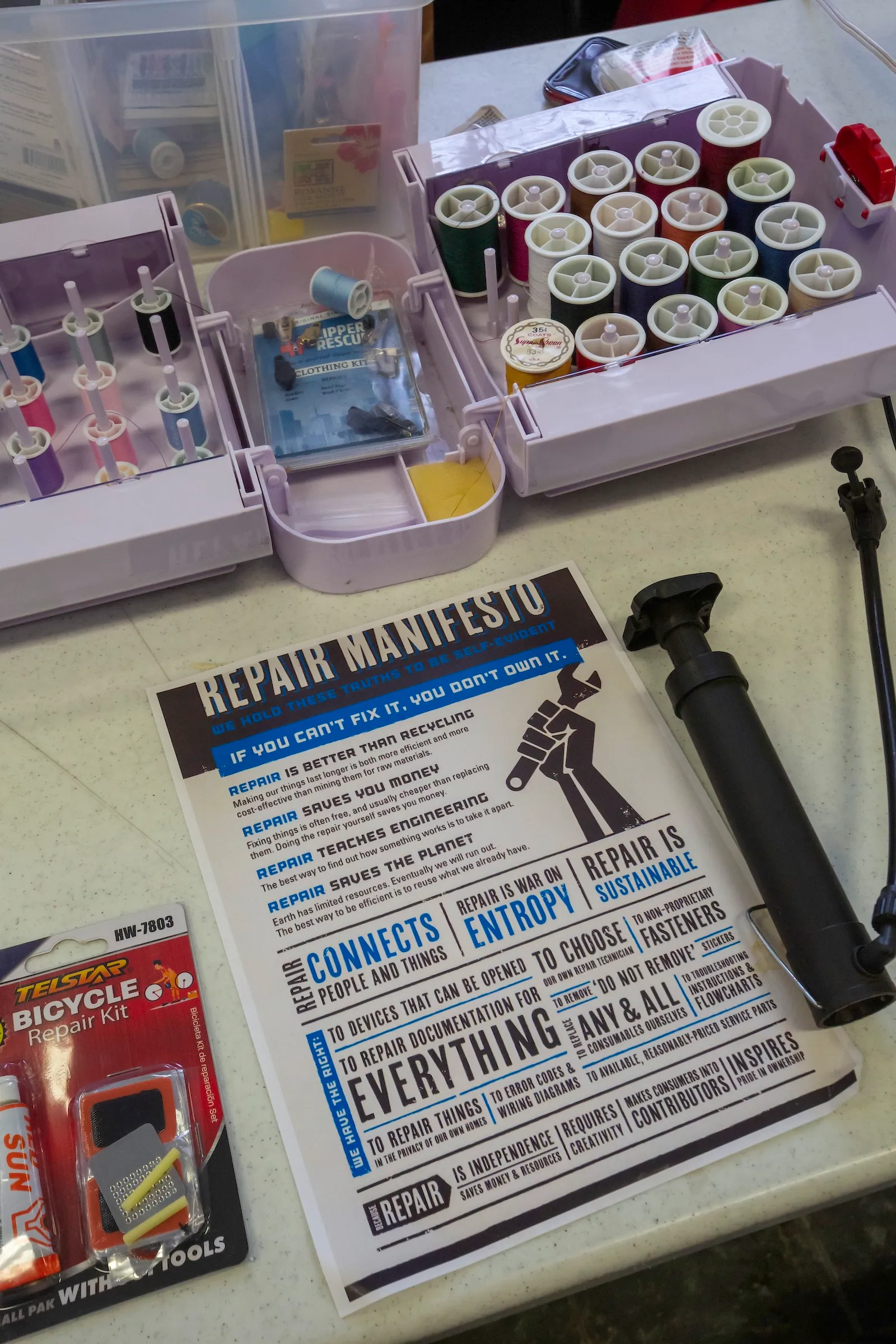
According to Postma, repairing goods is already far more common in relatively impoverished countries where replacing broken items can be exceptionally difficult and prohibitively expensive. Ironically, it is in wealthy nations where repair cafés are currently thriving, though they are far from uniform. Each individual café uniquely reflects the surrounding community and its specific socioeconomic landscape.
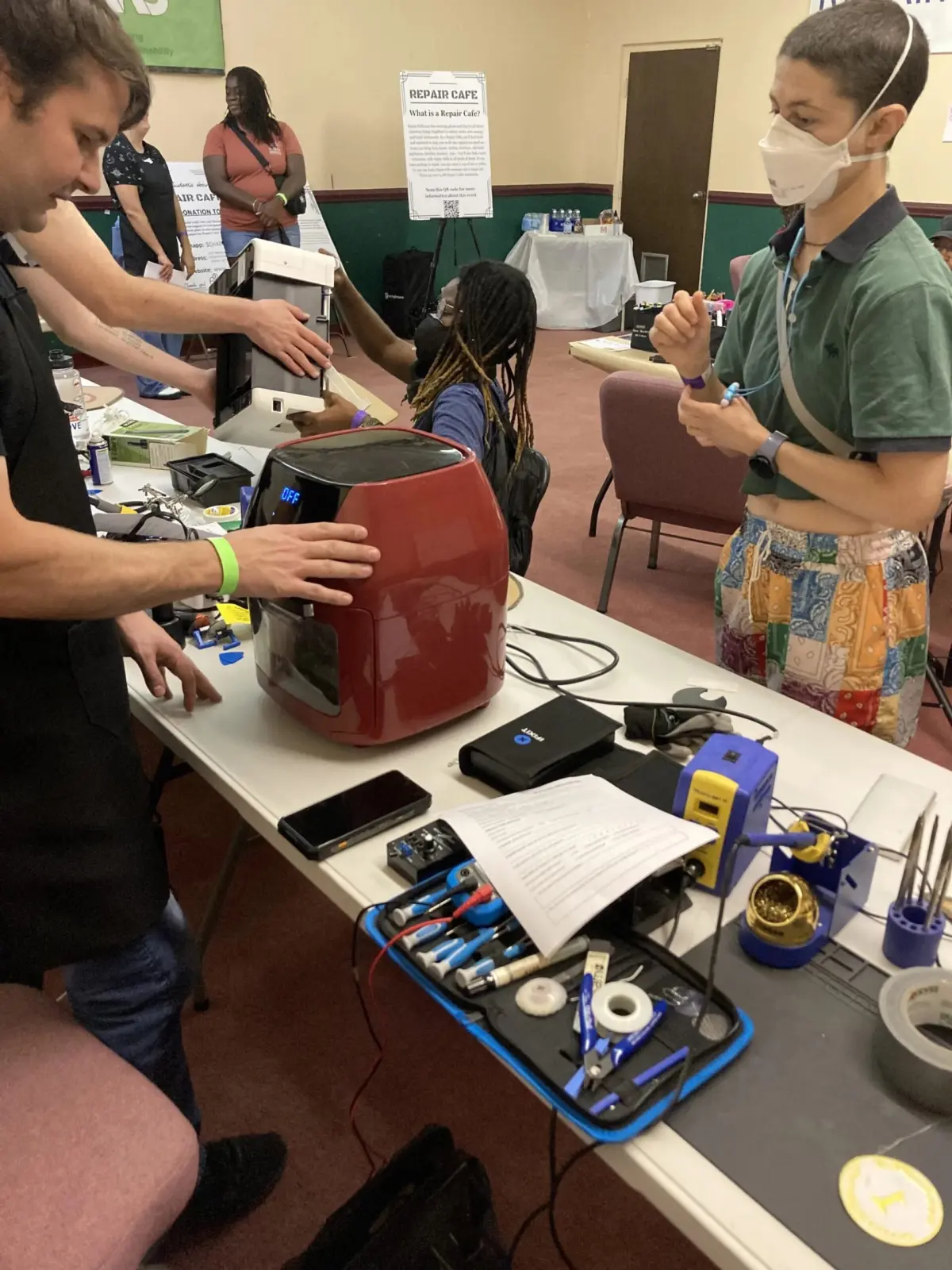
On a Sunday afternoon in the historic Collier Heights neighborhood of Atlanta, volunteers brought most of their own tools to the basement of a building owned by a Seventh Day Adventist Church, carefully arranging them on white plastic folding tables set atop a light pink carpet. The atmosphere and setup looked vastly different from the Decatur event held just a 30-minute drive across the city. The median annual household income in the predominantly Black Collier Heights neighborhood is roughly $40,000 lower than in Decatur, and many of the attendees who brought items wanted them fixed less for sentimental reasons and much more out of sheer necessity to keep using them.
Gale Pines walked into the basement carrying a red air fryer that had suddenly stopped working after they used it to dehydrate fresh ginger. When their apartment’s primary oven ran, Pines explained, it heated up the entire kitchen, making it nearly impossible to cook comfortably. Consequently, while navigating the rigorous demands of nursing school, Pines prepared most of their evening meals in the air fryer, most frequently cooking simple batches of chicken nuggets and fries.
Pines had recently graduated, but was facing difficulties finding a steady job and simply could not afford to purchase a brand-new $100 air fryer. “It’s just hard to exist,” Pines said. “I don’t really have a very big support network outside of my friends.”
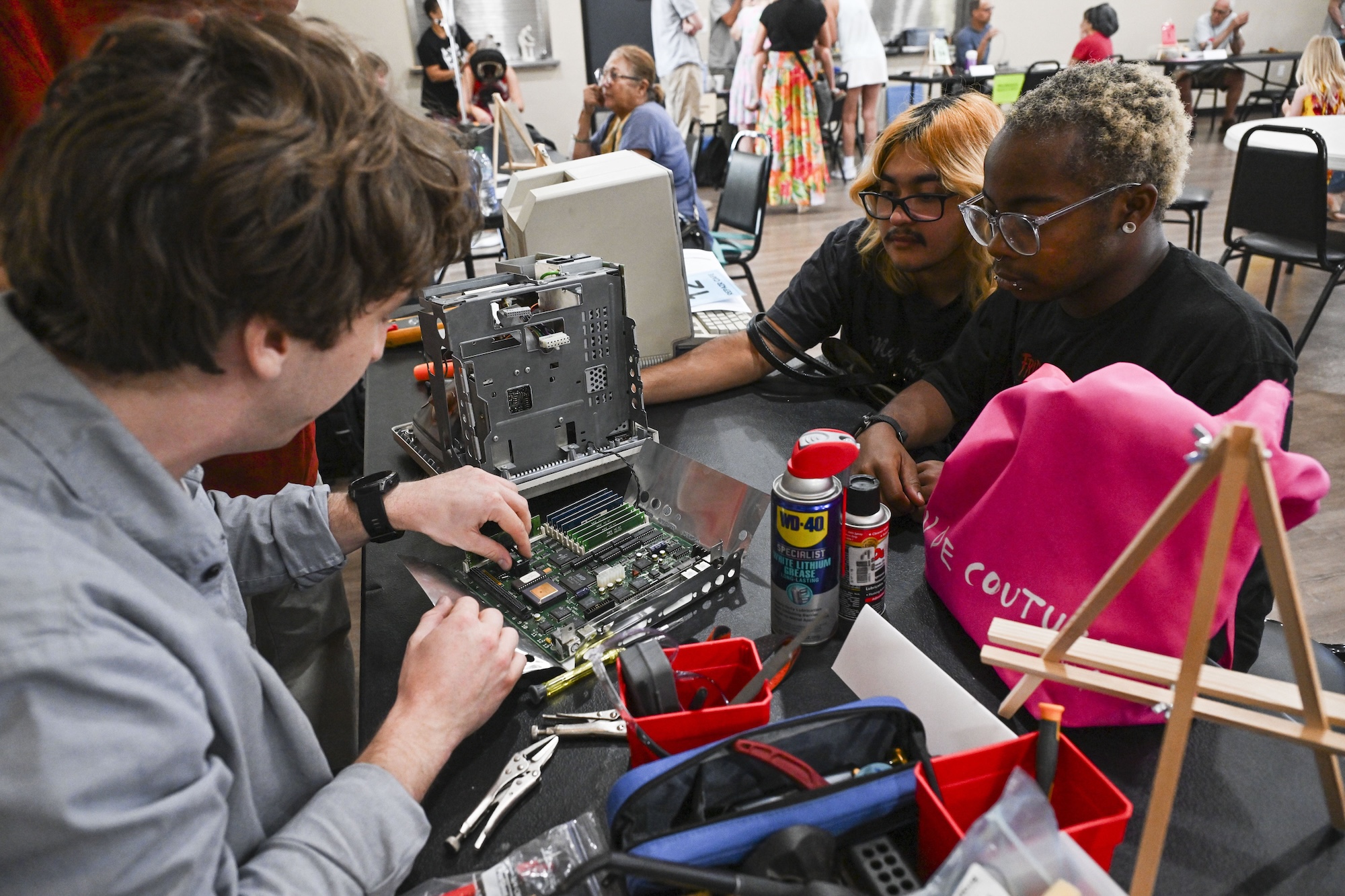
One of Pines’s housemates eventually told them about the Collier Heights repair café. Pines already kept a small bag of broken electronics in their garage that they strongly preferred not to send to a local landfill. “Being in the height of climate collapse, we can’t just keep buying new stuff all the time, both for the economy and for our material scarcity,” Pines noted.
When a volunteer at the Collier Heights repair café finally opened up the malfunctioning air fryer, they quickly diagnosed the root of the problem: a failed capacitor. Another volunteer happened to have brought a compatible replacement part, and the two worked together to execute the fix right in front of Pines. While Pines was deeply impressed by the process, they admitted to being unable to fully follow the relatively complex repair work. Even so, Pines felt completely fine about not having learned how to fix the appliance independently.
“To just be around people that want to help other people with the skills that they have, that’s value that is really important to me, and something that I try to do as well,” Pines said. “If somebody in my community has a question about their medication or something and can’t afford to go to the doctor, I’m happy to answer any questions that people have.”
Another volunteer, Lew Lefton, reflected on the broader cultural shift, suggesting that the fundamental satisfaction humans traditionally draw from making and fixing things has largely been lost in modern society. However, looming existential threats such as climate change and the rapid rise of artificial intelligence have driven many people back toward rediscovering basic, practical human skills that could prove vital to survival. According to Lefton, people who attend a repair café adopt a distinctly different perspective on the future, particularly when they learn a new skill or choose to volunteer their own time. “If the world ends,” he said with a wry smile, “at least I’ll know how to fix a motor.”

Back in Decatur, Lilly Pettus prepared to leave the warehouse with a newly sturdy dining room chair. A single screw and some fresh wood glue successfully stabilized the cracked joint, though the chair would still eventually require some upholstery work. Fortunately, someone Pettus had met at the café—who had provided one of the extra sets of hands holding her chair together while the glue set—was able to advise her on where to buy matching fabric. Pettus was already considering bringing the chair back to a future repair café for additional help reupholstering its worn seat cushion.
“The beauty of it,” Pettus said, “was that I actually was able to learn more about the chair. It was a great experience to know that—I’m not gonna say I birthed it, I of course did not—but I actually had something to do with helping to get it put back together.”