
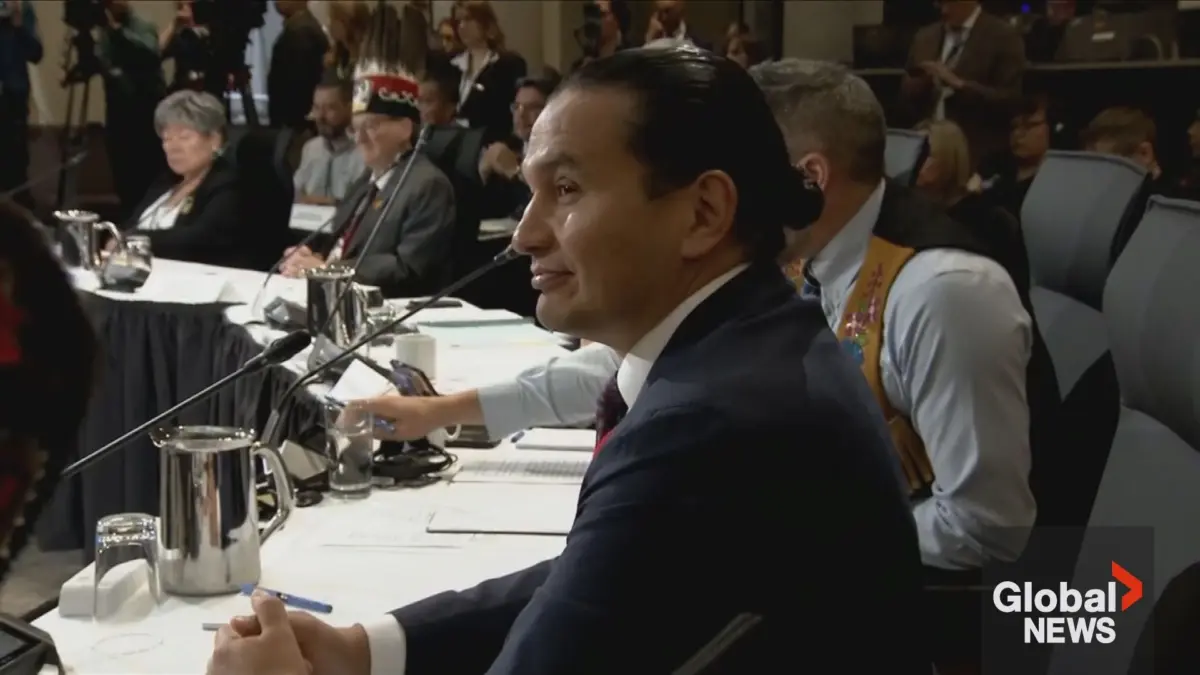
A sharp disagreement has emerged over the true focus of recent high-level discussions regarding the future of the Indian Act, following a landmark closed-door meeting in Ottawa between federal, provincial, and First Nations leaders. While federal officials and provincial leadership suggested that Indigenous leaders initiated calls to dismantle the 1876 legislation, national leadership from the Assembly of First Nations is strongly disputing that narrative, arguing that the primary concerns of chiefs in attendance were instead sidelined by political commentary.
Assembly of First Nations National Chief Cindy Woodhouse Nepinak stated on Tuesday that the only leaders who actively brought up the prospect of abolishing the Indian Act during last week’s historic gathering were Manitoba Premier Wab Kinew and Prime Minister Mark Carney. Her account stands in direct contrast to claims made by both Carney and Kinew following the summit, in which both figures asserted that the initiative to replace or repeal the century-old law originated from First Nations chiefs in the room.
According to Woodhouse Nepinak, the gathered First Nations leaders were principally focused on critical economic and environmental matters—specifically the federal government’s proposed major projects legislation, which chiefs argue directly threatens their inherent rights and title. She explained that those essential conversations went to the wayside once Premier Kinew and Prime Minister Carney voiced their public remarks regarding the complete elimination or sweeping overhaul of the federal statute.
The dispute highlights the deep-seated complexities surrounding the Indian Act, a foundational piece of federal legislation enacted in 1876 that grants the federal government extensive authority over First Nations communities, land management, and individual governance across Canada. Under the statutory powers of the act, Ottawa dictates who qualifies for legal Indian status, maintains authority over the official Indian Register, and regulates the daily administration, operations, and decision-making capabilities permitted on reserve land.

Following the closed-door conference, Prime Minister Carney told reporters that he was very open to the idea of doing away with the statute, framing any potential federal legislative action as a direct response to grassroots Indigenous requests rather than a top-down mandate imposed by Ottawa. Carney stated at the time that while not every participant raised the desirability of such a move, other participants had done so, meaning that discussions were starting from the right place by responding to a request rather than having the federal government decide policy unilaterally. However, in subsequent public statements, the prime minister nuanced his stance, indicating that the Indian Act could ultimately be reformed rather than outright abolished.
The office of Minister of Crown–Indigenous Relations and Indigenous Services Minister Mandy Gull-Masty weighed in on the conflicting accounts on Friday. In an emailed statement, ministerial spokesperson Livi McElrea affirmed that Premier Kinew was not the sole voice raising the possibility of reforming or removing the statutory framework during the Ottawa summit. McElrea noted that because the meeting was conducted behind closed doors, it would be inappropriate to provide further specific details regarding individual contributions to the conversation. However, the statement emphasized that Prime Minister Carney has publicly acknowledged that the Indian Act is fundamentally racist and that a broader, comprehensive conversation with First Nations about its ultimate future remains necessary.
Despite broad agreement among First Nations leaders that the Indian Act is an archaic, paternalistic, and deeply restrictive instrument of state control, there remains little consensus across Indigenous communities regarding whether the legislation should be fully repealed, systematically reformed, or replaced with an alternative national framework. Many leaders caution that simply abolishing the act without protective guarantees could inadvertently compromise treaty rights, land rights, and federal fiduciary obligations established over generations.
While opinion remains divided on full abolition, First Nations leaders overwhelmingly support targeted amendments to the rules governing status determination under the Indian Act. For generations, federal status rules have been criticized for creating systemic inequities, gender-based discrimination, and administrative hurdles that strip First Nations individuals of their recognized identities and community ties. Despite this widespread support from Indigenous leadership to fix status eligibility provisions, the federal government has not yet committed to specific statutory changes on how status is assigned under the law.
The debate surrounding the potential repeal of the Indian Act carries significant historical weight, evoking memories of past federal attempts to eliminate the legislation that met fierce resistance from Indigenous nations. Most notably, in 1969, decades before he would become prime minister, Jean Chrétien served as the minister of Indian Affairs in the Liberal government of Pierre Elliott Trudeau and introduced a controversial policy document formally known as the Statement of the Government of Canada on Indian Policy, commonly referred to as the "White Paper."

The 1969 White Paper proposed the total abolition of the Indian Act, the elimination of legal Indian status, the full absorption of First Nations people into the broader Canadian citizenry as ordinary taxpayers, the termination of historic treaties, and the privatization and division of reserve lands. The federal proposal triggered widespread opposition from First Nations leaders and organizations across the country. Led in large part by Indigenous scholar and leader Harold Cardinal and the Indian Association of Alberta, critics forcefully rejected the document, labeling Chrétien’s plan as an aggressive policy of forced assimilation that threatened the complete erasure of First Nations identities, legal rights, and distinct cultures. The intense political resistance ultimately forced the Trudeau government to abandon the White Paper entirely.
In the decades following the White Paper controversy, federal policy gradually shifted toward establishing mechanisms that allow individual First Nations to opt out of specific sections of the Indian Act and transition toward comprehensive self-government agreements. Several communities across Canada have successfully navigated these administrative and legal avenues to exercise self-determination outside the confines of the 1876 law.
Among those self-governing entities is the home community of Indigenous Services Minister Mandy Gull-Masty, the Cree First Nation of Waswanipi in Nord-du-Québec. Waswanipi operates as a self-governing community under the landmark 1975 James Bay and Northern Quebec Agreement. Recognized as the first modern land claim agreement in Canadian history, the accord re-established local control and governance structures independent of the traditional Indian Act regime—a historic negotiation in which Jean Chrétien also played a prominent regulatory role.
The renewed rhetoric concerning the reform or potential abolition of the Indian Act coincides with Prime Minister Carney’s push to accelerate major resource, industrial, and infrastructure project developments in partnership with provincial governments and Indigenous communities. As part of this broader economic strategy, the federal government introduced the Building Canada Act, aimed at streamlining regulatory approval processes and expediting development timelines across the country.
The draft version of the Building Canada Act initially contained explicit provisions that would have granted federal authorities the power to sidestep provisions of the Indian Act to advance priority infrastructure projects. However, that specific clause met immediate political opposition in Parliament. Following strong criticism from both the Conservative Party and the Bloc Québécois, who raised concerns regarding legislative overreach and constitutional mandates, the federal government removed the controversial sidestepping provision from the bill.

For First Nations leadership, the intersection of project-acceleration legislation and broad declarations about dismantling the Indian Act raises urgent questions about federal priorities. As Assembly of First Nations National Chief Woodhouse Nepinak pointed out, the primary focus for chiefs attending the Ottawa summit was ensuring that new federal development frameworks do not trample upon treaty rights, environmental protections, or local decision-making authority.
As political leaders on all sides navigate the fallout from the closed-door summit, the future of Canada’s legal relationship with First Nations remains suspended between calls for major project development and longstanding demands for structural justice. While federal officials maintain that dialogue regarding the racism embedded within the Indian Act must continue, First Nations leaders reiterate that substantive progress requires addressing immediate legislative threats to Indigenous rights before embarking on sweeping, uncoordinated overhauls of foundational federal laws.