
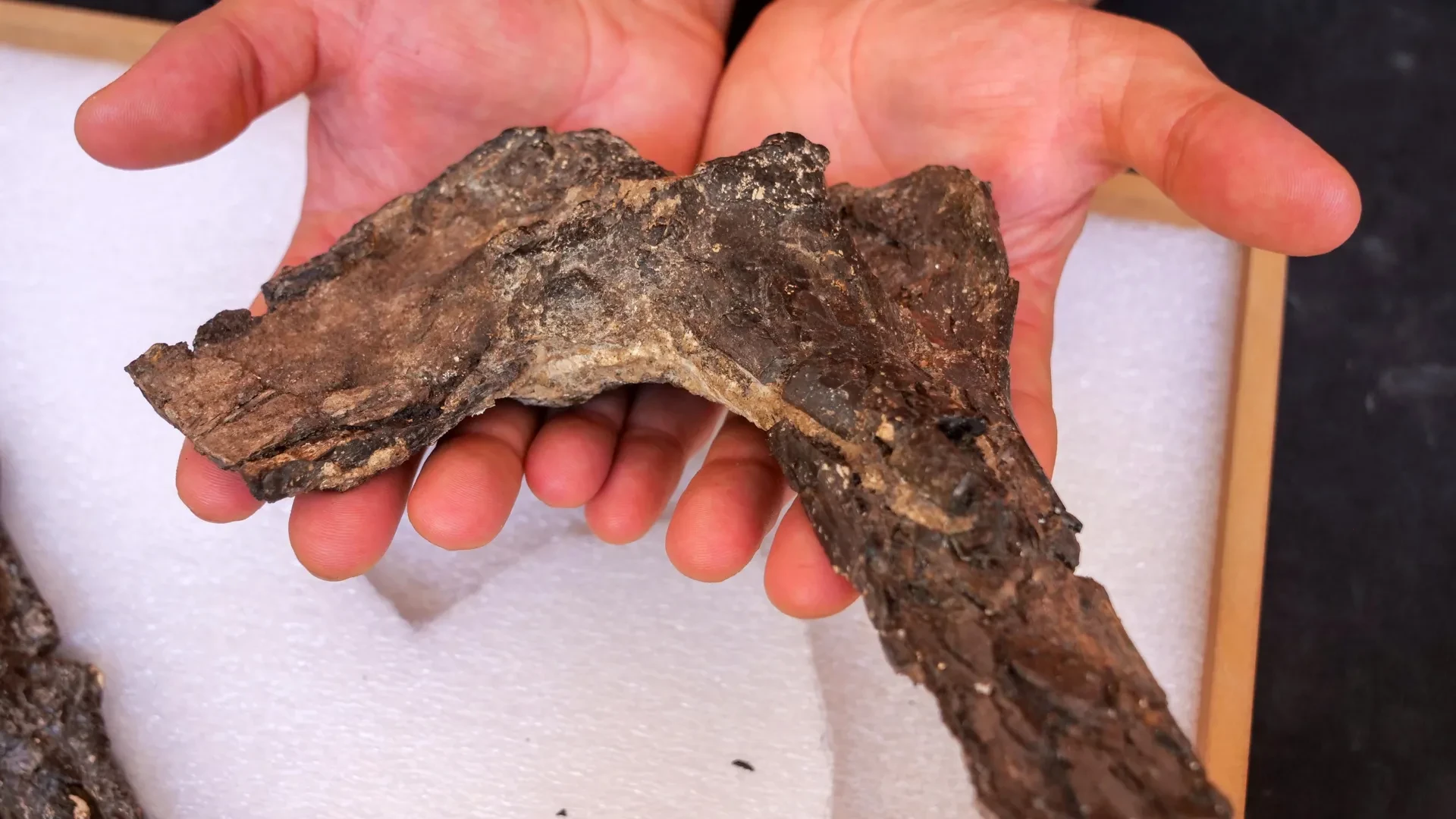
Scientists have made a groundbreaking discovery by uncovering remarkably preserved traces of dinosaur blood deep inside 115-million-year-old bones. This extraordinary finding reveals that delicate biological molecules can survive far longer than previously believed by the scientific community. The breakthrough has the potential to fundamentally transform how researchers study prehistoric animals, offering unprecedented molecular insights into creatures that roamed the Earth millions of years ago, and could even influence the ongoing search for ancient life beyond our planet.
An international research team led by Curtin University successfully identified fossilized red blood cells and distinct chemical evidence of blood molecules preserved within the remains of Aratasaurus museunacionali. This carnivorous theropod dinosaur was originally discovered in northeastern Brazil. The landmark findings, which have been published in the prestigious Proceedings of the National Academy of Sciences, also revealed the presence of amino acids associated with collagen, an essential structural protein commonly found in bones and various other connective tissues throughout the animal kingdom.
This latest discovery provides the scientific community with its first definitive chemical confirmation of molecules derived directly from hemoglobin inside fossilized dinosaur red blood cells. While earlier academic research had occasionally identified microscopic structures resembling blood cells within ancient fossils, scientists had not previously been able to conclusively demonstrate the presence of these particular molecular remains locked safely inside them.
Ancient Dinosaur Blood Preserved Inside Fossilized Bones
When the multidisciplinary team of researchers carefully examined the limb bones of the Cretaceous-era dinosaur, they identified numerous mineralized red blood cells nestled tightly inside vascular canals. These microscopic passages are the very channels that once contained active blood vessels during the animal’s lifetime. Subsequent chemical analysis of these structures unveiled preserved heme molecules, which serve as crucial functional components of hemoglobin—the specialized protein responsible for enabling red blood cells to efficiently transport oxygen throughout an organism’s body.
Finding these specific molecules provided direct, undeniable chemical evidence that the ancient fossil contained authentic remnants of prehistoric blood. Furthermore, it powerfully demonstrated that certain biological materials, long thought to be far too fragile to endure the immense passage of millions of years, can indeed remain detectable under exceptional geological and environmental conditions.
The intensive scientific study was led by John Curtin Distinguished Professor Kliti Grice, who serves as the founding director of Curtin University’s WA-Organic and Isotope Geochemistry Centre, in addition to her role as an Australian Research Council Laureate Fellow.
"To detect intact heme-derived molecules in 115-million-year-old red blood cells is astonishing: this really is a landmark discovery," Professor Grice stated, emphasizing the profound nature of the findings. "It not only extends the known fossil record of blood, but also offers a direct molecular window into the physiology of long-extinct animals so we may better understand them and the world they lived in."
How Dinosaur Blood Survived 115 Million Years
The extraordinary preservation of these delicate biomolecules appears to be directly connected to a specific mineral known as hausmannite. This mineral played a critical stabilizing role, helping to protect the fossilized blood cells and preserve their complex molecular components—including the amino acids belonging to collagen—over an immense span of geological time.
In effect, the surrounding minerals functioned much like a natural time capsule, effectively shielding the microscopic evidence of the dinosaur’s biology long after the creature’s death and the subsequent burial of its remains.
Researchers examining the site believe that the environmental conditions surrounding the dinosaur’s burial were also crucial to this rare preservation event. They suspect that the animal was rapidly and completely covered by fine sediment in an aquatic or terrestrial environment characterized by very low oxygen levels and abundant microbial activity. These specific depositional conditions may have successfully halted the typical decay processes, helping to preserve biological material that would ordinarily have broken down and disappeared entirely within a relatively short period after death.
This international research effort brought together a diverse group of specialists from various renowned institutions. Collaborators included scientists from Curtin University’s School of Earth and Planetary Sciences, the Japan Agency for Marine-Earth Science and Technology, the Brazilian National Museum, the Regional University of Cariri, and Johns Hopkins University, highlighting the global and collaborative nature of modern paleontological research.
A Discovery That Challenges Fossil Preservation Limits
The findings directly challenge a longstanding assumption in the fields of paleontology and organic geochemistry: that molecules associated with blood, particularly those fragile components derived from hemoglobin, could never remain preserved across such enormous periods of deep geological time.
Beyond confirming the unexpected survival of ancient blood components, this discovery raises the exciting possibility that numerous other fossils housed in museum collections and research laboratories around the world may actually contain valuable molecular information that conventional visual examinations have simply overlooked until now.
"These findings challenge longstanding assumptions that certain biomolecules such as hemoglobin cannot survive deep time," Professor Grice reiterated. "It opens exciting new avenues for molecular-level paleontology, allowing us to investigate the evolution of blood, metabolism and even activity levels in ancient animals."
Such detailed molecular information could eventually help researchers better understand how various extinct animals functioned in their natural ecosystems, shedding light on aspects of their metabolism, internal temperature regulation, and overall physiology that have historically been notoriously difficult, if not impossible, to accurately reconstruct from fossilized bones and skeletal structures alone.
Implications for Ancient Life Beyond Earth
The significance of this scientific breakthrough may extend well beyond the realm of dinosaur paleontology. By improving our understanding of how fragile biological structures can successfully survive for tens or even hundreds of millions of years, the findings could also assist scientists in their ongoing efforts to identify possible traces of ancient life in other extreme and challenging environments, including those located far beyond Earth.
Professor Martin Van Kranendonk, head of Curtin University’s School of Earth and Planetary Sciences, noted that the research results are fundamentally changing how contemporary researchers understand the long-term preservation of molecular structures across vast timescales and under harsh environmental conditions.
These valuable insights could prove particularly beneficial to the field of astrobiology, an interdisciplinary scientific domain that investigates the potential existence and nature of life elsewhere in the universe. If complex biological molecules or their distinct chemical signatures can indeed persist under the right geological conditions for more than 100 million years, scientists engaged in space exploration and planetary science may need to carefully reconsider where, how, and using what methods they search for evidence of ancient microscopic organisms on other worlds.
"This study exemplifies how coordinated efforts across institutions, continents and scientific disciplines can unlock extraordinary insights into ancient life," Professor Van Kranendonk said.
The extensive research project was made possible through financial and institutional support, including a competitive 2021 Australian Research Council Laureate Fellowship awarded to Professor Grice. The complete study, titled "Heme signatures in mineralized red blood cells within vascular canals of a 115-million-year-old dinosaur bone," was officially published in the Proceedings of the National Academy of Sciences.