
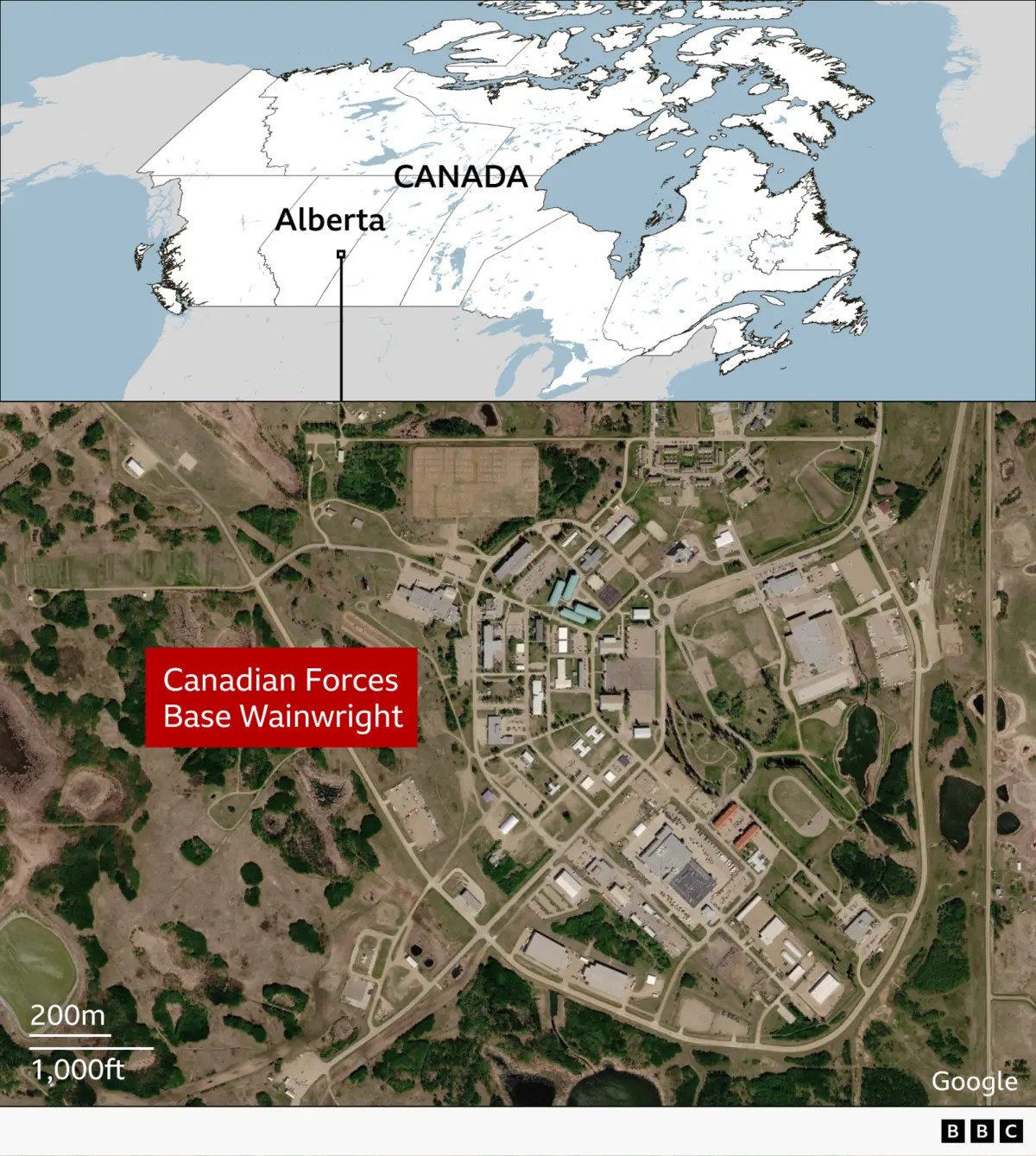
A violent, fast-moving fire swept through a Canadian military base in western Canada on Saturday, killing at least four service members and leaving 19 others in critical condition with severe burn injuries. The catastrophic blaze erupted during active training exercises at Canadian Forces Base (CFB) Wainwright, located in rural Alberta, quickly overcoming personnel on the ground as shifting winds drove the flames across dry prairie terrain.
In total, 39 individuals were hospitalized following a massive, multi-agency medical evacuation that stretched health resources across the region to their absolute limits. Emergency responders, medical personnel, and military leadership worked through the night to treat the injured, extinguish the remaining flames, and secure the remote installation.
Prime Minister Mark Carney addressed the nation following the disaster, describing the event as one of the worst peacetime tragedies on Canadian soil in the history of the country’s armed forces. As military investigators work to determine the exact origin of the blaze, local communities, defense officials, and the families of service personnel are left confronting an unprecedented loss within Canada’s defense community.
How Did the Fire Start?
The disaster began to unfold on Saturday afternoon at approximately 16:00 local time (22:00 GMT) on the extensive training ranges of Canadian Forces Base Wainwright. According to military officials, what started as a localized grass fire rapidly spiraled out of control due to harsh and unpredictable weather conditions.
Major-General Wade Rutland, Commander of the 1st Canadian Division, reported that the grass fire ignited on an active training range while military units were undergoing operational exercises. Almost immediately after ignition, "uncommonly strong winds caused it to spread rapidly and shift direction," pushing the wall of fire directly toward soldiers stationed in the area. The sudden shift in wind vector left personnel with little time to retreat or take cover, surrounding troops on the open terrain.
Military and civilian firefighting units were immediately dispatched to the scene, mounting an intense effort to contain the flames and rescue trapped personnel. Fire crews fought the "violent" and "fast-moving" inferno continuously throughout the night. Prime Minister Carney commended the extraordinary bravery of the emergency teams, noting that responders "fought this fire throughout the night in some of the worst conditions imaginable, risking their lives to protect their fellow Canadians."
While the initial trigger for the grass fire remains under active investigation, early confusion surrounding the incident led to conflicting reports. Local media outlets initially reported that the inferno may have been triggered when military equipment or ordnance struck a natural gas main during a live-firing exercise. However, military officials later clarified those reports, stating that investigators do not believe any explosions were caused by oil or gas infrastructure operating on or near the base grounds.
The Department of National Defence confirmed that a thorough investigation into the cause of the fire is underway. Defense officials explicitly noted that, at this stage of the inquiry, there are no indications that the blaze was the result of any terrorist activity or deliberate act.

Casualties and the Mass-Emergency Rescue Effort
The human toll of the fire quickly overwhelmed local medical infrastructure, requiring a large-scale, coordinated emergency effort across the province of Alberta. Military authorities confirmed that four service members died as a direct result of the blaze. A further 39 individuals were transported to regional medical facilities for urgent treatment, with 19 of those patients listed in critical condition due to life-threatening burn injuries and smoke inhalation.
Officials have refrained from speculating on whether the death toll could rise in the coming days, though medical authorities acknowledged that many of the hospitalized service members sustained exceptionally severe burn trauma. Ongoing care for the critical victims is expected to be intensive, requiring extended stays in specialized burn units and intensive care wards.
The logistical challenge of evacuating dozens of injured personnel from a remote military base prompted a massive 10-hour emergency response operation managed by Alberta’s health services. The operation mobilized a fleet of 22 ground ambulances alongside eight emergency medical aircraft, including helicopters and fixed-wing air ambulances, to transport victims from Wainwright to major trauma centers.
The primary destination for many of the critically injured was the Royal Alexandra Hospital in Edmonton, located roughly 120 miles from the military base. On Saturday evening, as an endless procession of ambulances arrived at the emergency department, hospital administrators declared a "Code Orange"—a formal disaster response protocol implemented when a healthcare facility faces a sudden, high-casualty incident that threatens to exceed operational capacity.
The influx of severely injured soldiers severely strained the hospital’s resources. Speaking to the Canadian Broadcasting Corporation (CBC), one physician working at the facility described the scene as agonizing, revealing that the emergency department had been "completely overwhelmed" by the sheer volume and severity of the incoming burn patients.
Trauma teams worked tirelessly through the night to stabilize casualties, manage airways, and perform emergency interventions. The Code Orange protocol remained active for nearly 20 hours before being officially stood down on Sunday afternoon as the acute surge of incoming patients subsided and individuals were successfully transferred into long-term intensive care units.
Where Is Canadian Forces Base Wainwright?
Canadian Forces Base Wainwright is situated in a sparse, rural sector of east-central Alberta. Positioned approximately 120 miles (193 km) southeast of Edmonton and roughly 180 miles (290 km) northeast of Calgary, the installation occupies a vast expanse of fenced prairie terrain ideal for large-scale military maneuvers.
The base stands as one of the Canadian Army’s busiest and most vital training facilities. It serves as the primary ground where army units undergo high-intensity, realistic battle training, live-fire artillery practice, and pre-deployment certifications before being deployed on domestic or international missions. In addition to its extensive land ranges, the facility features an active airfield utilized regularly by the Royal Canadian Air Force (RCAF) for tactical transport, air-ground integration training, and supply operations.

Because CFB Wainwright is a major operational hub, its population shifts constantly depending on the schedule of training exercises taking place on the range. While permanent staff numbers remain steady, the total base population frequently surges to well over 1,000 personnel at any given time as regiments from across the country arrive to complete intensive training modules.
The isolated nature of the base’s extensive range complex—combined with dry vegetation and open, wind-swept prairie land—presents unique environmental hazards, particularly during live-fire exercises when dry conditions and sudden shifts in weather can quickly escalate training hazards into major safety emergencies.
National Grief and Political Response
The scale of the tragedy at CFB Wainwright has sent shockwaves across Canada, drawing profound expressions of grief from defense leaders, public officials, and citizens nationwide. The loss of four service members, coupled with the critical injuries sustained by nearly two dozen others, marks one of the single deadliest domestic military incidents in modern Canadian history.
In an official address to the nation, Prime Minister Mark Carney honored the service members who lost their lives and praised the bravery of those who ran toward the danger to pull their comrades to safety. Carney stressed that the courage displayed by military personnel and civilian first responders under extreme duress reflected the highest values of the Canadian Armed Forces.
Reflecting on the solemn responsibility facing the country in the wake of the tragedy, Carney emphasized that "Canada must now serve" the dedicated service members killed and injured in the line of duty, alongside their grieving families. He pledged that the federal government and the Department of National Defence would provide full support to the victims, their loved ones, and the broader military community as they navigate the aftermath of the event.
As military investigators continue to sift through the charred terrain of the Wainwright training range to pinpoint the exact sequence of events that led to the ignition, the immediate focus remains on providing critical medical care to the 19 soldiers battling severe injuries in hospital. Further updates regarding the condition of the injured and the findings of the military investigation are expected in the coming days as official inquiries proceed.