
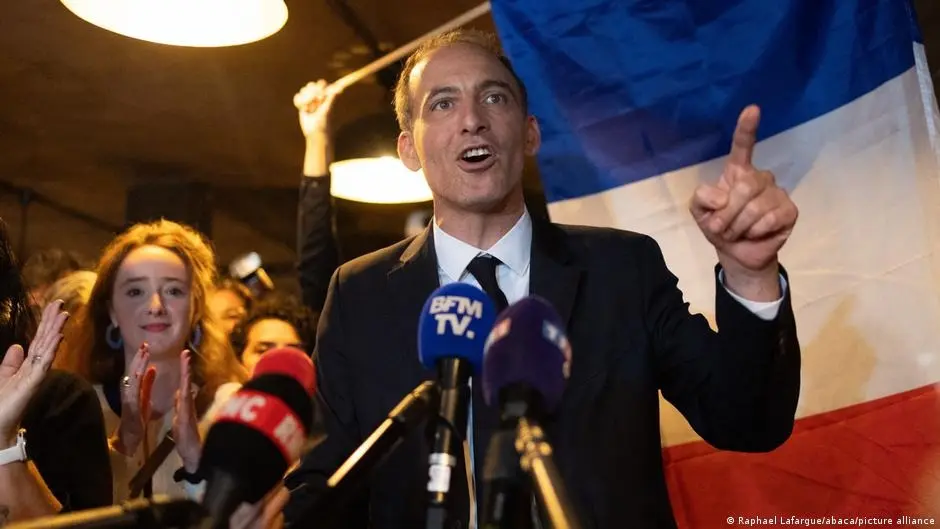
PARIS — In the historically working-class neighborhood of Belleville, an eastern Parisian district that has undergone substantial gentrification in recent years, Raphael Glucksmann gathered with supporters on October 11 to celebrate an overwhelming political triumph. The 46-year-old Member of the European Parliament, long known as an intellectual essayist and the son of the late renowned philosopher André Glucksmann, had just secured the French Socialist Party’s nomination for the upcoming 2027 presidential election.
While party strategists and observers had anticipated a contested two-round primary, Glucksmann swept the contest in a single stroke, capturing a decisive 66% of the vote in the first round. The commanding margin immediately installed him as the standard-bearer for France’s traditional center-left, formalizing his role at the head of a political movement seeking to rebuild its standing on the national stage.
Yet the celebratory atmosphere quickly gave way to a vivid illustration of the fractious landscape of the French left. As Glucksmann stepped outside the Cantine de Belleville restaurant following his victory speech, an unidentified assailant struck him with a flour bomb, coating the candidate, bystanders, and a nearby black Parisian taxi in white powder.
The immediate fallout was bitterly political. The following morning, Glucksmann publicly called on Jean-Luc Mélenchon, the 75-year-old leader of the populist, hard-left party La France Insoumise (LFI), to issue an unequivocal condemnation of attacks carried out by his supporters. Although no evidence directly established that the assailant was an affiliated member or activist of Mélenchon’s party, the exchange brought the simmering animosities between the two rival left-wing factions into sharp focus.
The incident illuminated a central dilemma that promises to shadow Glucksmann’s presidential campaign: having explicitly built his platform on a total refusal to ally or cooperate with Mélenchon, he faces the daunting challenge of winning over the very voters who currently form the bedrock of the populist leader’s substantial political base.
Glucksmann’s Rapid Rise
The path leading to Glucksmann’s primary triumph was defined by an existential debate over the strategic orientation of French social democracy. Throughout the Socialist primary campaign, a single question dominated party gatherings, debates, and public statements: "Where do you stand on Mélenchon?"
The party was fundamentally divided on how to approach the veteran leftist. Current Socialist Party First Secretary Olivier Faure consistently argued in favor of leaving the door open to electoral pacts and institutional cooperation with La France Insoumise, maintaining that a fractured left could not hope to advance to the decisive second round of a presidential election. Glucksmann, by contrast, campaigned on an uncompromising stance, demanding a clear, total break with Mélenchon and the far-left wing of French politics.
His commanding 66% victory was therefore interpreted by party analysts not merely as a personal coronation, but as an explicit mandate from the Socialist rank-and-file to establish a clear demarcation line between mainstream social democracy and the populist radical left.
The internal contest had also exposed Glucksmann to sharp criticism regarding his political pedigree. Throughout the primary race, several rival contenders questioned his practical preparedness to govern the nation. Ségolène Royal, a prominent party veteran and the Socialists’ 2007 presidential nominee, leveled a particularly biting critique, openly likening his bid for the Élysée Palace to an "intern" seeking to take control of a major corporation. Royal emphasized that Glucksmann has never served in government, held a ministerial portfolio, or managed a local council or regional authority.
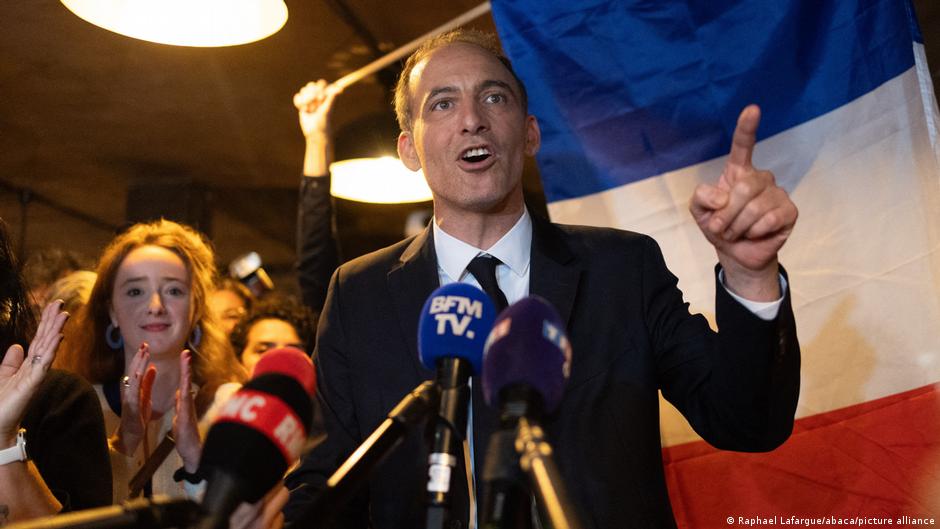
Compounding this dynamic is the unusual institutional arrangement underpinning his candidacy. In choosing Glucksmann to lead them out of years of political marginality, the Socialists have placed their future in the hands of an external figure. Glucksmann is not formally a member of the Socialist Party itself; rather, he belongs to Place Publique, a small center-left political party he co-founded.
From a statistical standpoint, Glucksmann enters the presidential arena facing significant challenges. A survey conducted by the polling firm Toluna Harris Interactive, published immediately following his primary victory, projected that he would garner between 10% and 11% of the national vote. By comparison, the same polling model placed Mélenchon at roughly 18%, indicating that the radical-left veteran remains in a far stronger position to reach the final two-candidate presidential runoff.
However, because the survey was fielded before the primary results were finalized, it did not measure any subsequent bump in popularity that a decisive nomination might generate. Even at 10% to 11%, the baseline projection represents a marked resurgence for the Socialists compared to their catastrophic showing in the 2022 presidential race, when their nominee, Paris Mayor Anne Hidalgo, secured a historic low of just 1.75% of the first-round vote.
Mélenchon’s Youth Appeal
To transform his primary victory into a competitive national bid, Glucksmann must confront Mélenchon’s deeply entrenched dominance among France’s youngest voters.
A September survey conducted by Ipsos—modeling a general election ballot featuring Glucksmann as the sole social-democratic representative and former Prime Minister Édouard Philippe as the sole centrist—revealed that Mélenchon captured an overwhelming 41% of voting intentions among French citizens under the age of 25. Across the political spectrum, the populist right-wing leader Marine Le Pen commanded 20% within the same demographic. While the data illustrates an ideological polarization among youth in France, it demonstrates that within left-leaning youth demographics, Mélenchon’s preeminence remains largely unchallenged.
The veteran leftist has continued to cultivate this constituency by directly aligning himself with student protests and academic demonstrations that have gained international attention across France. At a recent rally near Clermont-Ferrand in central France, Mélenchon expressed solidarity with demonstrating students and used the platform to reiterate central pillars of his domestic youth agenda. These proposals include lowering the national voting age to 16 and entirely abolishing Parcoursup, the computerized national platform that oversees admission to French higher education institutions.
The sociological roots of this dynamic have been examined closely by researchers on the center-left. In an analysis conducted for the Fondation Jean-Jaurès, a think tank historically aligned with the Socialist Party, political scientist Antoine Bristielle dissected the structure of Mélenchon’s coalition, identifying a distinction between a core of ideological partisans and the wider left-leaning public.
According to Bristielle’s research, Mélenchon’s most loyal and active supporters are predominantly educated, urban-dwelling young people who experience severe personal financial strain. Approximately four in ten households within this committed base survive on a net monthly income of less than €2,000 (roughly $2,200).
At the same time, Bristielle’s findings suggest a path of potential vulnerability within the broader left. His research estimates that just under a third of left-leaning voters in France prioritize an overall left-wing presidential victory above partisan loyalty to any specific movement or candidate. Within this pragmatic cohort, almost half are under 35 years of age and express a willingness to cast their ballots flexibly for the Socialists, the Greens, or La France Insoumise. While wealth redistribution, social equity, and an interventionist state remain critical policy requirements for this group, most voters within it show a clear preference for politicians who demonstrate a willingness to compromise and govern broadly.

Glucksmann’s Youth Efforts
Bridging this demographic divide will require Glucksmann to navigate a complex electoral environment. Political scientists Anja Durovic, Nonna Mayer, and Noémie Piolat, studying the 2024 European and parliamentary elections, noted that voting behavior in France departs notably from trends observed in neighboring countries like Germany, where young women lean heavily leftward while young men trend rightward. In France, young women were neither significantly more likely to back the left nor significantly less likely to support the far right than their male peers. Whether this balanced dynamic will persist through the 2027 presidential campaign remains an open question.
In an effort to appeal directly to wage-earners, younger demographics, and economically squeezed households, Glucksmann has rolled out a targeted domestic platform. He has proposed easing the overall burden on earned labor by lowering France’s General Social Contribution (CSG) social security tax. To offset this reduction and address wealth inequality, he has pledged to introduce sharply higher tax rates on inheritances valued at more than €2 million.
Beyond economics, Glucksmann’s broader platform reflects a calculated attempt to construct a coalition distinct from the radical left. He consistently frames himself as an ardent defender of European integration, presenting the European Union as an indispensable framework for collective democratic security. This contrasts sharply with Mélenchon’s historic characterization of the European Union as an inherently neoliberal institution that constrains national sovereignty.
This pro-European, internationalist outlook allows Glucksmann to advance foreign policy stances that could attract moderate voters currently aligned with the political movement of French President Emmanuel Macron.
The starkest contrast between Glucksmann and Mélenchon centers on the war in Ukraine. Glucksmann has consistently advocated for robust, decisive, and sustained European military and financial backing for Kyiv.
Conversely, La France Insoumise has approached the conflict with marked skepticism regarding Western military commitments. Manon Aubry, a prominent Member of the European Parliament representing LFI, has outlined strict conditions for her party’s acceptance of French aid to Ukraine: the provision of military assistance must be directly subjected to prior democratic debate in parliament, it must strictly prohibit strikes deep inside Russian sovereign territory, and it must not under any circumstances degrade France’s domestic military readiness. Reflecting this ideological position, LFI lawmakers in the French National Assembly voted directly against the bilateral French-Ukrainian security agreement in 2024.
Despite these sharp ideological differences, the practical political hostility between the two movements continues to dominate the daily campaign discourse. In the wake of the Belleville flour-bombing incident, the cultural and political friction resurfaced when Sébastien Delogu, an outspoken National Assembly lawmaker from Mélenchon’s La France Insoumise, took to social media to react. Rather than expressing sympathy for the Socialist nominee or denouncing political violence, Delogu posted a public message of solidarity addressed entirely to the Parisian taxi driver who would be forced to clean the flour off his vehicle.
The episode underscored the fraught path Glucksmann faces as he begins his presidential campaign. While he has decisively united the Socialist establishment around an agenda of ideological independence from the radical left, his viability in 2027 hinges on his ability to convince working-class and young voters currently loyal to Mélenchon’s movement to back his candidacy. Distancing himself from Mélenchon was the primary campaign’s easiest hurdle; consolidating a fractured electorate without alienating the broader left may prove far more challenging.