
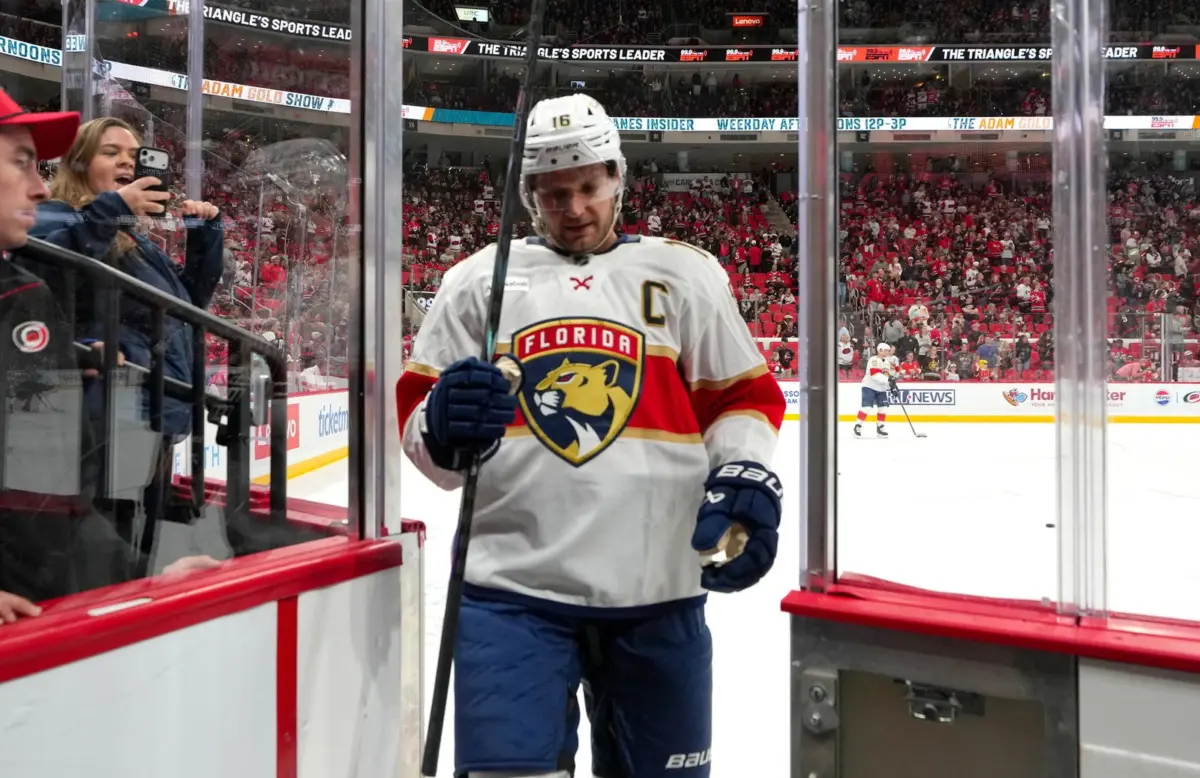
The Florida Panthers have built a modern NHL powerhouse through a calculated, high-stakes philosophy: bet heavily on veteran experience and let battle-tested leadership carry the franchise to the ultimate prize. For several consecutive seasons, that strategy paid extraordinary dividends. Powered by a seasoned core, the Panthers marched to back-to-back Stanley Cup appearances and secured a third straight trip to the finals during the 2024-25 campaign.
Yet, relying on a roster built heavily around older, established players is a classic double-edged sword in professional sports. As the league transitions through the 2025-26 campaign and into the early weeks of the current 2026-27 season, the Panthers are discovering the precarious downside of that approach. Father Time is undefeated, and the physical toll of deep playoff runs and grueling regular-season schedules is beginning to manifest in alarming ways for the organization.
A Precarious Start: Barkov and Marchand on the Sidelines
The immediate catalyst for concern in Sunrise revolves around early-season injuries to two of the team’s most vital offensive catalysts: star center and captain Aleksander Barkov, and veteran left winger Brad Marchand.
From one perspective, the Panthers dodged a catastrophic bullet. Neither Barkov nor Marchand is facing a lost season of the magnitude that Barkov endured last year, when long-term absences fractured the team’s rhythm. There is light at the end of the tunnel for Florida’s training staff and coaching staff, with expectations that both stars will eventually return to reclaim their prominent roles in the lineup.
However, the temporary loss of two foundational skaters highlights a much deeper, systemic risk associated with constructing a roster reliant on an aging core.
Walking a Tightrope: GM Bill Zito’s Veteran Blueprint
Statistically, the reality of Florida’s roster construction is impossible to ignore. According to league physical and demographic tracking, the Panthers stand as the second-oldest team in the entire National Hockey League. Only the Los Angeles Kings—boasting an average age of 30.79 years—sit older than Florida, whose roster averages 30.58 years of age.
By leaning heavily on relative greybeards to spearhead the organization’s quest for a bounce-back season, general manager Bill Zito is undeniably playing with fire. The strategy demands peak performance and physical resilience from athletes who have already logged immense mileage on their competitive odometers.
While it is true that there is no absolute, direct correlation dictating that an older player will inevitably suffer injuries—sometimes hockey clubs simply endure a bout of bad luck regardless of demographic profile—the cumulative wear and tear on a veteran body cannot be easily dismissed.
Depth Tested Early as Secondary Scorers Face Pressure
The consequences of these early-season absences are already rippling through the lineup, exposing a lack of offensive insulation behind the top-tier stars. When a franchise must lean on unexpected sources to drive production out of the gate, warning signs naturally emerge across the organization.

As a case in point, consider 37-year-old center Lars Eller. While Eller remains a respected, highly professional veteran presence, finding him tied for the second-most points on the team with a modest three points through the first four games underscores a glaring deficiency in early offensive output. Simply put, when the supporting cast and aging depth pieces are forced into primary offensive roles before the autumn leaves have even fully fallen, there is something critically missing from the top-to-bottom makeup of the squad.
Nobody could have realistically predicted that Barkov and Marchand would suffer significant injuries precisely at the onset of this new campaign. Even so, it should shock no one when an older roster encounters health roadblocks. Over the course of an 82-game NHL schedule, bad luck invariably catches up to organizations, and navigating a full campaign completely unscathed by major injuries is an extreme statistical anomaly.
The Margin for Error in the Brutal Atlantic Division
For a franchise aiming to re-establish dominance, this early misfortune threatens to become a defining, mitigating factor. In today’s NHL, where parity reigns supreme and the razor-thin margin between securing a playoff berth and watching the postseason from home often comes down to a mere handful of points, missing elite contributors for any notable stretch can prove fatal.
This reality is amplified exponentially within the hyper-competitive Atlantic Division. Every divisional matchup carries four-point implications, and dropping games early in the fall creates a mountain to climb later in the spring.
The Panthers currently sit with an uninspired 2-1-2 record. While that start could have been significantly worse, and certainly does not trigger immediate panic in the front office, it highlights a developing vulnerability. The longer high-impact veterans are forced to watch from the press box rather than dictate the play on the ice, the steeper the uphill battle becomes for Florida in the race for the postseason.
Looking Ahead: The Looming Threat of Attrition
The immediate solution for the Panthers is clear: the sooner Aleksander Barkov and Brad Marchand can safely return to game action, the better their prospects will look.
Yet, securing the health of two stars does not eliminate the overarching structural concern. There is no insurance policy guaranteeing that these current ailments will represent the extent of Florida’s injury troubles this year. In a league defined by physical battles, heavy checking, and relentless speed, the next veteran player to absorb a heavy collision could leave a void in the lineup that general manager Bill Zito cannot adequately fill through internal depth or tight trade-market constraints.
As the 2026-27 NHL season rolls forward, the Panthers find themselves at a fascinating crossroads. The veteran-laden identity that once carried them to the pinnacle of hockey now threatens to test their endurance, resilience, and playoff ambitions to the absolute limit.