
A massive technical breakdown occurring during an air traffic control infrastructure upgrade triggered a nationwide US ground stop that forced the suspension of take-offs across the country, grounding thousands of flights, stranding over a million passengers, and creating widespread operational turmoil across the global aviation network. The four-hour complete halt to domestic departures on Friday represented the longest nationwide airspace grounding in the United States since the catastrophic terrorist attacks of September 11, 2001. Transport Secretary Sean Duffy announced that federal authorities have launched an intensive investigation to determine whether the catastrophic failure was caused by operational incompetence on the part of the private defense and technology contractor tasked with performing the system upgrades or by a fundamental flaw in the underlying technical equipment.
Speaking at a formal press conference in the wake of the crisis, Secretary Duffy explained that the systemic disruption unfolded while technical crews were actively performing delicate maintenance on the critical communications architecture of the United States air traffic control network. The federal government had engaged technology provider L3Harris to execute a long-overdue overhaul designed to transition the country’s aging communications infrastructure away from legacy copper wire networks and onto modern fiber-optic lines. Duffy emphasized the extreme age and fragility of the nation’s existing telecommunications backbone, noting that the United States had been relying on an incredibly old telecommunications system utilizing copper wiring that was so obsolete it was actively being discontinued by technology vendors.
The immediate mechanical catalyst for the nationwide shutdown occurred when a network router being worked on during the upgrade process experienced a severe malfunction. According to details provided by Secretary Duffy, the router began unexpectedly flooding interconnected air traffic control systems with high volumes of data traffic. This electronic flood created severe, unsafe communication disruptions between ground control facilities and aircraft operating in the sky. Faced with compromised communications capabilities, air traffic controllers suspended all domestic take-offs at 15:54 Eastern Standard Time (19:54 GMT) on Friday on strict safety grounds. Federal investigators are now focused entirely on establishing the precise root cause of the crash, attempting to pinpoint whether the disaster stemmed directly from the physical replacement of the copper wiring or from an internal hardware fault within the router itself.
Although federal authorities succeeded in lifting the nationwide ground stop four hours later on Friday evening, the sheer magnitude of the disruption generated a colossal backlog that severely paralyzed commercial aviation well into the weekend. Data compiled by major flight-tracking platforms revealed that more than 15,000 flights within, into, or out of the United States were either delayed or canceled on Friday alone, directly impacting an estimated 1.5 million air travelers. The operational chaos carried over aggressively into Saturday as commercial airlines struggled to realign displaced aircraft and flight crews, resulting in more than 5,900 additional flight cancellations and over 7,000 recorded delays across the domestic network.

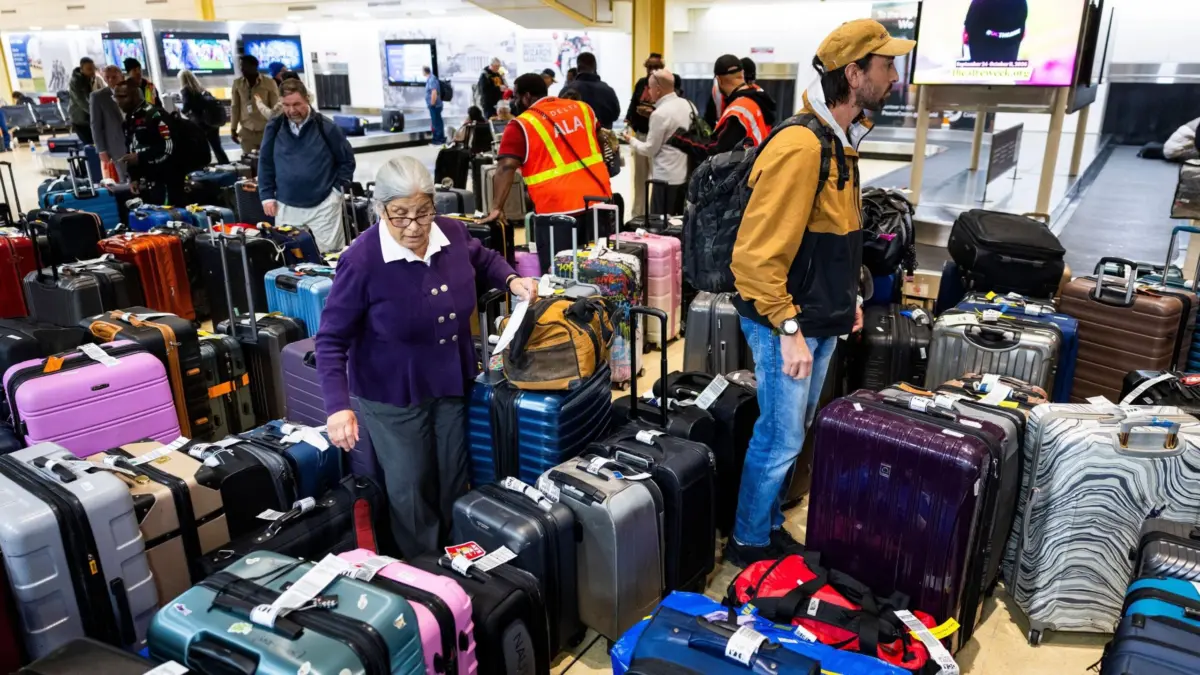
The real-world consequences for travelers unfolded in dramatic fashion at major airports and on tarmac taxiways nationwide. In numerous instances, aircraft loaded with passengers were caught mid-sequence when the ground stop was ordered, leaving travelers trapped inside planes stranded on airport tarmacs for extended periods, unable to take off for their destinations or return to terminal gates to disembark. Inside airport facilities across the nation, including major hubs such as John F. Kennedy International Airport in New York and Ronald Reagan Washington National Airport in Virginia, terminal concourses were transformed into seas of stranded luggage as thousands of weary travelers lined up at customer service counters and monitored mobile devices in desperate attempts to rebook disrupted itineraries. The domestic grounding also sent immediate shockwaves across the international aviation system, disrupting flight schedules around the globe and leading directly to cancellations for long-haul transatlantic departures originating out of the United Kingdom and continental Europe.
In response to immediate public anxiety surrounding national security and aviation infrastructure integrity, senior government and transportation officials moved quickly to address speculation regarding potential malicious interference. Transport Secretary Duffy confirmed that preliminary findings gave federal authorities no reason to suspect that the system failure was the result of an external cyber-attack or an unintended malfunction involving a rogue artificial intelligence agent, though he reiterated that a thorough investigation into every aspect of the incident remains actively underway.
Bryan Bedford, the head of the Federal Aviation Administration (FAA), reinforced these findings during the joint press conference, explicitly ruling out external threats or automated software anomalies. Bedford informed reporters that investigators have found zero evidence of anything nefarious and zero evidence of anything AI-related connected to the system failure. Both officials maintained that the focus of federal scrutiny remains firmly trained on the technical execution of the maintenance work and the physical performance of the routing equipment.
Contractor L3Harris issued an official public statement addressing its involvement in the modernization effort and the subsequent airspace crisis. The technology vendor disclosed that prior to the unexpected system shutdown on Friday, its technical teams had successfully completed more than 70 percent of the contracted work assigned to modernize the nation’s air traffic control communications infrastructure. Company representatives affirmed that L3Harris is fully cooperating with and supporting the FAA in its ongoing investigation. In its statement, the firm expressed deep concern over the event, assuring the public and industry partners that it takes the nationwide ground stop and its immense impact on travelers, commercial airlines, and federal air traffic operations with the utmost seriousness.
The crisis has once again thrust the precarious state of American civil aviation infrastructure into the center of an intense political and fiscal debate in Washington. Transport Secretary Duffy issued a stern warning to lawmakers, asserting that catastrophic operational disruptions of this nature could easily happen again unless the United States Congress commits to approving comprehensive, sustained funding to overhaul the country’s antiquated air traffic control network.

The political battle over funding comes at a pivotal moment for federal transportation policy. US President Donald Trump has formally requested $30.1 billion (£22.8 billion) in federal appropriations specifically designated for upgrading the nation’s air traffic control infrastructure. Both chambers of the United States Congress are currently under the legislative control of the Republican Party, placing the burden of negotiating and passing the multi-billion-dollar infrastructure package directly on congressional leadership. Secretary Duffy has underscored the scale of the challenge, having previously stated that fully modernizing the nationwide air traffic control system to meet contemporary technological standards would ultimately require an investment exceeding $50 billion.
Security and transportation experts have weighed in on the wider implications of the shutdown, offering a mixed assessment of the system’s current reliability. Former Transportation Security Administration (TSA) Administrator John Pistole provided perspective on the event in an interview with the BBC, acknowledging the impressive operational recovery achieved by federal controllers while simultaneously warning of underlying systemic vulnerabilities. Pistole noted that the fact that authorities were able to resolve the technical failure and clear the airspace to restart operations in four and a half hours represents genuinely good news, demonstrating a commendable level of inherent resilience built into the aviation system. However, Pistole cautioned that such recovery capabilities do not solve the fundamental risk, posing the critical question of what guarantees exist to prevent an identical failure from occurring again tomorrow.
The extreme rarity of a nationwide ground stop underscores the severity of Friday’s system collapse. Full national airspace shutdowns ordered by the federal government are among the most drastic measures in civil aviation management. Prior to this event, a nationwide grounding of all domestic departures had occurred only once since the historic multi-day flight ban imposed immediately following the September 11, 2001 terrorist attacks. That single prior instance occurred in early 2023, when a critical technical failure in the Federal Aviation Administration’s Notice to Air Missions (NOTAM) system forced officials to issue a nationwide ground stop. However, that 2023 outage was significantly shorter in duration, lasting just one hour and 52 minutes, though it still managed to delay approximately 9,500 flights and cause about 1,300 cancellations. By contrast, Friday’s four-hour shutdown lasted more than twice as long as the 2023 NOTAM incident, leaving a far more devastating operational trail in its wake.
As commercial airlines work through the massive logistical backlog of displaced aircraft, re-routed flight crews, and stranded passengers, federal aviation regulators maintain that a full recovery is within sight. The Federal Aviation Administration announced that while residual delays and cancellations would persist through the weekend as carriers adjust their networks, the overall US flight schedule is expected to fully return to normal operations by the end of Sunday. Meanwhile, federal investigators from the FAA and the Department of Transportation continue their examination of L3Harris’s work sites and damaged routing hardware to establish definitive accountability for the historic disruption.