
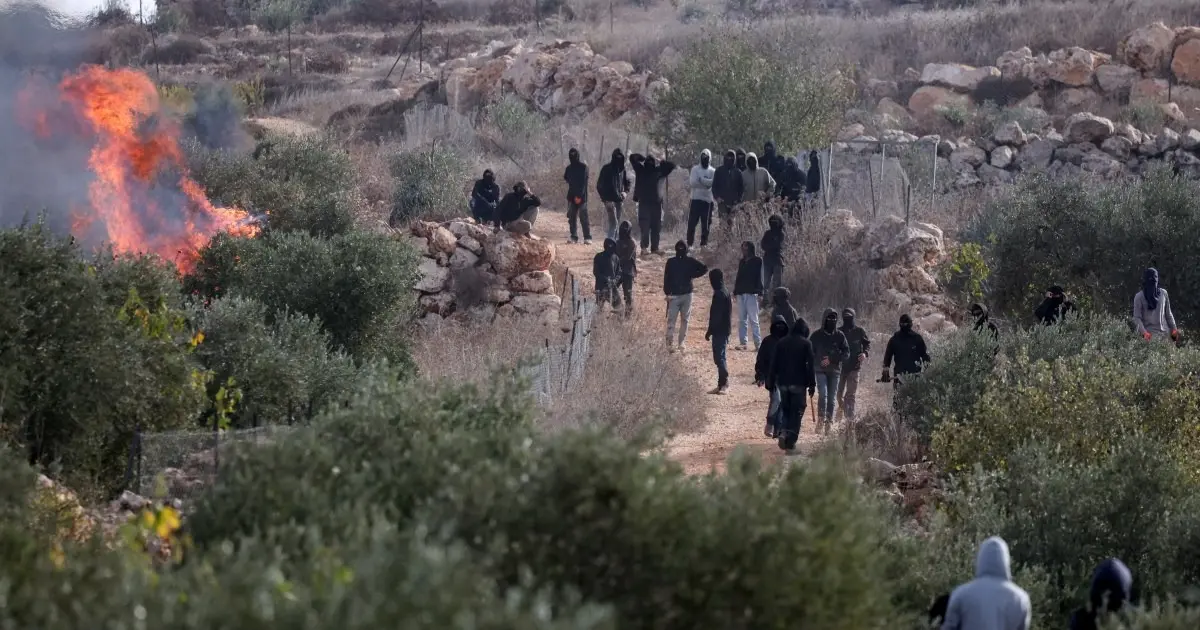
Just one month into this year’s olive harvest season, Palestinian agricultural communities across the occupied West Bank are facing severe disruption and loss. According to field reports and environmental monitoring, Israeli settlers and military personnel have damaged or uprooted approximately 4,500 olive trees since the current harvest began. This recent surge in destruction forms part of a much broader trend: since January alone, an estimated 100,000 olive trees have been destroyed across the West Bank. In the Gaza Strip, the scale of agricultural loss is even more severe. Since October 2023, approximately 97 percent of Gaza’s two million olive trees have been wiped out.
These figures represent the latest phase in a decades-long pattern of environmental transformation. Between the onset of Israeli military occupation in 1967 and the 2010s, more than 800,000 Palestinian olive trees were destroyed across the occupied territories. The recurring sight of uprooted groves stands in sharp contrast to the narrative presented by official Israeli state delegations at global climate, biodiversity, and desertification conferences. At these international summits, state representatives routinely emphasize specialized technical expertise and promote the historic concept of "making the desert bloom." Yet for Palestinian farmers whose agricultural lands have been bulldozed or chemically degraded, these environmental claims are viewed as greenwashing designed to mask extensive ecological destruction.
The targeting of olive trees is a central component of a wider impact on the Palestinian environment, affecting native flora, soil health, water resources, and broader ecosystems. Since the displacement of 1948, territorial and environmental policies have extended beyond land acquisition and the displacement of residents. They have actively re-engineered the natural landscape, steadily eroding the environment’s structural capacity to sustain the indigenous populations who have cultivated and lived on the land for generations.
Re-engineering ‘the desert’
To evaluate the ongoing environmental transformations, it is necessary to examine the historical conditions of the land prior to modern statehood. When the initial waves of Zionist settlers began arriving in Palestine during the late 19th century under Ottoman rule, they encountered a regional ecosystem that was actively cultivated and economically productive. Far from being a barren wasteland, Palestinian agricultural land generated sufficient yields not only to feed the local population but also to support export markets across neighboring provinces of the Ottoman Empire and across the Mediterranean into Europe.
The agricultural system of that era was adapted to diverse regional microclimates. In the inland plains and fertile valleys, Palestinian farmers cultivated staple grain crops such as wheat, barley, and oats alongside expansive groves of olive and fruit trees. Closer to the Mediterranean coastline, irrigated garden plots produced a wide variety of fresh vegetables and fruits. Farther south, in the arid expanse of the Naqab desert, semi-nomadic Bedouin tribes maintained pastoral grazing systems, managing herds of sheep, goats, and camels to produce meat, milk, and wool.
Traditional Palestinian land stewardship relied on methods adapted to local ecological conditions. Inhabitants integrated their agricultural practices within existing ecosystems—ranging from marshy wetlands to arid zones—rather than attempting to forcibly alter the natural terrain. Local farmers selected drought-resistant crop varieties for drier regions, while reserving water-intensive cultivation for fertile lowlands near natural springs and streams.
By contrast, European Zionist settlers brought agricultural practices shaped by non-native continental environments, working to reshape Palestine’s landscape to reflect European ecological models. Settlers introduced non-indigenous species, most notably the European stone pine, frequently removing native flora—including long-standing olive groves—to establish pine plantations. Drainage projects altered natural wetlands, streams were rerouted, and afforestation initiatives were launched across semi-arid areas.
Many of these large-scale interventions created persistent ecological vulnerabilities. The introduction of non-native species such as the eucalyptus tree disrupted local hydrological dynamics and introduced highly flammable vegetation into dry regions, contributing to a higher frequency and intensity of wildfires. Furthermore, public forestation projects were frequently planted directly over the structural remains of depopulated Palestinian villages following 1948, using dense pine forests to cover destroyed communities while supplanting traditional farming systems.
Ecocide in Palestine
Following the 1967 war and the military occupation of the West Bank and Gaza Strip, Israeli administrative authority was extended directly over natural resources. Military orders placed water infrastructure, land use, and environmental management under centralized control, establishing a system of tight resource allocation.
Water distribution quickly became a central mechanism of territorial control. As illegal settlements expanded throughout the occupied West Bank, local water infrastructure was integrated into a centralized grid. Today, the regional water system is managed by Mekorot, Israel’s national water company, which controls network operations across the occupied territories. Mekorot regularly routes water resources away from Palestinian municipalities to maintain continuous supplies for illegal settlements. During the summer months, water supplies to Palestinian towns and villages are routinely throttled or shut off to accommodate peak demand in settler communities, causing widespread harm to Palestinian agricultural output and local ecosystems.
Alongside water restrictions, soil quality has been repeatedly compromised. Over multi-year periods, military forces and settlers have used chemical pesticide spraying over Palestinian fields near settlement perimeters and military zones, rendering farmland uncultivable and deterring farmers from accessing their plots. Combined with mechanical uprooting, tree burning, and land clearing for settlement construction, these practices have accelerated topsoil loss and severe ground erosion throughout the West Bank.
In the Gaza Strip, environmental damage has escalated to an unprecedented scale. Military campaigns since October 2023 have inflicted widespread destruction on farmland, vegetation layers, soil composition, and underground water supplies. Intensive bombardment and heavy earthmoving operations have destroyed approximately 85 percent of all buildings across Gaza, generating an estimated 70 million tonnes of rubble heavily contaminated with hazardous substances.
Environmental assessments indicate that heavy bombardment has dispersed significant concentrations of toxic metals into the environment, including lead, cadmium, arsenic, tungsten, and aluminium, alongside residue from high explosives such as TNT, RDX, and perchlorates. These chemical compounds infiltrate topsoil layers and leach into the coastal aquifer, posing long-term environmental hazards that will affect water safety and soil viability for years. At the same time, heavy machinery continuously bulldozing agricultural plots has stripped away the organic topsoil layer essential for plant growth, turning vast areas of previously arable land inert.
A coloniser’s logic
The widespread destruction of natural resources highlights a fundamental tension within state narratives that claim deep historical ties to the land while altering its ecological foundations. From a structural perspective, colonial land management prioritizes possession, administrative dominance, and resource extraction over long-term environmental balance or indigenous agricultural practices.
This approach—characterized by chemical clearing, resource diversion, and environmental re-engineering—stands in direct contrast to traditional Palestinian agricultural practices. Despite persistent land loss, resource restrictions, and infrastructure destruction dating back to 1948, Palestinian agricultural communities have consistently worked to clear damaged plots, remediate soil, and replant crops.
This cycle of destruction and resilience is visible in individual farming families over multiple generations. In one representative case, a Palestinian farmer named Hamdan spent four decades managing an eight-dunam olive grove that produced an average of 1,500 kilograms of olive oil per season. In 2008, the grove was completely bulldozed by military forces. Hamdan immediately began replanting the land with assistance from his family.
By 2014, just as the newly planted olive trees were maturing and returning to production, military operations again swept through the area, destroying the grove a second time. The physical and financial loss proved devastating; Hamdan suffered severe shock and died less than a week after his grove was destroyed.
Despite the loss, his family resumed the effort in 2015, spending months clearing debris and planting new saplings. The young trees required three years of care before yielding their first harvest. The family successfully gathered olives for two seasons before military bombardment destroyed the grove once more during the 2021 conflict.
The 2021 bombardment left the ground heavily damaged, marked by deep craters and chemical contaminants that rendered traditional olive growing unviable. The family spent extended periods remediating the land, filling craters, and converting the plot to cultivate seasonal field crops like wheat. However, in December 2023, military forces devastated the property once again. Today, the family remains unable to return to or replant the land, as it lies beyond the expanding boundary of the military’s restricted "Yellow Line."
The commitment to maintain agricultural continuity remains visible across the occupied territories. Even within makeshift camps for displaced residents, individuals consistently set up small garden plots beside their tents, planting crops such as mint, basil, and flowers in recycled containers.
Despite extensive official messaging and international environmental diplomacy, the physical condition of the region presents a stark reality. Sustainable land stewardship is demonstrated not by political narratives or technical greenwashing, but by the agricultural practices of communities who continue to cultivate, preserve, and restore the natural environment under severe conditions.