
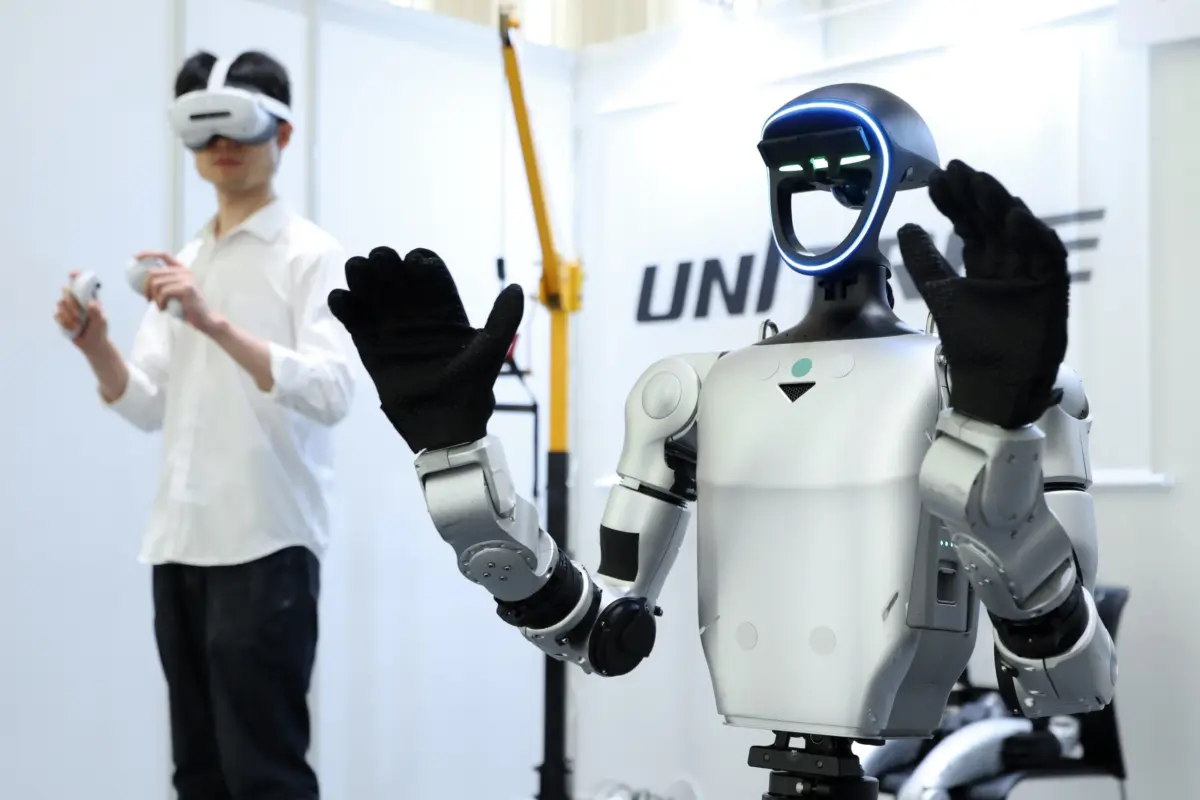
The debate over the future of robotics and artificial intelligence often oscillates between two distinct narratives. On one side are tech optimists and industry leaders who believe that physical automation is on the precipice of its own "ChatGPT moment"—a sudden, watershed breakthrough driven by massive general foundation models. On the other side are veterans of the hardware and software trenches who see a much more painstaking, foundational evolution playing out across laboratories and industrial floors.
Amulya Vishwanath firmly belongs to the latter camp. Having spent seven years leading product marketing for NVIDIA’s advanced robotics platforms, Vishwanath offers a perspective deeply rooted in the gritty realities of hardware development. According to her, robotics is not on the verge of a singular, magical software unlock that will suddenly make every machine universally capable. Instead, she argues that the robotics industry is currently navigating its "Lego era."
This foundational phase means that the core building blocks of modern robotics—ranging from physical actuators and advanced robotic hands to intricate software stacks and stringent safety standards—are still actively being dismantled, reimagined, and rebuilt from the ground up. Rather than waiting for a single overarching intelligence to magically orchestrate physical machines, engineers and innovators are meticulously assembling the basic components required to make autonomous systems reliable, safe, and commercially viable.
Vishwanath’s measured assessment runs directly counter to the surging hype surrounding general-purpose foundation models. Earlier this year, General Intuition CEO Pim de Witte appeared on TechCrunch’s Equity podcast to share a vastly different vision for the industry. De Witte argued that the arrival of a single, highly capable general foundation model would render much of today’s specialized, piecemeal robotics engineering largely redundant. In that view, the robotics space is just waiting for its conversational AI equivalent to synthesize perception, reasoning, and physical execution into an effortless, plug-and-play package.
However, Vishwanath’s extensive tenure at NVIDIA gives her a unique vantage point on the immense chasm that exists between digital language models and physical world deployment. While large language models can ingest vast swaths of internet text to learn human syntax and reasoning, robots must operate within the messy, unpredictable confines of the physical world. They must grapple with friction, gravity, fluid dynamics, occlusions, and the infinite variability of unstructured environments—challenges that cannot be solved by text prediction alone.
Addressing this paradigm shift, Vishwanath recently sat down with Dominic-Madori Davis on an episode of TechCrunch’s Equity podcast to discuss her next chapter. Having stepped away from her long-standing executive role at NVIDIA, she has embarked on a new journey as the founder and managing partner of Techable VC, an early-stage venture capital firm. Through Techable VC, Vishwanath is actively writing the first institutional checks for startups operating at the intersection of physical AI and deep tech.
During the podcast conversation, Vishwanath and Davis explored the broader thesis behind her new investment vehicle, which targets high-impact domains such as robotics, advanced materials science, and the life sciences. By backing early-stage founders who are tackling hard-tech challenges, Vishwanath is applying the lessons learned during her years at the bleeding edge of graphics processing and accelerated computing.
The discussion also touched upon Vishwanath’s personal and professional evolution as one of the pioneering women executives to spin out of NVIDIA and establish an independent early-stage venture firm. Transitioning from a corporate tech giant to the high-stakes, high-risk environment of venture capital requires a distinct set of skills, particularly when evaluating founders who are attempting to commercialize complex scientific breakthroughs rather than purely digital software applications.
As physical AI continues to attract billions of dollars in capital and intense public fascination, perspectives like Vishwanath’s serve as a vital grounding force. While the dream of universal, autonomous robots remains the ultimate North Star for the industry, the journey there will likely be defined not by a single miraculous chatbot moment, but by the patient, block-by-block construction of a brand-new technological foundation.