
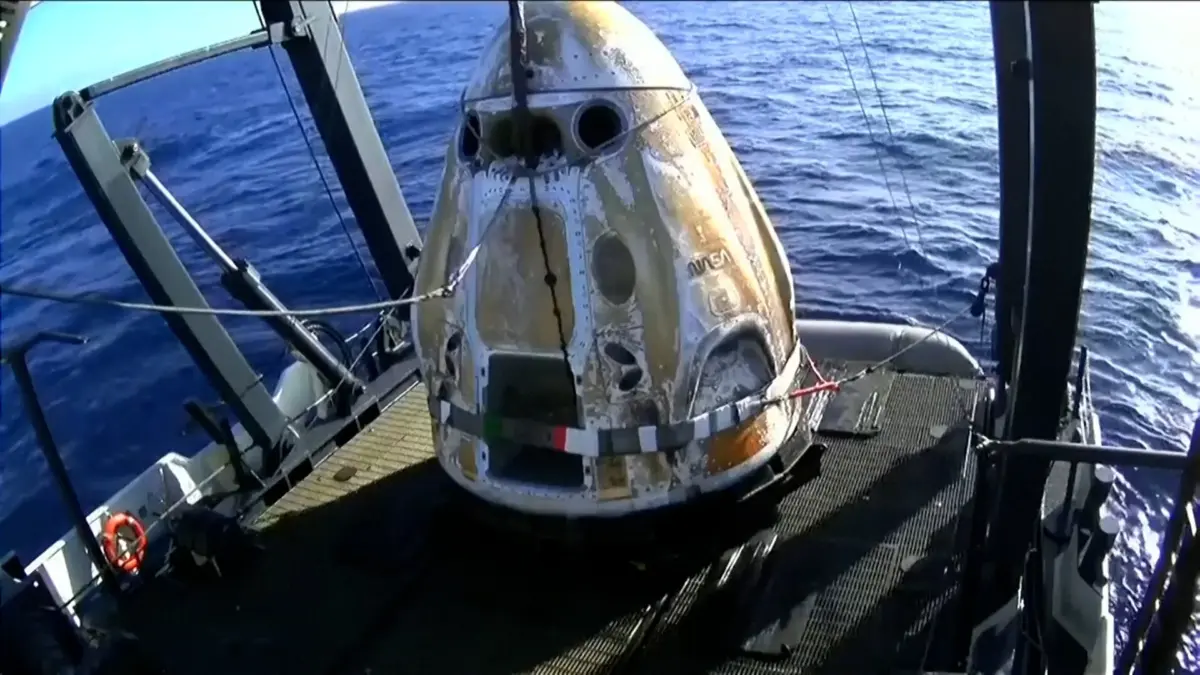
Four astronauts successfully returned to Earth on Thursday after completing an extended eight-month scientific mission aboard the International Space Station. The crew’s journey concluded with a smooth, parachute-assisted splashdown in the Pacific Ocean off the coast of California, marking the end of a long-duration orbital deployment that tested human endurance, advanced scientific research, and demonstrated the continued operational capabilities of international spaceflight programs.
The return journey began high above Earth as the spacecraft disengaged from its docking port on the International Space Station, initiating a slow and deliberate separation maneuver. After clearing the immediate vicinity of the orbital complex, the vehicle executed its deorbit burn, a precise firing of its onboard propulsion system designed to reduce orbital velocity. This controlled braking maneuver lowered the spacecraft’s trajectory, pulling it out of stable orbit and directing it toward Earth’s upper atmosphere.
Plunging into the atmospheric interface at high speed, the spacecraft encountered rapidly increasing atmospheric density, which created immense air friction against the vehicle’s heat shield. Temperatures surrounding the capsule rose dramatically, turning the surrounding air into a glowing envelope of superheated plasma. This extreme thermal barrier created a temporary, expected communications blackout as radio signals were blocked by the ionized gas. Throughout this critical phase, the heat shield protected the internal cabin and its four crew members from temperatures reaching thousands of degrees.
As the dense atmosphere decelerated the craft from high speed down to subsonic levels, the vehicle’s automated flight control system initiated the parachute deployment sequence. Small drogue parachutes were fired first to stabilize the capsule’s attitude and strip away excess kinetic energy. Once the spacecraft reached a lower altitude, the main parachutes deployed, unfurling completely to slow the descent to a steady rate. Floating beneath the canopies, the capsule descended gracefully toward the waters off the California coast.
The spacecraft made impact in the Pacific Ocean, where the water provided a soft cushion for the final splashdown. The landing location, strategically selected off the West Coast of California, offered favorable weather and ocean conditions for crew retrieval. Immediately upon touchdown, recovery vessels, fast-response inflatable boats, and specialized support teams operating in the Pacific moved in to secure the spacecraft.
Maritime recovery teams approached the floating capsule to perform initial safety checks, assessing the structural condition of the vessel and confirming that no hazardous propellants remained active on the exterior. Support personnel attached flotation collars and stabilization lines to steady the spacecraft against ocean swells while ensuring the vehicle remained upright. Specialist crews then secured heavy-duty hoist lines to lift the capsule out of the water and onto the deck of the primary recovery ship.
Once the capsule was safely onboard the recovery vessel, ground crews opened the spacecraft’s main hatch to greet the four returning astronauts. Support technicians assisted the crew members out of the capsule, placing them into specialized reclining chairs to begin their immediate transition back to Earth’s gravity. After spending eight months in microgravity, returning astronauts face severe physical disorientation, making direct assistance mandatory during the extraction process.
Living in a weightless environment for eight months induces profound changes in human physiology. In microgravity, body fluids redistribute toward the head and chest, causing alterations in blood pressure, cardiovascular output, and fluid levels. Without the daily resistance of Earth’s gravitational force, muscle tissue weakens and bone mineral density steadily decreases, despite daily two-hour exercise routines conducted aboard the station.
The human vestibular system, which relies on inner ear organs to detect balance and orientation, also adapts to weightlessness during extended spaceflight. Upon returning to Earth, the sudden reintroduction of 1-G gravity disrupts sensory processing, often causing spatial illusions, nausea, and difficulty maintaining balance. Ground-based medical specialists conducted preliminary physical assessments on board the recovery ship to evaluate heart rate, blood pressure, and overall physiological responsiveness before clearing the crew for transit to land facilities.
The eight-month stay aboard the International Space Station represented a longer-than-average mission duration for orbital crew rotations, which typically last around six months. Extended mission timelines offer scientists and medical experts valuable insights into how prolonged exposure to microgravity affects the human body over long durations. Data collected from this mission will contribute to ongoing research aimed at mitigating the physiological risks of long-duration space travel, essential knowledge for future human missions to the Moon, Mars, and beyond.
Throughout their eight months in low Earth orbit, the four astronauts maintained a rigorous daily schedule divided between scientific research, technological tests, and station maintenance. The International Space Station serves as a unique microgravity laboratory where experiments across various disciplines—including human biology, physics, materials science, and astronomy—can be conducted in conditions impossible to replicate on Earth’s surface.
During their mission, the crew managed numerous scientific experiments that examined how physical systems and biological organisms respond to prolonged weightlessness. Research focused on cellular behavior, plant biology, fluid dynamics, and materials processing, offering potential applications for both space exploration and terrestrial technologies. The crew also conducted experiments monitoring their own physiological responses, tracking changes in muscle mass, cardiovascular health, and immune system function.
In addition to scientific work, the crew spent significant time maintaining the complex systems that keep the International Space Station operational. The orbital laboratory requires continuous maintenance, including monitoring life support equipment, repairing power systems, managing thermal controls, and maintaining hardware exposed to the vacuum of space. Crew members also routinely participated in routine station housekeeping, cargo management, and operational drills to prepare for potential emergencies.
The smooth completion of this eight-month mission underscores the complex international coordination required to operate human spaceflight missions. Operational schedules, orbital alignment, launch availability, and spacecraft readiness all factor into determining crew swap timelines. Extended stays like this one showcase the adaptability of mission planners and crew members in adjusting to changing operational requirements while maintaining high levels of productivity in orbit.
With the astronauts now back on Earth, the retrieved spacecraft will undergo a thorough technical inspection. Engineering teams will examine the heat shield, parachute systems, structural frame, and internal electronics to evaluate how the hardware performed during atmospheric re-entry and splashdown. The data gathered from these inspections will inform future operational standards and vehicle maintenance protocols.
For the four crew members, the journey is far from over as they enter an intensive period of post-landing physical rehabilitation. Over the coming weeks, medical specialists will guide the astronauts through structured exercise regimens designed to rebuild muscle strength, restore bone mass, and recondition their cardiovascular and vestibular systems to Earth’s gravity. The crew will also participate in extensive debriefing sessions, sharing operational feedback with flight directors, systems engineers, and scientific researchers.
The successful splashdown in the Pacific Ocean off California marks another milestone in continuous human spaceflight operations. As the four crew members begin their journey of physical recovery and reunion with their families, the International Space Station continues to orbit Earth, carrying new crews and ongoing research projects into the next chapter of space exploration.