
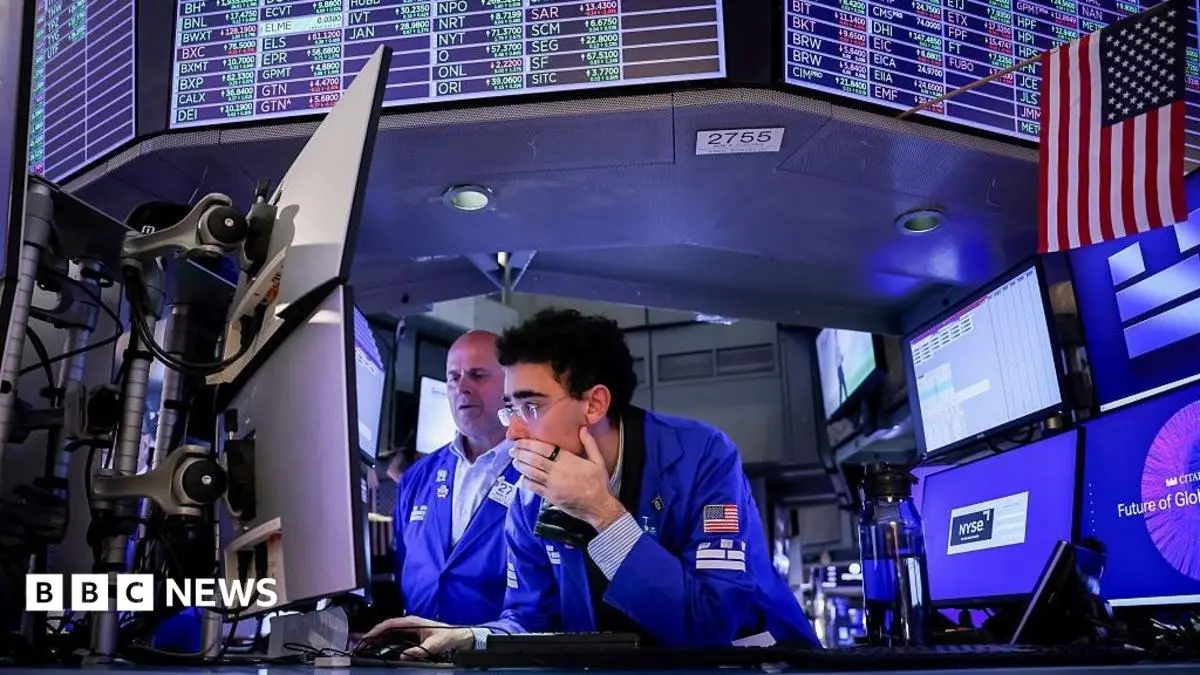
Global financial markets have experienced a severe downturn, with trillions of dollars in equity value wiped out across North America, Europe, and Asia. A sharp sell-off in major technology stocks was triggered by the outcome of the United States midterm elections, where political campaigns focused on restricting artificial intelligence (AI) development and slowing the expansion of data centers achieved broad victory.
The market contraction highlights growing investor anxieties over potential regulatory barriers, localized community opposition to energy-intensive data hubs, and broader skepticism regarding whether the massive capital investments poured into AI infrastructure will deliver expected financial returns.
The sell-off was led by technology equities on Wall Street before spreading rapidly across European and Asian trading sessions, pushing key stock indices down by historic margins and triggering emergency market mechanisms in major global financial centers.
Political Shifts and Pressure on Data Centres
Political developments in the United States served as the main catalyst for the market retreat. Democratic candidates ran aggressive campaigns across the nation focused on reigning in the rapid growth of AI and imposing strict controls on data center facilities—the heavy computing hubs essential for training and powering large-scale artificial intelligence models. Dozens of state and local ballot measures aimed at restricting or halting these developments were put directly to voters.
In Tuesday’s midterm elections, Democrats secured major victories, taking control of both the United States Senate and the House of Representatives. This realignment hands legislative authority to Democrats in Congress for the remainder of President Donald Trump’s presidential term.
Local and state-level races underscored the broad shift in policy direction. In Texas, a primary hub for global technology and infrastructure expansion, Democratic Governor-elect Gina Hinojosa ran heavily on an anti-data center platform. Hinojosa pledged to implement a strict moratorium on new construction within the data center sector, directly threatening billions of dollars in planned capital projects across the state.
Federal lawmakers echoed these state-level initiatives. Democratic Senator Bernie Sanders issued a public call for federal intervention, taking to social media to urge immediate nationwide policy changes.
"Americans don’t want Big Tech oligarchs wrecking the environment, gutting jobs and threatening humanity’s future. NATIONAL DATA CENTER MORATORIUM NOW," Sanders posted on X (formerly Twitter).
In response to the market decline, President Donald Trump criticized the election results and the political opposition in posts published on Truth Social, framing the market rout as a direct outcome of the Democratic victories.
"The Stock Market suffered one of the Worst Days in History based on the results of the Election," Trump wrote. "Remember, it wasn’t Republicans, it was Dumocrats. Do not fear, however, we will soon, one way or the other, be BIGGER AND STRONGER THAN EVER BEFORE. MAKE AMERICA GREAT AGAIN!"
In a subsequent post on Thursday evening, Trump targeted the electorate directly: "The Stock Market crashed today because the Dumocrats had a big Tuesday — So sad to see, you only have yourselves to blame!"
‘Fresh Panic’ Hits Wall Street
The political shift triggered immediate volatility across major US exchanges on Thursday, with companies heavily exposed to the AI supply chain suffering the most severe declines.
The tech-heavy Nasdaq Composite index led the market lower, closing down by more than 5.5% in its worst single-day performance since 2025. Data compiled by Dow Jones indicates that the index erased approximately $2.5 trillion (£1.9 trillion) in market value in a single trading session. The sharp decline pushed the Nasdaq firmly into correction territory, defined by market analysts as a drop of 10% or more from a recent high.
The broader US market suffered similar losses. The S&P 500 index fell by 4.4% by the end of Thursday’s session, while the Dow Jones Industrial Average erased all gains achieved earlier in the week to close down by more than 3.4%.
Semiconductor manufacturers and chip hardware designers faced severe selling pressure:
- Nvidia saw its shares slide by more than 9%, shedding over $400 billion from the company’s individual market valuation in New York trading.
- Advanced Micro Devices (AMD) and Micron Technology both experienced sharp losses, with each stock dropping by more than 17%.
- Intel shares closed down by 10.3%.
- SanDisk, a major producer of flash memory, plunged by more than 22%.
- The Philadelphia Semiconductor Index, which monitors 30 of the largest global companies involved in semiconductor design, equipment, and manufacturing, registered a single-day drop exceeding 12%.
The downturn extended to technology ventures led by billionaire Elon Musk. Shares in electric vehicle maker Tesla fell by nearly 11%, while valuation estimates for aerospace firm SpaceX dropped by 8%. Together, the declines wiped out more than $300 billion in combined market value from Musk’s business empire.
Musk had invested heavily in political campaigns leading up to the election, spending nearly $450 million to back Republican candidates. That funding included at least $45 million dedicated to supporting Ken Paxton’s campaign for a Texas Senate seat. However, Texas flipped to Democratic candidates amid a broader national turnout, leaving key Republican campaigns defeated.

In total, the group of dominant technology giants known as the "Magnificent Seven"—which includes high-cap firms such as Apple, Nvidia, and Tesla—lost approximately $1 trillion in cumulative market value in a single day.
Susannah Streeter, chief investment strategist at Wealth Club, noted that the steep sell-off reflected deep structural concerns among investors.
"Fresh panic over the AI trade has hit Wall Street hard," Streeter said. "Fears that the vast sums poured into AI infrastructure may not deliver the returns investors have been banking on are now colliding with the prospect of a sharp slowdown in data centre construction."
Global Contagion Hits European and Asian Markets
The panic on Wall Street quickly spread to European markets during Thursday’s trading before spilling into Asian financial centers on Friday morning.
In Europe, major technology equipment suppliers saw heavy losses. German semiconductor manufacturer Infineon saw its stock fall by more than 8.5%, while Netherlands-based ASML, a primary supplier of extreme ultraviolet lithography equipment used in chip manufacturing, dropped 6.5%.
As trading opened across Asia on Friday, tech-heavy benchmark indices posted severe declines, driven by widespread selling in hardware, memory, and semiconductor production stocks.
In Japan, the Nikkei 225 index dropped 6.3% by Friday afternoon. Shares in memory chip manufacturer Kioxia plunged nearly 11.5%, while semiconductor production equipment maker Tokyo Electron fell by 5.8%.
South Korea’s financial markets experienced intense volatility. The benchmark Kospi index fell by more than 8% during morning trading, triggering a market-wide "circuit breaker"—an automated safety mechanism that temporarily halts all trading across the exchange to prevent panic selling. Following the resumption of trading, the Kospi closed the afternoon session down by roughly 5%.
South Korean chipmaker SK Hynix fell by more than 8.8%, while Samsung Electronics dropped approximately 6%.
In Taiwan, the technology-focused Taiex index fell 4.5% on Friday. Financial data from LSEG confirmed that the Taiex suffered its largest single-weekly decline since 2001, reflecting severe exposure among local component suppliers and manufacturing foundries.
Commenting on the Asian market reaction, MarketWatch chips analyst Britney Nguyen described the downturn as a "continuation of worries" surrounding the high capital costs associated with building and maintaining AI infrastructure worldwide.
Tech Executives and Analysts React to Sector Backlash
The rapid political shift and resulting market reaction have exposed a growing gap between technology companies and local communities hosting data infrastructure.
Addressing attendees at the WSJ Tech conference in Napa, California, on Wednesday evening, OpenAI president and co-founder Greg Brockman acknowledged that tech firms were caught off guard by the strength of public resistance to data center expansion.
"A lot of our shift over the course of this year has really been to realise that from San Francisco trying to build infrastructure in Texas, Georgia, and other places, you can’t just tweet and say: ‘This is going to be good.’ You need to be in those communities," Brockman said.
Speaking at the same conference, Meta’s president Dina Powell McCormick emphasized that technology companies must actively re-engage the public to maintain support for artificial intelligence projects.
"I think we need to double and triple down on telling the story," McCormick told the conference, arguing that the industry must better articulate the long-term economic and social benefits of the technology.
Beyond the immediate political developments in the United States, equity analysts note that institutional investors are increasingly concerned about broader market fundamentals. With trillions of dollars committed to server hardware, real estate, and energy grid development, mounting skepticism over near-term monetization has heightened fears that tech valuations may have entered bubble territory, leaving the market vulnerable to further corrections.