
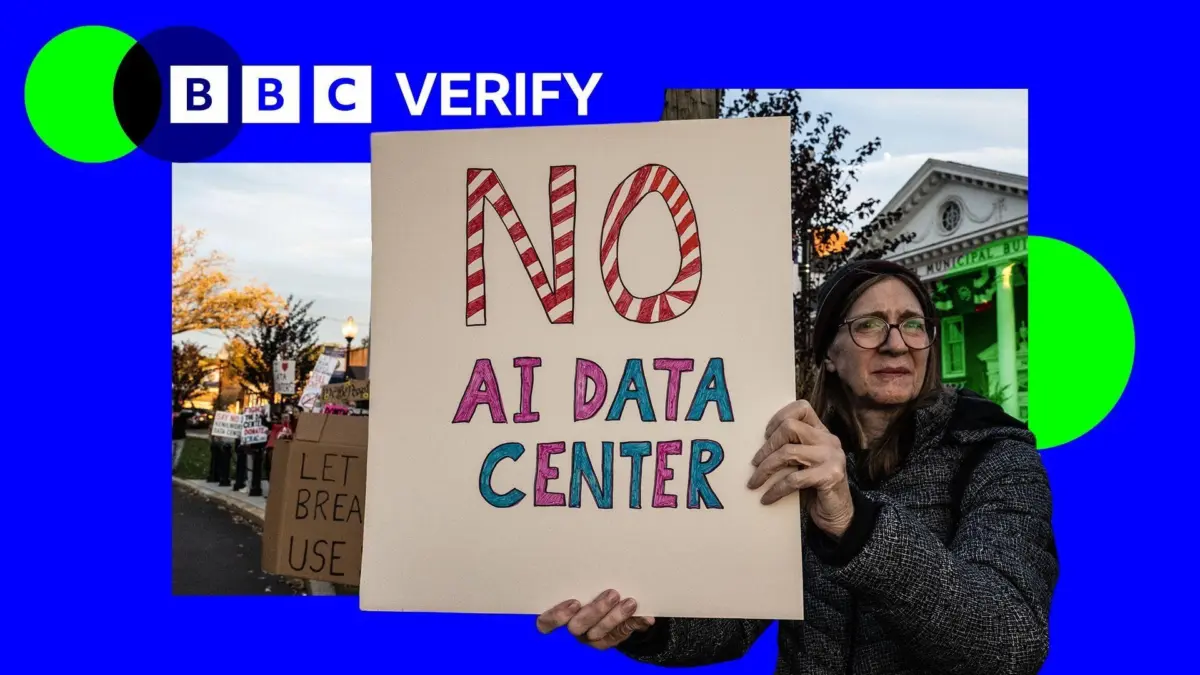
The rapid physical expansion of artificial intelligence infrastructure across the United States has transformed from a corporate investment story into a potent political issue, with a major voter survey suggesting public backlash against data center construction may have influenced recent midterm election dynamics.
Data centers—the sprawling, energy-intensive facilities housing the massive computing power required to train and run complex AI models—have proliferated rapidly across American towns and cities. However, analysis by BBC Verify indicates that local opposition to this construction boom has crossed a threshold, evolving from quiet community friction into an influential topic on the political campaign trail with potentially far-reaching consequences for the technology sector.
What did the voter poll suggest?
A comprehensive voter poll conducted for the Associated Press and a consortium of news organizations revealed that data centers have unexpectedly emerged as a prominent priority for the electorate. According to the survey, 56% of voters reported that issues surrounding data centers were a "crucial or major" factor influencing their decision at the ballot box. Even more striking was the level of localized pushback: 76% of respondents stated they would oppose the construction of a new data center within their own community.
The sentiment was far from uniform across the political spectrum. The poll indicated that hostile attitudes toward data center expansion were considerably more pronounced among voters who identified as Democrats during this election cycle.
This surge in voter skepticism aligns with recent findings from Pew Research, which highlighted a steep decline in public favorability toward the industry. The Pew survey suggested that approximately half of all Americans now view data centers as "mostly bad" for the environment, residential energy prices, and overall quality of life. This represents a marked deterioration in public sentiment compared to earlier in the year, reflecting growing anxiety over the tangible footprint of the artificial intelligence surge.
The findings point to a remarkable shift in political salience. Just five years ago, data centers were rarely a topic of mainstream public discourse or campaign debate. Today, they command significant attention among voters concerned about local resources and utility expenses.

At the same time, context remains critical. While data center expansion has clearly captured public concern, it remains behind long-standing national grievances. Issues such as government corruption and the elevated cost of living were cited by 90% and 89% of voters respectively as "crucial or major factors" in their voting decisions, indicating that while AI infrastructure has become a powerful localized issue, it exists alongside broader economic and governance challenges.
Did the AI backlash affect Senate races?
Determining the precise extent to which opposition to AI infrastructure dictated state-level election outcomes remains complex. An analysis by BBC Verify of state-level voter polling in Senate races suggests that states that swung toward the Democrats largely mirrored broader national trends regarding data center anxieties or, in some instances, demonstrated somewhat less focused concern.
Consequently, it is not possible to definitively attribute a specific number of votes or Senate victories exclusively to anti-data-center sentiment. A wide variety of competing local and national issues inevitably shaped voter behavior across individual battleground states.
Nevertheless, political shifts were notably visible in key epicenters of the American AI build-out. In Texas, Georgia, and Ohio—three states that have served as primary destinations for multi-billion-dollar tech investments—voters elected Democratic senators and governors who explicitly advocated for tighter regulatory oversight of data center development.
Campaign pledges and legislative proposals put forward by these newly elected state leaders reflected growing public pressure. Key measures under discussion include:
- Enforcing mandatory contributions from tech developers to fund local power grid upgrades and infrastructure expansions.
- Implementing stricter environmental compliance standards, particularly regarding the high volumes of water utilized for cooling server equipment.
- Re-evaluating, conditioning, or scaling back state and local tax incentives that were previously offered to attract major technology firms.
While these regulatory proposals vary by jurisdiction, their presence in high-profile campaigns underscores how quickly public resistance to infrastructure expansion has translated into concrete policy proposals.

What could the election results mean for the future of the AI boom?
The election outcomes arrive at a delicate moment for the U.S. economy, which has derived substantial growth in recent years from massive corporate investments in artificial intelligence infrastructure.
Official economic data highlights the extraordinary scale of the build-out. In August 2026, inflation-adjusted monthly spending on the physical construction of data centers—excluding the costly IT hardware and specialized chips installed inside them—reached $5 billion (£4.2 billion). This figure represents a fivefold increase compared to spending levels recorded in 2023.
To put the current investment cycle into historical context, an analysis by Columbia Business School indicates that U.S. capital spending on AI infrastructure currently represents a larger share of the overall national economy than capital expenditure on new railways did at the absolute peak of the 19th-century American railroad boom.
As state and local political leadership shifts, experts suggest the regulatory landscape for technology companies could become considerably more demanding.
Cori Crider, executive director of the European think tank Future of Tech Institute, told BBC Verify that technology companies must prepare for a fundamentally altered political environment. Crider noted that the industry should expect incoming state leaders to attach stringent conditions to future projects, or potentially move to "even stop runaway data centre build" in high-density areas.
Financial analysts also anticipate that shifting political dynamics will affect project economics. Seema Shah, chief global strategist at global investment firm Principal Asset Management, observed that requiring developers to fund regional electricity grid upgrades, satisfy tougher environmental rules regarding resource usage like water, or forfeit long-standing tax relief could fundamentally alter the financial calculations of new projects. Shah noted that such measures would likely "raise development costs and slow new supply" across the market.

However, industry consultants emphasize that tighter regulation is unlikely to halt the broader expansion entirely. Heather West, an analyst at the Eurasia Group consultancy, explained that while temporary construction bans and regulatory hurdles will introduce friction, they will not bring the AI build-out to a permanent standstill.
West noted that projects that have already secured permitting or are currently under construction will largely proceed as planned. Instead, the operational friction will primarily impact the "next wave" of development, which faces headwinds from localized opposition, prolonged permitting procedures, and intense political pressure forcing data center operators to finance their own power infrastructure.
Furthermore, strong economic counterweights remain that may deter politicians from imposing outright bans. Analysts from consultancy Oxford Economics pointed out that state and municipal leaders face compelling economic incentives to avoid measures that severely disrupt construction activity. Data centers continue to generate significant local tax revenues and create substantial numbers of high-paying construction jobs, providing local governments with strong reasons to seek workable compromises.
Deepak Surana, an analyst at technology research firm The Futurum Group, suggested that the outcome in states like Texas will ultimately take the form of "a negotiation, not a moratorium." Surana expected state leaders to work toward structured agreements designed to insulate local residents from elevated energy and water bills without cutting off investment entirely.
Signs of corporate adaptation to this political reality have already begun to emerge. OpenAI, which operates a major data center facility in Texas and has additional projects under construction in Ohio, announced a new commitment just one day after the midterm election results were finalized. The company pledged to ensure that it would fully fund its own electricity needs, directly addressing one of the primary concerns raised by local voters and newly elected officials.