
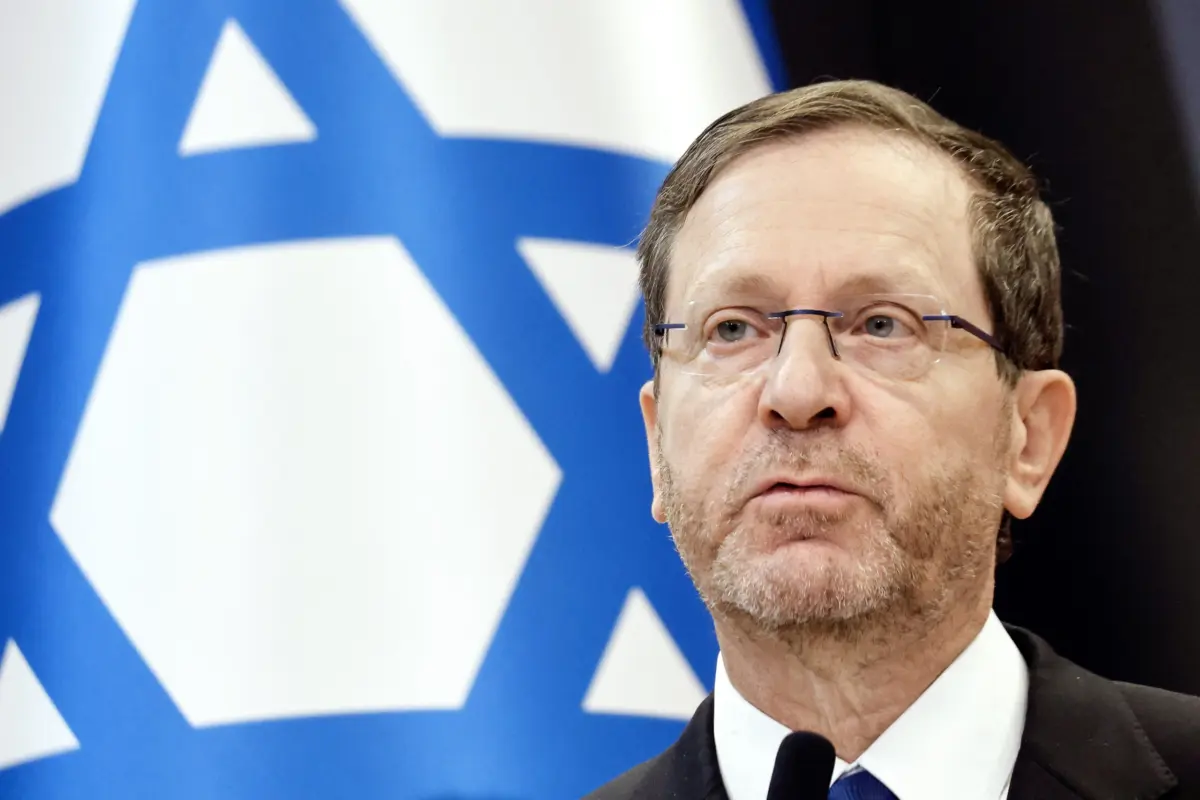
Israeli President Isaac Herzog has announced that he will formally designate a candidate to attempt to form the country’s next government by Sunday, following extensive marathon consultations with political parties elected to the 120-seat parliament, known as the Knesset. The announcement arrived after a decisive majority of newly elected lawmakers cast their support behind opposition leader and former military chief Gadi Eisenkot over incumbent Prime Minister Benjamin Netanyahu.
During the consultation process held at the presidential residence, approximately 67 lawmakers officially endorsed Eisenkot to lead the incoming government, compared to 46 who backed Netanyahu. The stark division in recommendations presents a monumental challenge for Netanyahu, whose decade-plus hold on power has been thrown into severe uncertainty following the general election held on October 27.
Speaking in televised remarks at the conclusion of the consultation rounds on Thursday, President Herzog noted that while the numerical outcome of the talks might appear straightforward, the path toward establishing a stable governing coalition remains highly complex. Herzog explained that despite the top-line numbers, deep-seated political rivalries, opposing ideological platforms, and internal vetoes continue to complicate the landscape across all parliamentary blocs.
Herzog cautioned that although the results of the consultations may appear clear, there were mutual vetoes between the blocs and within the blocs themselves that make it difficult to say who has the best chance of assembling a governing coalition. To navigate these political hurdles, the president announced plans to conduct private, one-on-one discussions with key party leaders over the Israeli weekend, which runs Friday and Saturday, before announcing his final selection on Sunday.
The October 27 election failed to hand either Netanyahu or Eisenkot a straightforward path to an immediate parliamentary majority. This inconclusive result handed President Herzog the delicate duty of selecting a premier-designate in a deeply divided country, tasked with assembling a viable governing alliance of at least 61 Knesset members.
The parliamentary breakdown highlights the fractured nature of the electorate. Netanyahu’s party, Likud, emerged as the single largest party in the 120-seat Knesset, winning 27 seats. However, Netanyahu’s broader religious-nationalist coalition managed to secure a combined total of only 53 seats, falling well short of the majority needed to form a government on its own.
Eisenkot’s political alliance, led by his party Yashar, captured 48 seats in the election. His coalition unites four Jewish-led parties spanning the political spectrum from the centre-left to the right. The 48-seat finish came despite pre-election polling that had consistently pointed toward a much tighter contest between the primary competing camps.
A pivotal dynamic in the post-election calculations was the strong performance of political factions representing Israel’s Palestinian minority. Arab-led parties achieved an unprecedented outcome in the legislative election, securing a combined total of 19 seats. This historic turnout positioned the Arab-led factions as decisive players in the formal recommendation process.
Throughout the election campaign, both Eisenkot and Netanyahu explicitly ruled out forming a coalition government with Arab-led parties. Despite these public rejections, both of the Arab-led factions chose to endorse Eisenkot during their official meetings with President Herzog, pushing his total recommendation count to 67 lawmakers—a comfortable majority of the Knesset.
The decision by Arab-led factions to back Eisenkot was largely driven by a shared determination to prevent Netanyahu from maintaining his grip on power. Ahmad Tibi, a senior member of the Joint List, an alliance representing Arab parties, explained the motivation behind their recommendation in statements to The Associated Press news agency, framing their choice as a pragmatic move to effect political change.
"We want to do things that we did not do in the past in order to remove this criminal government," Tibi stated, emphasizing the override priority among Arab lawmakers to bring an end to the incumbent administration despite earlier campaign disputes.
Following the consultations, Eisenkot’s party, Yashar, noted that his 67 recommendations represented the highest number of formal endorsements received by any prime ministerial candidate since 2015. Yashar publicly urged President Herzog to grant Eisenkot the official mandate as soon as possible so that he could move swiftly to form a national emergency government to address the country’s pressing challenges.

Simultaneously, Netanyahu suffered a significant political blow on Thursday when United Torah Judaism, one of the two primary ultra-Orthodox parties and a long-standing partner in his traditional right-wing coalition, refused to recommend any candidate for the premiership. The party’s refusal to back Netanyahu deprived the prime minister of crucial votes he had relied upon in previous coalition-building efforts.
The split between United Torah Judaism and Netanyahu was prompted by unresolved legislative disputes during the previous parliamentary term. According to reporting by The Times of Israel, United Torah Judaism broke with Netanyahu over his coalition’s failure to pass legislation granting ultra-Orthodox men broad exemptions from mandatory military service—a cornerstone issue for the party’s leadership and religious base.
The unwillingness of United Torah Judaism to automatically align with Netanyahu has sparked discussions regarding potential coalition realignments. Yariv Oppenheimer, a member of the Democrats—a party forming part of Eisenkot’s alliance—expressed confidence during an interview with Al Jazeera that President Herzog would ultimately select Eisenkot on Sunday given the political realities.
Oppenheimer remarked that he saw no reason why Herzog would not choose Eisenkot, noting that United Torah Judaism had signaled that its parliamentary support remained negotiable for the right legislative terms. He suggested that a compelling offer from Eisenkot’s bloc regarding their policy priorities could provide the numbers necessary to secure a governing majority. Oppenheimer added, "It’s very clear that Netanyahu doesn’t have a chance to establish a government at all."
Under Israeli parliamentary procedure, once President Herzog officially nominates a premier-designate, that candidate will have 28 days to negotiate, finalize, and present a new government to the Knesset. If the candidate requires additional time to complete coalition building, the president holds the authority to grant a single extension of up to 14 days.
During this negotiation window, Netanyahu will remain in office as caretaker prime minister. He will continue to exercise executive powers until a new coalition is formally sworn in, or until another election is called if no nominated candidate succeeds in assembling a majority government within the legally mandated timeframe.
Faced with the prospect of losing office, Netanyahu has actively sought to challenge the credibility of the election results. The prime minister has seized upon an ongoing administrative review by election officials into potential vote tampering, using the inquiry to cast doubt on the overall outcome and publicly accusing Arab-led parties of attempting to steal the election.
Critics have strongly condemned Netanyahu and his political partners, accusing them of attempting to delegitimize democratic processes and destabilize public trust in the institutional outcome. Netanyahu and his allies have rejected these criticisms, maintaining that their actions are focused on ensuring electoral integrity.
Addresssing the allegations, Israel’s Central Election Committee issued a statement on Wednesday confirming that the integrity of the election had not been compromised. Supreme Court Justice Noam Sohlberg, who serves as the head of the Central Election Committee, directly addressed the controversy during a formal meeting with President Herzog at the presidential residence.
Justice Sohlberg delivered a clear warning regarding the dangers of undermining public faith in the electoral process, urging elected officials across the political spectrum to uphold democratic norms rather than fracture them. Speaking to Herzog, Sohlberg stressed the vital importance of protecting institutional stability, stating, "This is a real danger. One of the foundations of democracy is the peaceful transfer of power." Sohlberg also praised the election process, highlighting that high voter turnout, particularly among Israel’s Arab minority, represented a healthy and positive sign for the country’s democratic framework.
Despite the assurances provided by the Central Election Committee, Netanyahu’s allies on the far right have continued to escalate their rhetoric. National Security Minister Itamar Ben-Gvir and other right-wing figures have called for the immediate arrest and police interrogation of Arab party leaders, further intensifying political tensions across the country.
As Israel awaits President Herzog’s decision on Sunday, the political climate remains exceptionally charged. With competing factions assessing their strategic options and the premier-designate preparing for complex coalition negotiations, the coming weeks will determine whether a new government can be successfully formed or if the nation will remain locked in political uncertainty.