
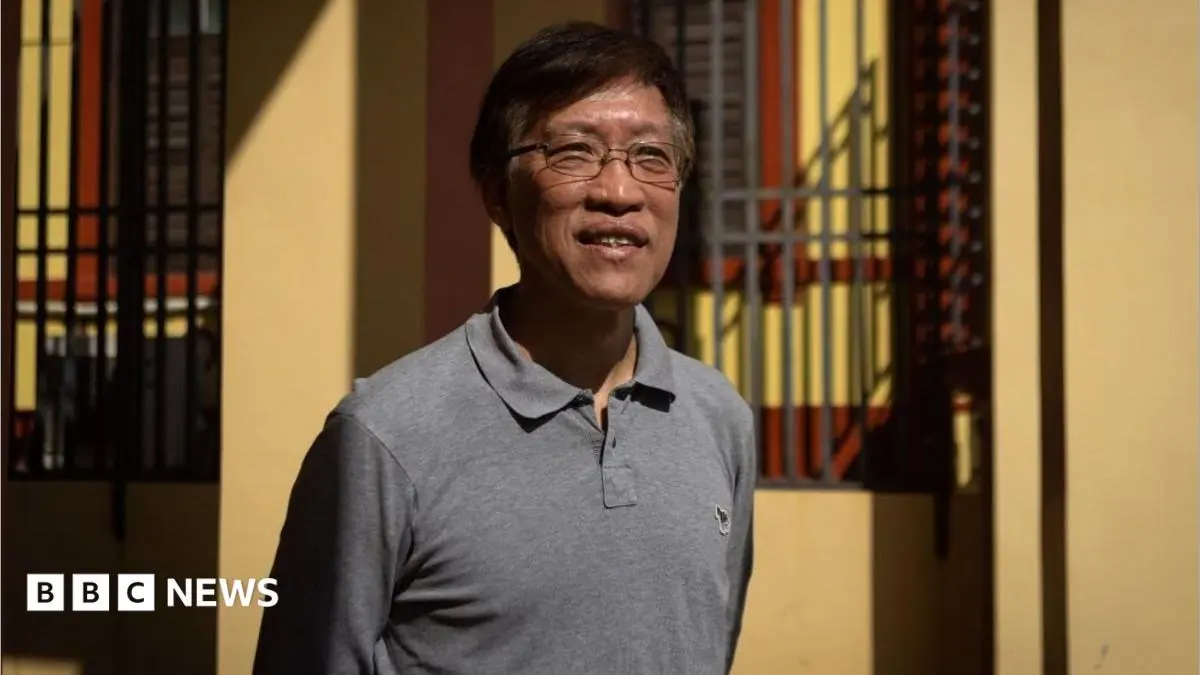
A court in Macau has sentenced former lawmaker and veteran pro-democracy campaigner Au Kam San to 12 years and six months in prison following the territory’s first national security trial. The ruling, delivered at the conclusion of a closed-door judicial process, marks a significant milestone in the legal and political history of the former Portuguese colony, representing the first time a former legislator in the special administrative region has been tried and convicted under Macau’s national security laws.
Following the conclusion of the proceedings, 69-year-old Au was convicted on Friday of "subversion against the political power of the state" in addition to several other security-related offences. The conviction follows a legal process that has drawn sharp criticism from his family and political supporters, who have pointed to the secrecy of the trial and the restrictions placed on the defendant’s choice of legal defense.
The sentencing drew an immediate and forceful condemnation from Au’s wife, Virginia Cheang, who denounced the entire legal proceeding against her husband. In a public statement addressing the verdict, Cheang characterized the judicial process as a "groundless persecution designed to humiliate Au," questioning both the validity of the charges and the motives behind the secret prosecution of the former elected representative.
The trial itself was conducted away from public scrutiny, concluding in September after lasting just three days. Court officials and prosecutors maintained strict confidentiality surrounding the proceedings, with the presiding judge explicitly ordering that the trial be held behind closed doors. The court justified the decision by stating that secrecy was necessary "to ensure that no prejudice is caused to the interests of national security," preventing media, observers, and the general public from attending the hearings or reviewing the underlying evidence presented by the state.
Au’s legal troubles began in July 2025, when he was taken into custody by law enforcement authorities. Prosecutors subsequently leveled seven formal charges against him, setting up the historic national security prosecution. The indictment included three counts of subverting the state’s power, three counts of endangering national security by establishing contact with foreign organisations, and one count of breach of confidentiality.
Following the brief three-day trial in September, the court found Au guilty of four of the seven charges contained in the indictment. However, Macau’s government and judicial authorities have never publicly disclosed the specific details, underlying evidence, or precise actions that formed the basis of the prosecution’s case. The public record remains restricted, leaving the exact nature of the allegations unconfirmed by official public documents.
Despite the lack of public detail, prosecutors outlined a broad narrative during the proceedings, accusing the former lawmaker of engaging in a sustained effort to undermine state power. According to prosecutors, Au had assisted and collaborated with what the state designated as "external hostile organisations." The prosecution argued that over an extended period of time, Au had actively engaged in collecting, preparing, and disseminating information that was "manifestly filled with political claims of a subversive nature against the state."
The handling of Au’s defense raised additional concerns among his supporters regarding due process and legal rights. Information disclosed earlier by Au’s family revealed that the former lawmaker was not permitted to select or retain his own independent legal representation. Instead, judicial authorities assigned a court-appointed attorney to handle his defense throughout the proceedings, limiting the family’s ability to engage outside counsel.
The emotional impact of the secret trial and the severe sentence was highlighted by Au’s wife in the wake of Friday’s judgment. Expressing profound concern for her husband’s well-being and future confinement, Cheang stated that she hoped government authorities would grant her and her family permission to write to Au on a regular basis and be allowed to visit him in prison as he serves his sentence.
Writing in a poignant open letter released on Friday, Cheang reflected on the bleak outlook facing her family. "I dare not hope for more as I believe that will only lead to greater disappointment," she wrote, describing the pain of watching her husband face an extensive prison term following a process that the family views as deeply unjust.
Au’s conviction marks a dramatic conclusion to a long career in Macau’s public life. Prior to entering politics, Au worked as a primary school teacher. He subsequently transitioned into public service, winning election to Macau’s Legislative Assembly in September 2001. That election marked the beginning of a two-decade tenure in office, during which Au served continuously as an elected representative in the territory’s legislature.
Throughout his 20 years in the Legislative Assembly, Au established himself as one of the few prominent pro-democracy voices in Macau politics. He operated within a legislative body predominantly composed of pro-Beijing loyalists and commercial figures, frequently serving as one of only a small handful of opposition lawmakers willing to openly challenge government policies and advocate for democratic governance.
In addition to his legislative work, Au was widely recognized for his long-standing involvement in civil society and political activism. For decades, he served as a key co-organizer of annual candlelight vigils held in Macau to commemorate the victims of the 1989 Tiananmen Square crackdown in Beijing. These annual events provided a rare platform for public memory and political expression regarding the events of June 4, 1989.
The legal framework governing Macau has evolved significantly since the territory was handed back to Chinese administration in 1999, ending more than 400 years of Portuguese colonial rule. Under the principle of "One Country, Two Systems," Macau was established as a special administrative region with its own legal system. In 2009, Macau enacted its original national security law, which explicitly criminalised acts of treason, secession, and subversion directed against the ruling Chinese Communist Party and the central government.
In recent years, authorities in Macau moved to significantly expand and reinforce this security framework. In 2023, the local government enacted sweeping revisions to the 2009 national security law, broadening its reach to cover non-violent acts of secession and expanding the definitions of acts deemed dangerous to state security.
Further legal modifications were introduced this year, specifically amending judicial procedures to allow national security trials to be conducted entirely behind closed doors. It was under these newly enacted procedural rules that the judge in Au’s trial ordered the court cleared of the public and press, setting the stage for the secret proceedings that resulted in Friday’s 12-and-a-half-year sentence.
The legal actions against Au reflect a broader shift across both of China’s special administrative regions regarding public memory and political dissent. For decades, annual Tiananmen Square vigils were tolerated in both Macau and neighboring Hong Kong, standing as prominent symbols of the distinct legal rights and political freedoms enjoyed in the two territories compared to mainland China. However, those annual gatherings have effectively been eliminated in both cities since Beijing introduced a sweeping national security law for Hong Kong in 2020, leading to a wider crackdown on opposition politics across the region.
The timing of Au’s sentencing connects directly to similar legal developments in Hong Kong. Just one day before Au received his 12-and-a-half-year sentence in Macau, a Hong Kong court sentenced Joshua Wong, one of the most recognizable figures of Hong Kong’s pro-democracy movement, to 10 years in prison under Hong Kong’s national security legislation.
Wong, who is now 30 years old, gained international prominence as a teenage student activist leading pro-democracy protests. By the time of his sentencing on Thursday, Wong had already spent the last six years continuously in custody, illustrating the extent to which national security prosecutions have reshaped the political landscape across both former European enclaves.
With the conclusion of Au’s trial, Macau’s first national security case comes to a close, leaving the 69-year-old former teacher and 20-year legislative veteran facing more than a decade behind bars. As Au begins his sentence, his family continues to wait for official confirmation regarding visitation rights and correspondence, while the territory adjusts to the reality of its strict national security jurisprudence.