
This story was originally published by The Trace, a nonprofit newsroom covering gun violence in America.
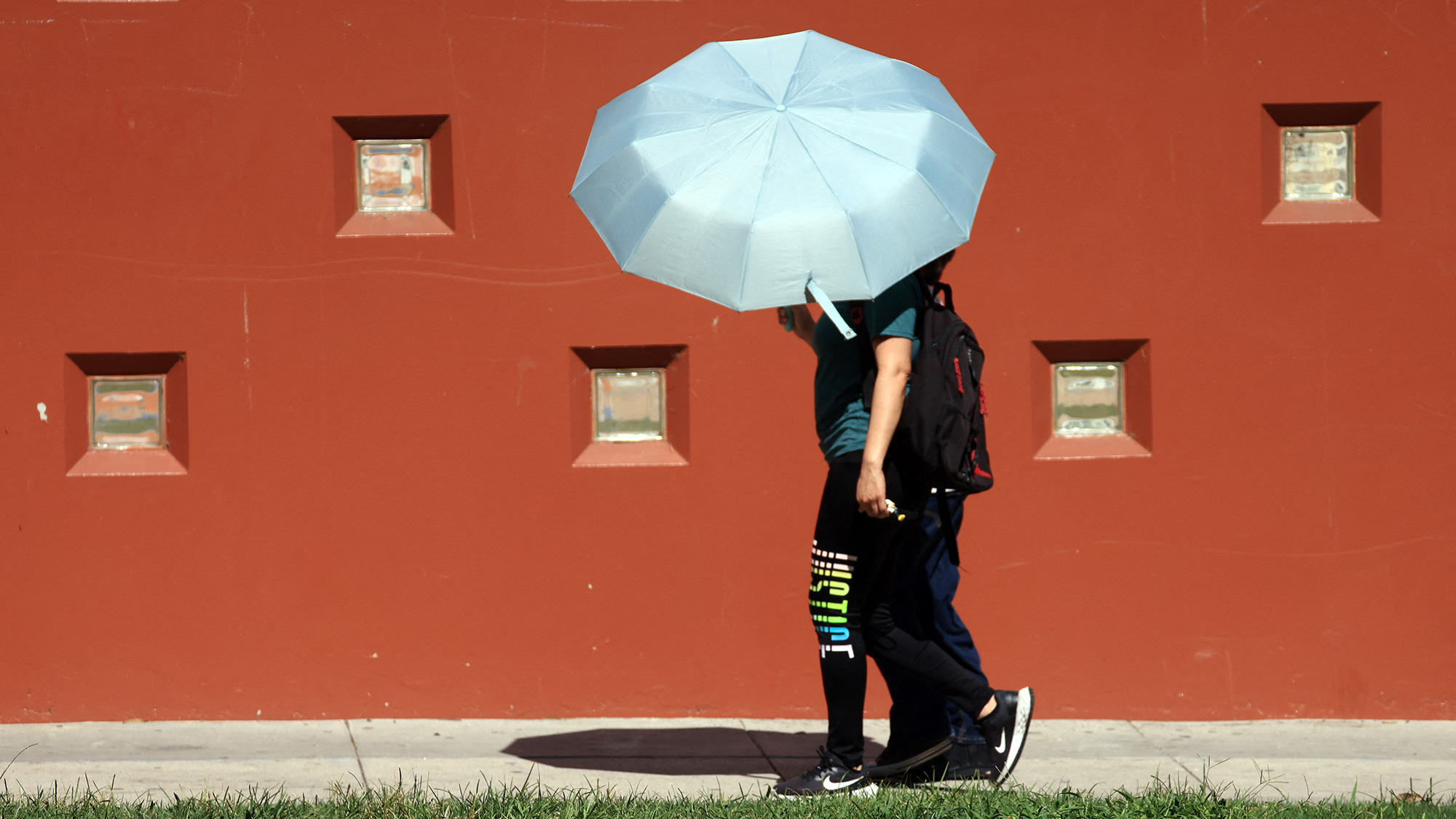
Even as Philadelphia trends toward its lowest annual homicide total since 1963, the city’s summer seasons are increasingly defined by a volatile new variable: extreme heat. Over a recent Fourth of July weekend, a sprawling heat dome descended from Maine to the Gulf of Mexico, exposing approximately 165 million people across the United States to major or extreme heat conditions.
Major metropolitan areas including Boston, Baltimore, and Raleigh shattered historical temperature records, while Philadelphia sweltered under readings topping 100 degrees for three consecutive days. Amid this oppressive climate, the city experienced a surge in gun violence. Between July 2 and July 4, the Gun Violence Archive logged nine separate shooting incidents, leaving three people dead and nine others wounded.
Frontline community workers say the connection between soaring temperatures and interpersonal conflict is immediately visible on the streets.
“Those who commit gun violence are in a vulnerable population that have limited economic ability to make sure that they have air conditioning,” said Marion Campbell, executive director of Eddie’s House, a Philadelphia-based nonprofit providing violence prevention and social services. “When you get hot, you get irritated, OK? I’m just going to keep it real. You get irritated, and your inability to manage your frustration could be heightened.”
While public health research has long confirmed that rising temperatures correlate with spikes in gun violence, the specific fingerprint of human-caused climate change on community violence has remained largely unquantified until now.
A newly released analysis shared with The Trace by Climate Central, a nonprofit research and communication organization, estimates that approximately 2,000 shootings between 2021 and 2025 across the 100 U.S. cities with the highest volumes of gun violence can be directly attributed to extreme temperatures amplified by climate change. Furthermore, climate attribution scientists calculated that the baking July Fourth weekend in Philadelphia was made at least twice as likely to occur because of planetary warming.
Researchers warn that this is only the beginning of a dangerous trend. As global temperatures continue to climb, urban communities will likely face sustained upward pressure on rates of firearm violence.
“Across all of these cities, we see that in aggregate, climate change is raising the risk of gun violence,” said Kristina Dahl, vice president for science at Climate Central. “Short of really swift and deep cuts to heat-trapping emissions globally, we expect the planet to continue to warm.”
John Roman, a distinguished senior fellow at NORC, a social research center at the University of Chicago who reviewed the Climate Central analysis, noted that the well-established theory connecting high temperatures to increased violence is robust. He pointed out that while observers might find it confusing to see record-high summer temperatures paired with record-low baseline gun violence in certain cities, the underlying climatic influence remains potent.
“I think if we still had the same climate we had in 1980, I think we’d see even lower violence than we see today,” Roman said.
Understanding How Climate Drives Violence
Until this recent analysis, researchers had not placed a concrete figure on the contribution of climate change to interpersonal violence.
“We’re talking about close to 2,000 shootings that we can attribute to climate change’s influence on high temperatures,” Dahl said. “So, that’s still a lot of people who are being exposed to this kind of traumatic event because of climate change.”
Researchers emphasize that no individual shooting can be pinned directly to climate change. Gun violence is driven by a complex web of socioeconomic stressors, and individual perpetrators do not cite the weather as their primary motivation. Instead, Climate Central’s methodology examined the broader, aggregate statistical relationships between climate change, ambient temperature, and shooting incidents across 100 distinct urban centers.
The analytical process began by establishing the baseline relationship between outdoor temperatures and gun violence for each city. Because a 95-degree day represents an acute crisis in the humid Northeast but a routine afternoon in Phoenix, researchers constructed individual gun violence models for each city using historical data. These mathematical equations project the expected number of shooting incidents for any given temperature.
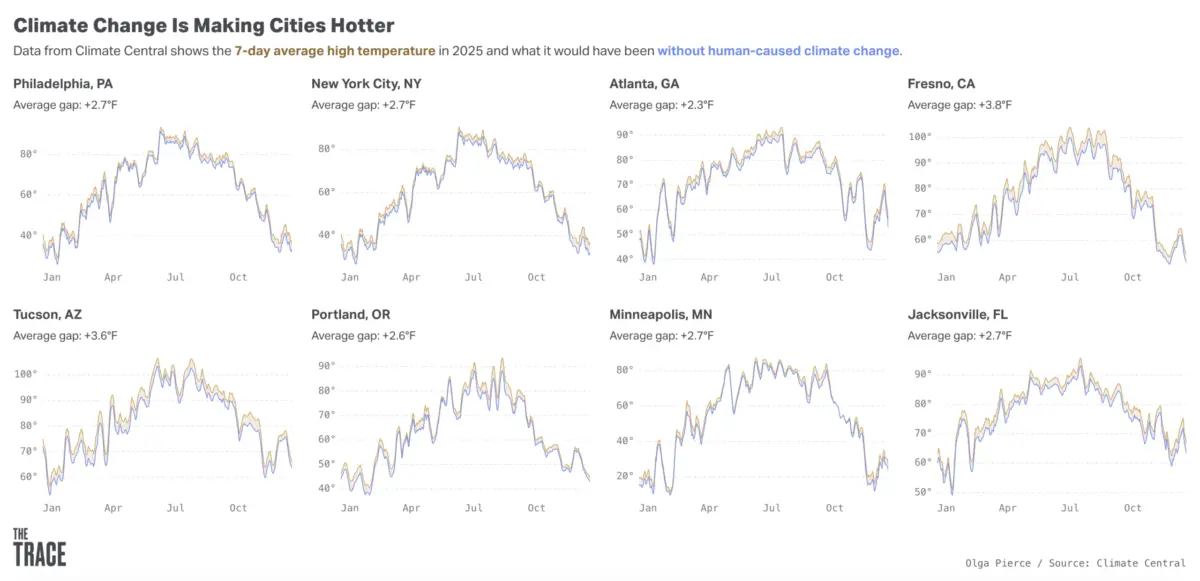
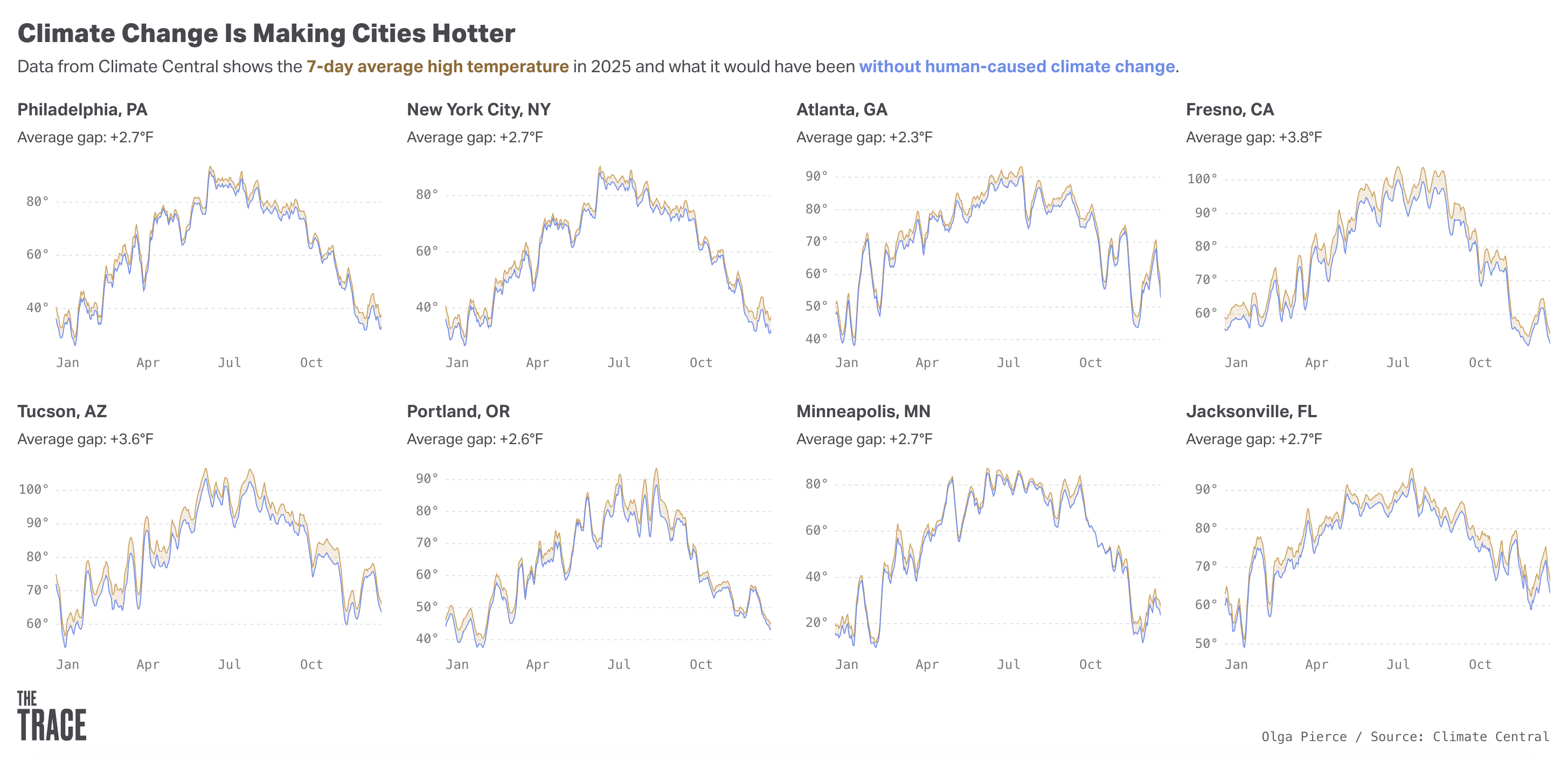
Next, the research team simulated a counterfactual world without human-caused climate change. By combining 22 leading global climate models with real-world temperature archives, they calculated hypothetical daily weather patterns for each city over the five-year study period. Comparing these simulated temperatures against actual recorded data revealed that climate change has warmed the typical day in these cities by about 2.4 degrees Fahrenheit, ranging from a 1.7-degree increase in San Francisco and Miami to a 3.8-degree bump in Fresno, California.
By applying these temperature gaps to the individual city models, researchers estimated the number of shooting incidents associated with the additional warmth. Over five years across 100 cities, the aggregate difference accounted for roughly 1,950 shootings—about 1.7 percent of the 116,281 total shootings recorded in the Gun Violence Archive for those locations during that timeframe.
In Philadelphia, the temperature gap averaged about 2.7 degrees Fahrenheit, corresponding to an estimated 149 additional shootings between 2021 and 2025. Researchers stress that these figures are statistical estimates rather than exact counts, and that climate is only one of many interacting factors shaping urban violence rates. Nevertheless, the analytical signal is unmistakable: climate change is compounding the risk.
Who’s Most Vulnerable to Urban Heat
The burden of extreme heat and its associated risks does not fall equally across urban populations. Instead, the impacts of climate change disproportionately affect historically disinvested neighborhoods where baseline rates of gun violence are already elevated.
The stark disparities are visible within single metropolitan areas. In New York City, for instance, the leafy, affluent streets of Manhattan stand in sharp contrast to neighborhoods like Mott Haven in the Bronx. According to municipal health department data, Mott Haven experiences significantly lower median incomes and features roughly 40 percent less green space than wealthier parts of the city. Dense concentrations of asphalt and concrete trap heat, driving surface temperatures up by an average of five degrees compared to greener districts—a difference that can prove critical to public health and safety.
Neighborhoods like Mott Haven function as urban heat islands, a phenomenon that nationally impacts low-income communities and communities of color at disproportionately high rates. Mott Haven’s population is 97 percent Black and Latino. At local community organizing meetings, residents report severe difficulties managing indoor temperatures. While roughly 84 percent of households possess air conditioning units, the prohibitive cost of electricity forces many residents to limit their use. One local mother reported receiving a monthly electric bill of $1,000 during peak summer months.
Outdoor conditions offer little refuge. Major bus corridors often lack adequate shade trees, underground subway platforms can trap heat and climb up to 18 degrees hotter than street level, and neighborhood playgrounds paved in asphalt rather than grass become dangerously hot. Furthermore, outdoor laborers face cumulative heat stress throughout the day, often without mandatory work-stoppage protections during extreme weather emergencies.
These environmental vulnerabilities are the direct legacy of historical housing policies and uneven municipal investments, according to Dahl.
“We know that the hottest parts of cities tend to be places where there hasn’t been an investment in the sort of natural environments that would help to keep the environment cooler,” Dahl said. “Trees and parks that can really create a lot of shade and help cool the city down are less likely to be present. This is one example among many, many, many in which climate change falls hardest on the people who have the fewest resources to cope with it.”
When vulnerable populations face chronic financial strain, resource scarcity, and systemic discrimination, their bodies enter a state of heightened physiological stress known as allostatic load. Kimberly Meidenbauer, an assistant psychology professor and environmental neuroscience researcher at Washington State University, explained that when chronic stressors are compounded by extreme heat, the human body struggles to regulate itself.
“If your body’s already dysregulated and under a lot of stress, it’s just probably not going to be able to handle an additional stressor quite in the same way,” Meidenbauer said.
The Science of Heat and Aggression
Scientists point to two primary, non-exclusive explanations for why high temperatures foster aggressive behavior, starting with human physiology.
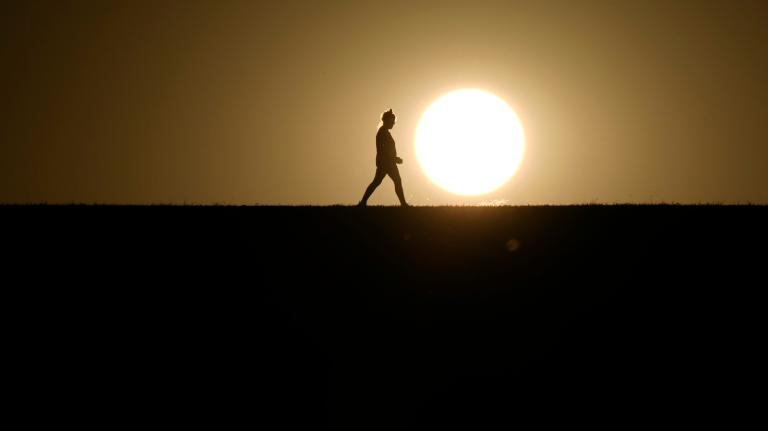
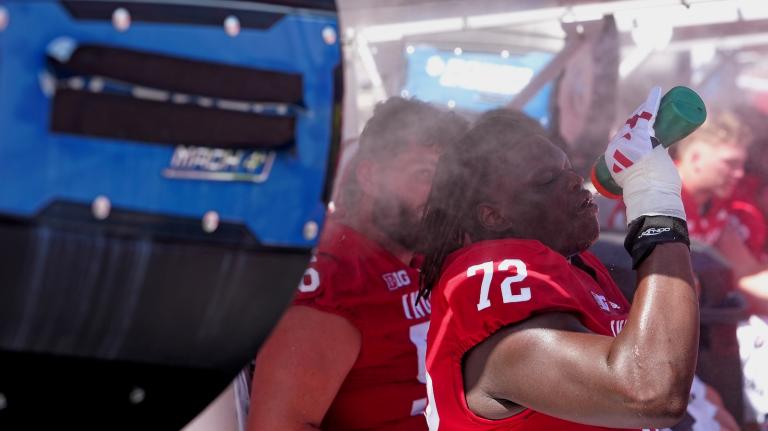
When ambient heat disrupts the body’s internal equilibrium, the hypothalamus detects the thermal stress and initiates thermoregulation, moving heat toward the skin’s surface through sweating and blood vessel dilation. While effective, this physiological process is deeply uncomfortable.
“Thermoregulation is pretty effective at keeping our bodies in a safe range, but it is also uncomfortable,” Meidenbauer noted.
This physical discomfort triggers negative emotional states such as irritability, hostility, and frustration, while simultaneously impairing prefrontal brain regions responsible for impulse control. Psychological research also suggests that individuals under thermal stress may misattribute the source of their agitation, blaming nearby social triggers—such as a crying infant or a minor argument—rather than the environmental temperature. Furthermore, experiments indicate that heat can warp social perception, causing individuals to view the intentions and facial expressions of others as more hostile and threatening.
To test these mechanisms empirically, Meidenbauer’s laboratory at Washington State University placed study participants in an infrared sauna and asked them to play a competitive computer game against an ostensibly remote opponent. The game allowed participants to steal points from their opponents, and warmer ambient temperatures consistently correlated with higher levels of impulsive aggression.
A second explanatory framework, known in criminology as routine activities theory and developed in the 1970s, suggests that violence rises during warm weather simply because more people are outdoors, increasing opportunities for interpersonal conflict. This dynamic explains the prevalence of spontaneous shootings at outdoor public events, such as high school football games, where large crowds gather and grievances can flare unexpectedly.
Intriguingly, researchers note that extreme temperatures can eventually suppress violence if it becomes too hot for people to remain outside. John Roman observed that crime data often shows violence increasing alongside moderate-to-high temperatures up to a critical threshold, after which incidents decline as people retreat indoors.
“If it’s 95, I don’t care how mad you are at somebody else, you’re gonna wait until it’s not 95 to go out and do something about it,” Roman said.
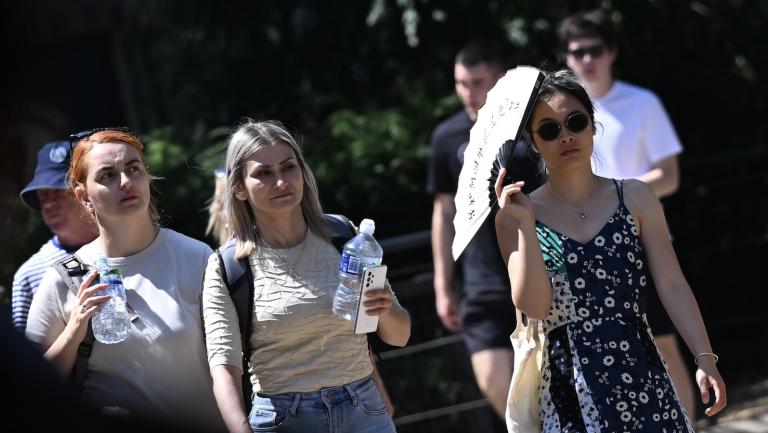
However, climate change introduces a new dimension to this pattern by expanding the number of mild shoulder-season days in spring and autumn that encourage outdoor activity.
“The more days you have that are warm enough to be outside, the more people are exposed to violence,” Roman said, “and so now it isn’t that July is super hot and people are madder or shorter fuse. It’s that April and March and October and November are much nicer to be out and about.”
Navigating Community Stereotypes and Solutions
As researchers and public health officials map these connections, community members in neighborhoods like Mott Haven express concern that linking temperature to gun violence risks reviving harmful historical stereotypes. Residents emphasize that outdoor gatherings during warm weather are a vibrant, peaceful cultural tradition, pointing to recent joyful public celebrations around international soccer matches and sports victory parades as proof that diverse communities can gather outdoors harmoniously.
Historically, pseudoscientific concepts like climatic determinism—the belief that warm climates produce hot-tempered, uncivilized populations—were weaponized for centuries to justify colonialism and slavery. Modern analysts emphasize that temperature is merely one aggravating factor among a vast constellation of socioeconomic variables.
“Temperature is only one of many factors that go into why someone might pull out a gun on a hot day,” Dahl said. “There’s a whole constellation of supports and services and policies that could help to alleviate some of the other stressors people are facing that might lead to these kinds of decisions.”
In response to worsening heat waves, municipalities are expanding emergency relief networks. Cities like New York operate hundreds of cooling centers in libraries and community spaces, while deploying mobile vans to assist elderly residents and establishing pop-up hydration stations for outdoor workers. Nevertheless, demand frequently outstrips municipal resources; local programs providing free air conditioning units to vulnerable populations routinely exhaust their application capacities before the summer heat peaks, often leaving families without financial assistance to cover operating electricity costs.
Public health experts argue that messaging must evolve to address the psychological toll of heat. Meidenbauer suggests that public advisories should encourage individuals to monitor not only physical symptoms of heat exhaustion, but also changes in their cognitive clarity, emotional regulation, and sleep disruption caused by warm nights.
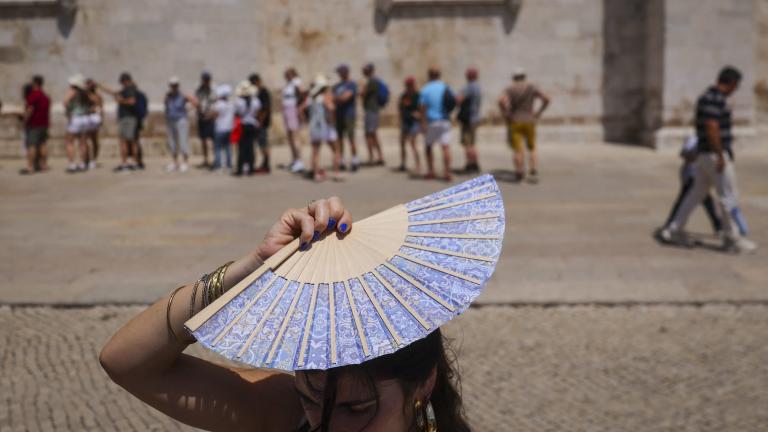
Long-term interventions focus heavily on mitigating urban heat island effects. In Philadelphia, research published in 2018 demonstrated that cleaning up vacant lots and planting fresh grass in low-income neighborhoods was associated with a roughly 29 percent reduction in nearby gun violence. Building on those findings, the city is currently advancing a major urban greening initiative known as Tree Plan. Funded by the city and managed by the Pennsylvania Horticultural Society, the project aims to expand the urban tree canopy to 30 percent citywide, counteracting extreme temperature disparities in areas where tree cover currently sits as low as 2 percent and surface temperatures soar up to 22 degrees higher than in leafy neighborhoods.
With climate models projecting continued global warming, local advocates stress that addressing environmental infrastructure is increasingly inseparable from public safety policy.
“We know when it gets hot outside people get angrier, and when people get angrier and there’s guns present, it’s more likely to end up violent,” said Adam Garber, executive director of the violence prevention advocacy group CeaseFirePA. “We know it’s getting hotter every year because of climate change.”