
One of the most innovative and rapidly advancing fields in modern earth sciences does not sound particularly glamorous at first glance. Known as distributed acoustic sensing, or DAS, the technology relies on an unassuming medium to spy on the natural environment: standard fiber optic cables. Despite its humble appearance, DAS is proving to be an enormously powerful tool for researchers attempting to understand some of the planet’s most complex and elusive physical processes.
By analyzing the subtle ways that vibrations scatter light as it travels through glass wires, scientists are gaining unprecedented visibility into subterranean and subglacial dynamics. In recent years, researchers have deployed these cables in remarkably diverse and challenging environments. They have used the technology to monitor volcanic activity at Mount Etna, detect low-frequency earthquakes, and even track footsteps on the surface above buried lines. Last year, a team of scientists took the technique offshore, laying a specialized fiber optic cable along the seafloor near a Greenland glacier. That deployment yielded unprecedented insights into how marine-terminating ice is rapidly deteriorating from the bottom up.
Now, a team of researchers working high in the mountains of Switzerland has utilized DAS to expose another deeply troubling trend in glacial mechanics known as hydrofracturing. This destructive process occurs when surface meltwater seeps deep down into fractures within the ice, creating immense hydraulic pressure that forces the cracks wider and deeper. By studying this phenomenon in fine detail, scientists hope to gain a much clearer picture of how ice masses the world over will decline in a warming climate, enabling more accurate predictions of consequential hazards, including global sea level rise.
The implications of this research extend far beyond theoretical glaciology. According to Thomas Hudson, a seismologist at ETH Zurich in Switzerland and lead author of a recent scientific paper describing the work, hydrofracturing is widely hypothesized to be a primary mechanism capable of causing the mass disintegration of major ice shelves and ice sheets in polar regions like Antarctica and Greenland. Yet, despite its importance to climate models, researchers have rarely been able to observe the mechanism in action with any significant level of detail. The deployment in the Swiss Alps represents a major step toward filling that critical observational gap.
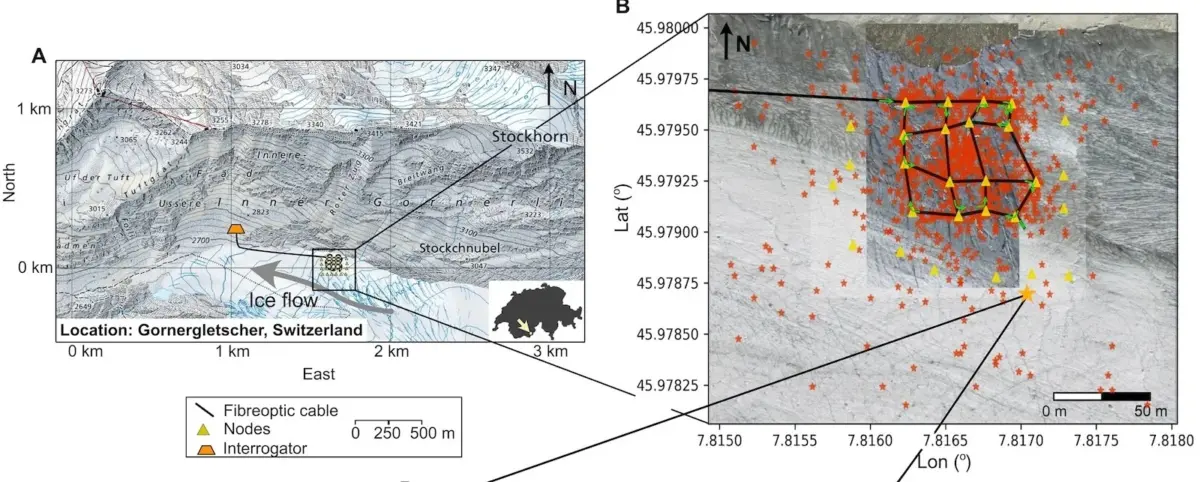
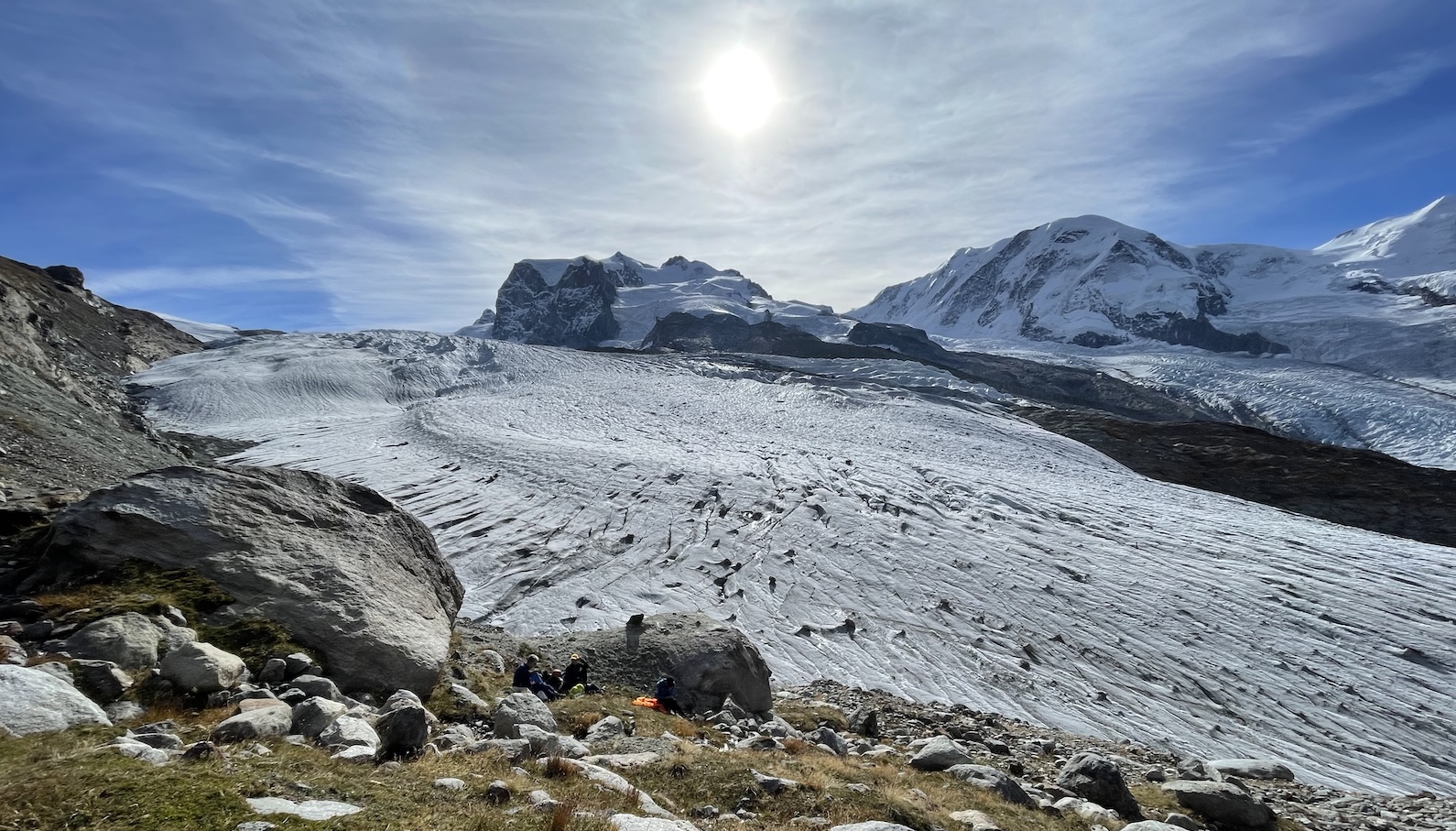
The secret to the success of distributed acoustic sensing lies in its capacity to transform a continuous length of glass fiber into thousands of individual monitoring points. On a rugged alpine glacier in Switzerland, Hudson and his colleagues laid out fiber optic cables in a systematic grid pattern across the shifting ice surface. To collect data, they connected the network to a specialized instrument called an interrogator, which fires rapid laser pulses through the cable. Even the tiniest environmental disturbances, strains, or micro-shakings along any point of the cable scatter minuscule amounts of light back toward the device, where they are logged with extreme precision.
Using calculations based on the constant speed of light, the research team could pinpoint the exact location and timing of an icequake—a fracture within the glacier that generates seismic waves remarkably similar to an earthquake. Because signals originating farther down the line take a fraction of a millisecond longer to return to the interrogator, the system can resolve events across the entire network with stunning spatial resolution.
This capability represents a massive leap forward when compared to traditional seismometers, which traditionally detect ground shaking at a single, isolated point. By breaking a single fiber optic cable into thousands of virtual strain sensors, the DAS setup effectively equips researchers with the observational equivalent of thousands of individual seismometers operating simultaneously across the landscape.
Beyond the sheer volume and resolution of the data it provides, DAS offers significant logistical and financial advantages for field scientists. Glaciers are inherently hazardous environments for researchers, crisscrossed by hidden crevasses, unstable ice towers, and unpredictable terrain where a single misstep can prove fatal. Traditional monitoring equipment often requires frequent maintenance and manual data retrieval in these dangerous zones.
With DAS, however, scientists can lay out the cable network, secure the infrastructure, and safely withdraw from the immediate hazard area. Once deployed, the system beams a constant, real-time stream of data back from the interrogator unit, which can be housed safely off the ice. Streaming data continuously from conventional, scattered seismometers in such remote terrain is notoriously difficult, and retrieving the physical storage units usually requires dangerous return trips to the field. From a purely data-logistical and safety perspective, Hudson notes, DAS stands out as a vastly superior monitoring method for unstable alpine environments.
The findings gathered from the Swiss alpine glacier underscore the complex array of threats facing mountain ice bodies today. The team’s observations revealed that the glacier is not merely suffering from surface melting driven by rising ambient air temperatures. Because liquid water is significantly denser than solid ice, meltwater actively seeks out weaknesses, flowing deep down into nascent cracks and exerting tremendous hydrostatic pressure. This pressure forces the ice apart from the inside, generating a dense network of internal crevasses that severely compromises the structural integrity of the entire glacier.
The depth and frequency of these internal fractures are critical variables determining whether a glacier remains stable or begins to break apart catastrophically. This structural degradation is of immediate practical concern for mountain communities, as many of these alpine glaciers loom directly over critical infrastructure, including mountain railways, hiking paths, and alpine villages. Developing methods to accurately monitor these internal stress fractures is therefore essential for mitigating natural hazards in mountainous regions.
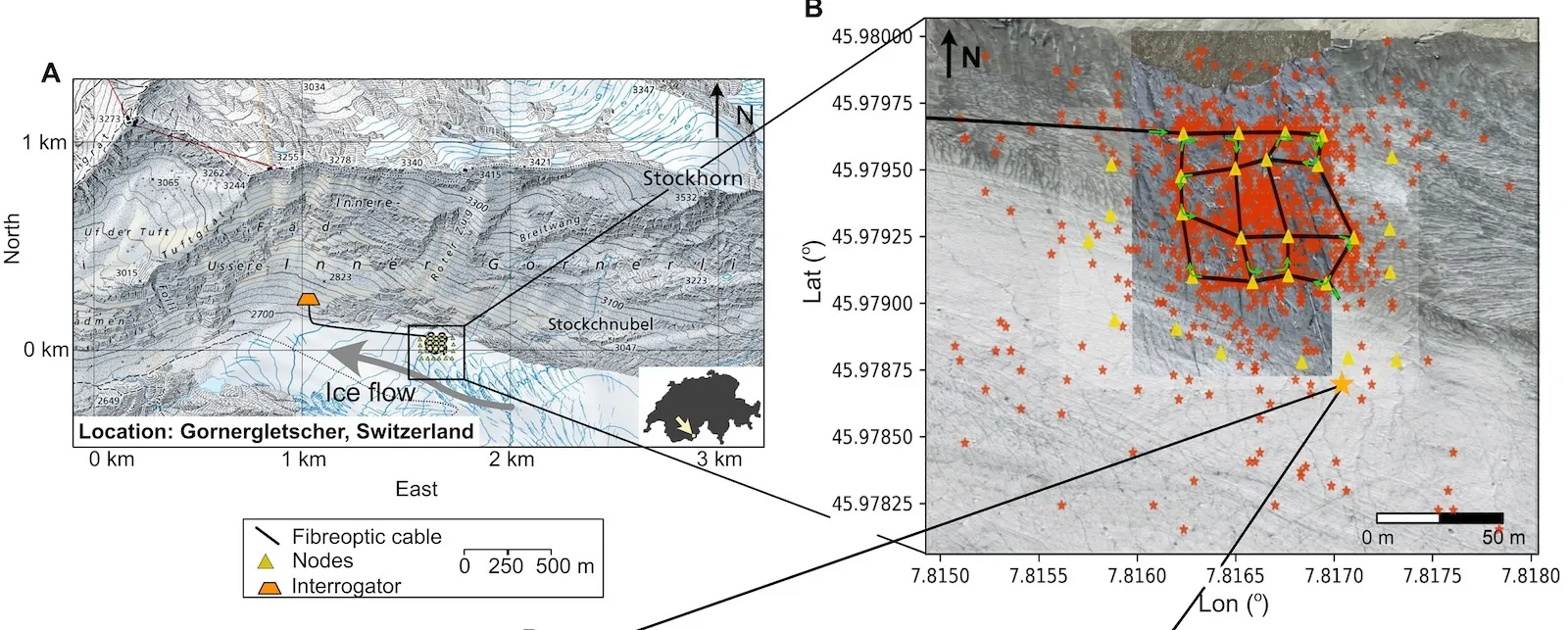
During just a single week of intensive fieldwork on the Swiss glacier, Hudson and his research team detected more than a thousand distinct icequakes. The data confirmed that surface meltwater readily penetrates deep into the heart of the glacier via these fractures, a dynamic that glaciologists suspect is occurring in similar alpine environments across the globe.
A primary long-term goal for researchers is to harness distributed acoustic sensing to develop early-warning systems capable of detecting the precursors to catastrophic glacial collapses and glacial lake outburst floods. Such disasters have demonstrated their destructive potential time and again, most recently in high-mountain regions like Nepal, where sudden flash floods and landslides devastate downstream valleys. Hudson expresses high confidence that precursory seismic signals exist prior to such events, noting that he would be overwhelmingly certain that a DAS array could pick up the warning signs.
At the same time, researchers emphasize that translating raw seismic data into an actionable, real-time early warning system for remote mountain communities remains a formidable challenge. While the technology excels at detecting and locating micro-fractures within the ice, bridging the gap between raw data collection and effective public safety alerts requires significant further development in data processing and emergency communication infrastructure.
On a global scale, DAS also holds immense promise for monitoring the colossal ice sheets in Greenland and Antarctica that are currently destabilizing and slipping into the world’s oceans. The retreat of these polar ice sheets is driven by complex ocean-ice interactions rather than simple atmospheric warming alone. In Antarctica, relatively warm ocean currents are actively eroding the undersides of floating ice shelves, while turbulent underwater currents accelerate melt rates from below. Meanwhile, recent DAS research in Greenland has uncovered additional feedback loops, revealing that when massive blocks of ice violently calve into the sea, the physical disturbance stirs up the water column and disrupts an insulating layer of cold water that normally protects the glacier face, ultimately triggering even more rapid melting in a self-perpetuating cycle.
By deploying fiber optic cables across these massive polar landscapes, scientists can peer beneath the surface in ways previously thought impossible, tracking the seismic waves that betray the formation of destabilizing cracks. Understanding the depth and spatial distribution of these subsurface fractures will ultimately give researchers a much clearer baseline for projecting how fast major glaciers and ice sheets are likely to disintegrate, providing crucial data for future global sea level rise projections.