
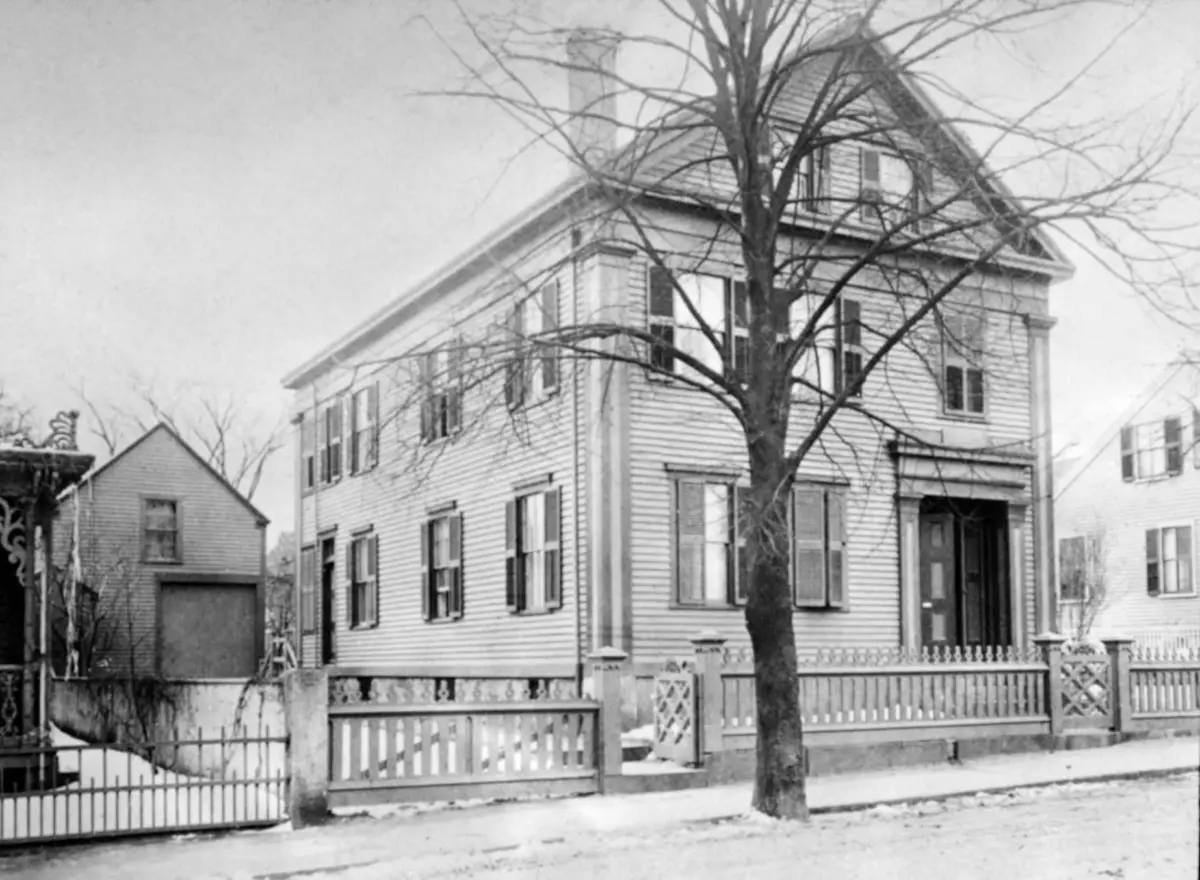
The Lizzie Borden House could easily pass for a charming New England bed and breakfast if you manage to push the brutal history of its 1892 murders to the back of your mind. But with framed photographs of the victims and hatchet-themed iconography plastered throughout the 1845 Greek Revival-style home, forgetting the past is nearly impossible. After all, what else would draw travelers to this particular six-bedroom residence tucked away in Fall River, Massachusetts?
Recently, a wave of morbid curiosity prompted a journey from New York City to the real-life dwelling where 32-year-old Lizzie Borden may—or may not—have brutally butchered her father and stepmother, Andrew and Abby Borden, on the morning of August 4, 1892. This renewed interest was sparked by the debut of Ryan Murphy’s latest installment of his high-profile, suspenseful anthology series Monster, which explores the infamous crimes associated with the Borden name. Previous seasons of Murphy’s hit series tackled the harrowing crimes of Jeffrey Dahmer, the Menendez brothers, and Ed Gein.

Monster: The Lizzie Borden Story premieres today on Netflix, igniting yet another cycle of public fascination surrounding the century-old mystery. However, Murphy is far from the first creative to take a swing at adapting the chilling tale. In the 130 years since the horrific incident shocked the nation, the story has been reimagined through countless feature films, operas, theatrical plays, ballets, Halloween costumes, and a macabre nursery rhyme that remains embedded in American folklore.
Our enduring cultural fascination with the killings has transformed a gruesome true crime case into something resembling a campfire legend, with Lizzie frequently cast as a folk villain. Yet, buried beneath decades of theatrical retellings lies the stark reality: Andrew and Abby Borden were bludgeoned to death with a hatchet inside their own home, and their daughter stood trial for first-degree murder. Today, the very house where the tragedies unfolded operates as a museum and an inn, welcoming adventurous guests for daily tours, overnight stays, and morning breakfast.

230 Second Street, Fall River, Massachusetts
The property is owned and operated by US Ghost Adventures, a company that runs spooky walking tours and pub crawls in more than 200 cities nationwide while offering overnight stays at five historic homes with haunted reputations. Lance Zaal, the founder of US Ghost Adventures, acquired the Borden home off the market in 2021 for approximately $1.9 million. Prior to the acquisition, the location had operated as a house museum since 1996, and before that, it remained in private hands for decades. The Borden sisters had parted ways with the three-story dwelling shortly after Lizzie’s celebrated acquittal.
Did she actually commit the murders? An all-male jury of 19th-century Massachusetts residents ultimately could not fathom that a polite, small-town spinster was capable of carrying out such a violent act. From a legal standpoint, the double murder remains officially unsolved to this day, providing an enduring layer of intrigue for modern guests who check into the house.
.jpg)
Zaal notes that visitors who book stays or tours generally fall into two distinct categories: history enthusiasts and thrill-seekers. Zaal firmly identifies with the former group, highlighting the extensive restoration work he has spearheaded during his tenure as owner. His preservation efforts include restoring the home’s original 19th-century fence and conducting meticulous paint analyses to match the exterior’s original Borden-era muted army green siding.
While Zaal warmly welcomes tourists eager to lean into the paranormal side of the property, he acknowledges that the sensationalization surrounding the Borden family’s tragedy can occasionally walk a morally ambiguous line. It requires a delicate operational balance. "Groups would rent the house out and do seances, and I’m really trying to have us…" Zaal trails off before clarifying his ultimate vision. "In the beginning, I really tried to control our perception. A lot of people think that me or my company, just because we’re called US Ghost Adventures, that we’re all about just the ghosts, but our focus is on history. We’re trying to also make history fun and interesting. You have to strike a balance with places with difficult history."

Zaal emphasizes that customer satisfaction and historical integrity remain paramount. "At the end of the day, it’s all about serving the customer. First, it’s about the integrity of the story, and preserving the property, and then it’s about making sure that the people learn something, and that they enjoy their time."
Naturally, the property is still a functioning commercial enterprise. For a modest fee, the staff can place a prop ax or a decorative doll on a guest’s pillow to set a moody atmosphere, while a romance package complete with rose petals caters to those seeking a different kind of getaway. Despite the unconventional premise, the team’s approach has proven remarkably successful. Zaal reports that many visitors return for a third or even fifth stay, establishing a dedicated community of lifelong Lizzie Borden enthusiasts. The property’s gift shop caters directly to this enthusiastic niche with merchandise like "I survived" T-shirts.

Arriving at the house shortly before an afternoon tour, visitors are greeted by guides who promise to treat everyone "better than family." Guests are led into the formal sitting room, where Andrew Borden was discovered slain on the sofa. A life-sized mannequin—with a cloth respectfully draped over its form—slumps across a replica couch, recreating the grim discovery. The home’s structural footprint, complete with steep and narrow stairways, remains largely unchanged from the way it looked when the family lived there, though necessary updates have been made to accommodate modern hospitality. The kitchen features early 2000s-era appliances and fire department-approved equipment used to cook breakfast for overnight guests, though guides are quick to clarify that the espresso machine did not belong to Lizzie.
Several spaces, including Andrew’s former office, have been converted into modern bathrooms. Although the Borden patriarch was a remarkably successful businessman who owned multiple properties, he was also notoriously frugal. He famously opted out of installing indoor plumbing despite its availability at the time. Financial tensions were allegedly a persistent point of contention between Andrew and his daughters, particularly Lizzie, who longed to live in a more affluent neighborhood up on "the hill." Financial motive has long been central to the speculation surrounding the murders, as the sisters stood to inherit a considerable fortune upon the deaths of both their wealthy father and his wife of 27 years.

The family bedrooms are located on the second floor. The John Morse room, named after Lizzie’s maternal uncle who stayed at the house the night before the killings, is where Abby Borden met her end. According to tour lore, Abby was likely in the middle of making up the bed following her relative’s departure when she was ambushed by the attacker. To heighten the atmosphere for daytime visitors, a mannequin stands in for Abby near the spot where her body was found, accompanied by a framed crime scene photograph. The staff thoughtfully removes the mannequin before guests retire for the evening.
Whether or not the public believes the former Sunday school teacher was guilty of patricide and stepmatricide, the brutal fact remains that someone committed a double homicide in broad daylight on that quiet morning in Fall River. Aside from Lizzie and the family maid, Bridget, no one else was on the property, and neither testified to seeing an intruder. If the floral-papered walls of the Lizzie Borden House could speak, the century-old mystery might finally be put to rest. Instead, visitors turn to modern ghost-hunting tools. Late-night tours invite guests to check out dousing rods and spirit boxes, though Ouija boards have been permanently banned following an incident where a 1920s-era board was stolen and later returned with an anonymous note pleading with staff to "make it stop."

While hatchet-themed signage, ax-shaped pillow accessories, and novelty souvenirs might prompt skepticism, commercial sensationalism around the case is hardly a modern invention. Crowds descended upon the property even as the murders were being investigated, turning the subsequent trial into a massive media circus. The current wave of popular culture adaptations is simply the latest chapter in more than a century of persistent Borden melodrama.
Beneath the commercial veneer, the swapped-out wallpaper, and the replica furnishings, the historic house retains its original bones. In the basement ceiling directly beneath the room where Andrew was killed, faint stains remain visible all these years later. Before turning off the lights in the quiet stillness of the night, the mind inevitably drifts down two stories to those enduring marks, prompting overnight guests to carefully step around the exact spot where history was forged.