
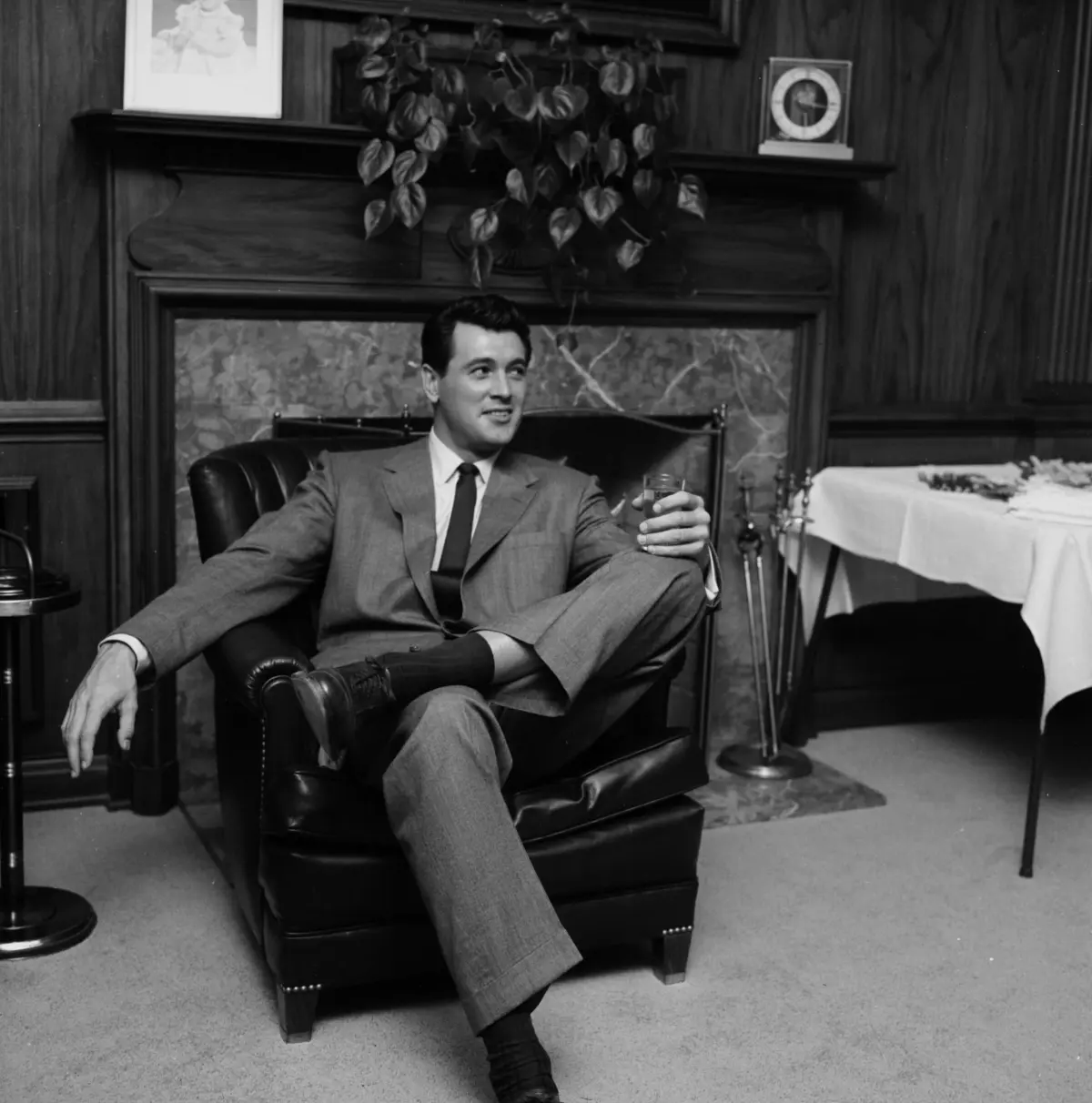
Though he remains an indelible icon of Hollywood’s Golden Age, celebrated for his towering stature, classic good looks, and unforgettable performances on the silver screen, Rock Hudson’s journey to superstardom was rooted in remarkably humble beginnings. Born Roy Harold Scherer Jr. on November 17, 1925, the future movie star spent a portion of his formative childhood years living alongside his parents in suburban Chicago with his maternal grandparents. According to Sara Davidson’s biographical work, Rock Hudson: His Story, life during this period was intensely communal and financially modest, anchored by a cramped one-bedroom bungalow located at 719 Center Street. In this single household, a total of six adults and five children shared a solitary bathroom, providing a stark contrast to the sprawling, opulent estates the actor would inhabit at the height of his fame.
As Hudson transitioned into adulthood and his Hollywood career exploded with major motion picture hits such as Giant, Pillow Talk, Lover Come Back, and All That Heaven Allows, the blinding glare of the public spotlight intensified. To cope with the relentless scrutiny of the tabloid press and the demands of being one of the most recognizable faces in the world, Hudson increasingly turned his various private residences into secluded sanctuaries.
"My house is the only place I really have any privacy," Hudson reflected candidly in Rock Hudson: His Story. "Outside the house, everything I do is watched and talked about, but once I come in those gates, I can relax and let go. I love to work on my house; to tear down walls and lay bricks."

Throughout his life, Hudson cultivated a series of distinct personal residences that reflected both his evolving status in the entertainment industry and his deep-seated desire for domestic refuge. These properties served as private backdrops for his personal relationships, architectural experiments, and quiet moments of solitude until his death in 1985.
Cohabitation
In the early years of his rising career, long before he attained total financial independence, Hudson shared living spaces with others in the Los Angeles area. A notable glimpse into this era is captured in a 1952 photograph featuring Hudson alongside fellow actor Bob Preble outside their shared North Hollywood home. According to accounts detailed in Rock Hudson: His Story, the two men lived together across four different residences over a span of three years.
Their final shared dwelling, situated on Avenida del Sol, was notably modern for its time, featuring futuristic glass fixtures designed to maximize the sweeping, picturesque views of the valley and the surrounding mountains. However, this domestic arrangement eventually came to an end when Preble moved out following his marriage to actor Yvonne Rivero.

During and long after this period, persistent rumors circulated within Hollywood circles regarding Hudson’s private life as a closeted gay man, including speculation about the nature of his relationship with Preble. Addressing these rumors years later in Rock Hudson: His Story, Preble seemed to acknowledge the complex dynamic between them. He shared that he and Hudson engaged in "a little experimenting… but nothing you would call a definite relation." Preble added, "I guess he hoped the barriers would come down. The situation did come close to spilling over to something that would have been foreign to my whole being, my whole behavior. But before that happened, I left and married Yvonne."
9151 Warbler Place
As Hudson’s star continued to rise, his residential choices shifted toward permanent investments. In 1954, he purchased a two-bedroom ranch-style house nestled near Sunset Boulevard at 9151 Warbler Place. The following year, he married secretary and interior designer Phyllis Gates, asking her to move into the property.
The home featured a warm, inviting kitchen characterized by a blend of exposed brick and natural wood elements. Because Hudson had poured virtually all of his liquid capital into securing the real estate purchase itself, the living room famously lacked conventional indoor seating initially. Instead, the actor furnished the space with redwood lawn chairs. Elaborate interior furnishings were far from the primary focus of the household anyway, as Gates was widely recognized as an exceptional home cook whose culinary specialties included classic comfort foods like meatloaf, pork chops, and mashed potatoes smothered in rich gravy.

A Rocky Marriage
The marriage between Hudson and Gates has long been reported by biographers and historians as a union arranged largely to shield the actor’s homosexuality from a studio system and public audience that were intensely conservative at the time. Despite the circumstances surrounding their nuptials, Gates maintained in later years that her affection for the actor had been genuine.
"I was very much in love," Gates recalled in Rock Hudson: His Story. "He was charming, his career was red hot, he was gorgeous, six foot six inches tall. How many women would have said no? If I had heard things about his being homosexual, I just put them in the back of my mind. So what if it was true?"
The marriage ultimately dissolved, leading to a high-profile divorce in 1958. As part of the legal settlement, Gates was awarded alimony payments of $250 per week for a duration of ten years, alongside ownership of the Warbler Place residence, which at the time was valued at $35,000.

The Beach House
Following his separation and subsequent divorce from Gates, Hudson sought solace by the water, moving into a coastal property in Malibu. A 1958 photograph captures the actor relaxing on the wooden deck of the residence, which served as his primary home while he was busy filming the landmark romantic comedy Pillow Talk.
Perched precariously atop wooden stilts, the beach house offered a uniquely immersive coastal experience. During periods of high tide, ocean waves would rush directly beneath the structural foundation of the building. In Rock Hudson: His Story, Hudson recalled forming close bonds with a tight-knit community of actors and stuntmen who resided along the same stretch of coastline.
Actor Don Burnett fondly remembered the active, sun-drenched lifestyle the group shared during those months. "We went swimming in the ocean without wetsuits all year round," Burnett said. "We did a lot of running in the Malibu hills, then we’d come down to the beach and jump in the ocean. We sailing and scuba diving—we taught Rock."

This idyllic seaside chapter, however, proved to be relatively brief. By the summer of 1959, Hudson departed Malibu and relocated temporarily to Newport Beach.
9402 Beverly Crest Drive
While working on the Universal Studios lot in 1961 to film the romantic comedy Lover Come Back, Hudson was leased a temporary residence by the studio located at 9402 Beverly Crest Drive. Originally owned by prominent talent agent and producer Sam Jaffe, the property offered a striking architectural aesthetic influenced by traditional Spanish-style homes, complete with classic stucco walls, a sloping red-tile roof, and dark wooden ceiling beams. The secluded, three-and-a-half-acre estate was dramatically surrounded by steep natural cliffs.
Hudson quickly fell deeply in love with the property and desperately wanted to purchase it. However, despite the surging momentum of his film career, the outright cost remained beyond his immediate financial reach. Universal Studios ultimately leveraged the situation when Hudson’s studio contract approached its expiration in 1962. The studio engineered a deal to acquire the Beverly Crest estate from Jaffe for $167,000, promising to transfer the title directly to Hudson in exchange for his agreement to re-sign with the studio. Hudson accepted the terms, and ownership of the property was formally signed over to the actor five years later.

Home Sweet Home
Determined to mold the former rental property into a true reflection of his personal taste, Hudson embarked on an extensive, multi-year renovation project. According to accounts in Rock Hudson: His Story, the actor utilized specialized literature to direct the architectural overhaul, frequently consulting comprehensive volumes dedicated to Mexican colonial architecture—books he affectionately referred to as his personal "bibles."
Drawing inspiration directly from traditional designs found throughout Mexico and the American Southwest, Hudson integrated architectural elements such as hand-painted ceramic tiles, massive stone archways, heavy wooden entry doors, and ceilings constructed from rustic tree branches. The interior was subsequently filled with an eclectic array of decorative items and cultural artifacts, including African tribal masks, zebra skins, and towering four-foot-tall pewter candlesticks.
The Castle
Over the years, Hudson came to affectionately refer to the expansive Beverly Crest estate as "The Castle." The moniker was fitting not only for its scale and dramatic hillside setting, but also for the whimsical and bold artistic choices the actor made throughout the property.

The grounds and interior were populated by numerous figures representing the animal kingdom, including oversized statues of horses and eagles, an ornate fountain shaped like a lion’s head, and mounted brass elephant heads positioned along the walls of the primary bedroom, where the trunks cleverly doubled as functional towel racks.
Another prominent and recurring motif throughout the estate was the unclothed male form. Hudson displayed striking metal sculptures of nude male figures—crafted by the renowned Mexican artist Victor Salmones—across the lush property grounds. Furthermore, a custom-carved relief of a nude male figure, inspired by traditional Spanish mythology, was integrated directly into the wooden headboard of the actor’s bed. Beyond these artistic expressions, the estate offered extensive resort-like amenities designed for both relaxation and entertaining, including a 40-foot swimming pool, a private spa, a home theater, and an expansive outdoor fireplace.
Open-Door Policy
Despite his frequent public declarations regarding the urgent need for personal privacy and sanctuary, those close to Hudson noted that his domestic life was characterized by a surprisingly welcoming atmosphere. Reportedly, the actor maintained an open-door policy and routinely refused to lock the exterior doors of his home.

Actor George Nader provided context regarding Hudson’s unique philosophy on hospitality in Rock Hudson: His Story, explaining, "There was always the chance of an encounter that way. He wanted the world to enter. He liked the excitement of the unknown."
Hudson’s enthusiasm for connection extended to his immense volume of correspondence. His longtime housekeeper, Joy, recalled that the movie star would rush to the front door to collect mail even faster than his guard dogs. When the telephone rang, he was invariably the first to pick it up, prompting the housekeeper to jest, "That cat will answer the phone from the casket."
Green Thumb
At "The Castle," Hudson inherited Jaffe’s veteran gardener, Clarence Morimoto, and quickly developed a passionate dedication to cultivating the estate’s extensive flora. The property’s greenhouse flourished with vibrant orchids, roses, zinnias, and tulips. Hudson also utilized the fertile land to harvest practical crops, growing limes for refreshing frozen daiquiris, fresh mint for traditional mint juleps, and sweet peaches utilized in homemade peach ice cream, a seasonal treat he prepared every summer. Additional crops including corn, squash, and tomatoes were regularly harvested from the grounds.

Reflecting on this deeply personal hobby in Rock Hudson: His Story, Hudson expressed a profound sense of peace found in physical labor. "For real relaxation, there’s nothing like gardening," he said. "When I’m thinking about career decisions and working out new roles in my head, I like to go out in the garden and sweat! Where’s my nippers? Where’s my pruners? I’ll prune and water and plant, sometimes I’ll just pull weeds for hours, and be totally lost in my thoughts. If I had it all to do over again, I’d probably be a landscape architect."
Forever Home
"The Castle" ultimately remained Hudson’s primary residence for the remainder of his life, serving as his home until his death from AIDS-related complications on October 2, 1985. A photograph captured in January of that year shows the actor sitting peacefully by the edge of his estate’s pool, just months before his passing.
In a poignant testament to the deep bonds he formed within the industry and the sanctuary the property provided, Hudson’s memorial service was held directly at the Beverly Crest estate. Approximately 300 mourners gathered on the grounds to pay their respects, among them his legendary Giant co-star, Elizabeth Taylor.

Valued at roughly $3 million at the time of his passing, the historic property later changed hands when Microsoft co-founder Paul Allen purchased the estate in 1997 for $9 million. Allen retained ownership of the landmark property until his own death in 2018. Three years later, in the summer of 2021, Allen’s estate officially placed the iconic Rock Hudson residence back on the open market with an asking price of $55.5 million.