
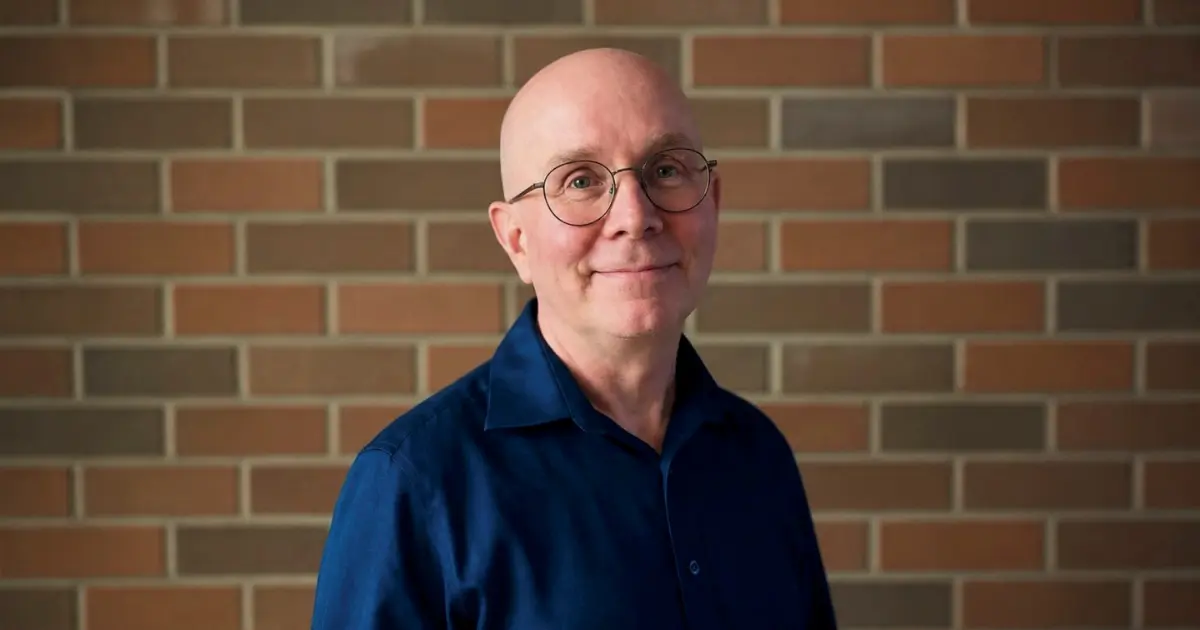
As he prepares to step into his new national leadership role, Rev. Éric Hébert-Daly is already hard at work mapping out the future for the United Church of Canada. Though his official term as general secretary does not begin until January 1, Hébert-Daly has spent the months following his confirmation at a September General Council Executive meeting getting up to speed. Selected after a rigorous seven-month search to succeed the retiring Rev. Michael Blair, Hébert-Daly brings a wealth of diverse leadership experience to the position.
Caught between meetings at a bustling Montreal train station, Hébert-Daly spoke with Broadview editor Janice Young via Zoom about his vision for the denomination, his unconventional path to ministry, and the vital lessons he learned working alongside the late political leader Jack Layton.
Why the General Secretary Role Now?
Reflecting on his motivation for pursuing the demanding national post, Hébert-Daly expressed deep enthusiasm for helping the denomination break away from rigid, traditional routines. He noted that he began to envision what national-scale renewal could look like, and how he might inject a sense of optimism and resilience into the church during a critical transitional period. For Hébert-Daly, this drive stems naturally from a calling he believes is being placed upon the church by God.
This forward-looking perspective heavily informs his overall vision for the denomination. While national polls consistently highlight a widespread spiritual hunger and a growing appetite among Canadians to connect with something larger than themselves, Hébert-Daly acknowledges that the organized church has often struggled to meet that profound need.
Rather than aiming to build massive megachurches, he envisions a more compact denomination that holds a distinct national reputation—recognized even by those who never cross its thresholds as a welcoming sanctuary for deep spiritual exploration, meaningful conversation, and authentic community. In his view, transforming the church into a trusted societal space for connection would be a powerful legacy.
Lessons from Political Leadership
Before answering the call to ministry, Hébert-Daly built a robust career in political and nonprofit leadership. Most notably, he served as the national director of the New Democratic Party (NDP) under the leadership of Jack Layton. Drawing parallels between his past political life and his current ecclesiastical calling, he recalled how political commentators had largely written off the NDP as a spent force when Layton first assumed the party’s leadership.
According to Hébert-Daly, Layton consistently urged his team to focus on the future rather than getting bogged down by past failures or what used to be. As an avid runner, Layton frequently used athletic metaphors, reminding his colleagues that runners do not look backward during a race; instead, they focus entirely on the path ahead and their destination.
Carrying those hard-earned lessons forward, Hébert-Daly rejects the notion that the current decline of the church is a prewritten, inevitable conclusion. Having witnessed organizations and individuals written off before—only to achieve historic breakthroughs—he firmly believes the United Church possesses the capacity to overcome its present challenges.
Fostering Inclusion and Intercultural Connection
As the first francophone general secretary in the history of the denomination, Hébert-Daly’s election marks a significant milestone. However, he remains modest about the impact of a single individual, noting that the historical dominance of the Roman Catholic Church within Canada’s francophone population explains why integrating French-speaking communities into the United Church has taken time.
Addressing broader questions of inclusion regarding francophone, Indigenous, migrant, and diasporic communities, Hébert-Daly emphasizes that ministry must focus on serving the genuine needs of people rather than protecting institutional self-interest. He stresses that intercultural encounters must be deeply transformational rather than superficial.
Reflecting on the relationship with Indigenous communities, he points out that while the church must decisively abandon its historical colonial mindset and respect the independence of distinct paths, true progress also requires meaningful moments of shared fellowship and relationship-building. True transformation, in his view, requires the entire church to change collectively rather than operating in isolated silos.
Navigating Challenges and Embracing Evangelism
Looking at the immediate hurdles facing the general secretary’s office, Hébert-Daly identifies the evolving relationship with the Indigenous church as a vital area of ongoing development. He views the National Indigenous Spiritual Gathering held over the summer as a crucial turning point, offering a mutual opportunity to forge a collaborative path forward.
Internally, he expresses concern over how local congregations view their own ministries, noting that Sunday services can sometimes feel overly administrative, resembling structured meetings with fixed agendas that leave little room for the movement of the Holy Spirit.
Growth, community engagement, and the concept of evangelism represent additional hurdles. Hébert-Daly acknowledges that the word "evangelism" has historically made members of the United Church deeply uncomfortable, largely due to negative associations from past generations. Nevertheless, he argues that if individuals have experienced profound community, prayer, or a connection to the divine, it is a missed opportunity not to share those transformative experiences. He is eager to champion a uniquely United Church approach to sharing faith openly.
Supporting Lay Leadership and Local Ministry
To address the challenges of the present era, Hébert-Daly emphasizes the importance of empowering lay leadership and ensuring that ministry personnel feel adequately supported, inspired, and resilient. Acknowledging that serving as a minister in Canada today is exceptionally difficult, he advocates for a culture of "failing forward"—where congregations are encouraged to try new initiatives, learn from missteps, and persevere.
Drawing from his four years of experience as a regional executive minister working closely with smaller communities of faith, Hébert-Daly finds daily inspiration in rural churches. He admires how rural congregations often maintain porous, welcoming boundaries between the church and the broader local community, proving that a congregation does not need to be a massive urban enterprise to make a profound spiritual impact.
An Unconventional Path to the Pews
Hébert-Daly’s own journey into the United Church informs his deep appreciation for inclusive sacred spaces. Born into a francophone Roman Catholic family, his parents—children of Quebec’s Quiet Revolution—actively discouraged his participation in the church. However, his grandparents ensured his continued connection to the faith by taking him to services.
Over time, he found himself struggling with restrictive Catholic policies regarding the role of women, the treatment of divorced individuals, and the queer community. Discovering the United Church provided him with a spiritual home where he could authenticially embrace his identity while sitting beside others who might hold differing views. In a polarized world defined by shouting matches and ideological division, he sees the church as uniquely positioned to serve as a sacred school for love, understanding, and human connection.