
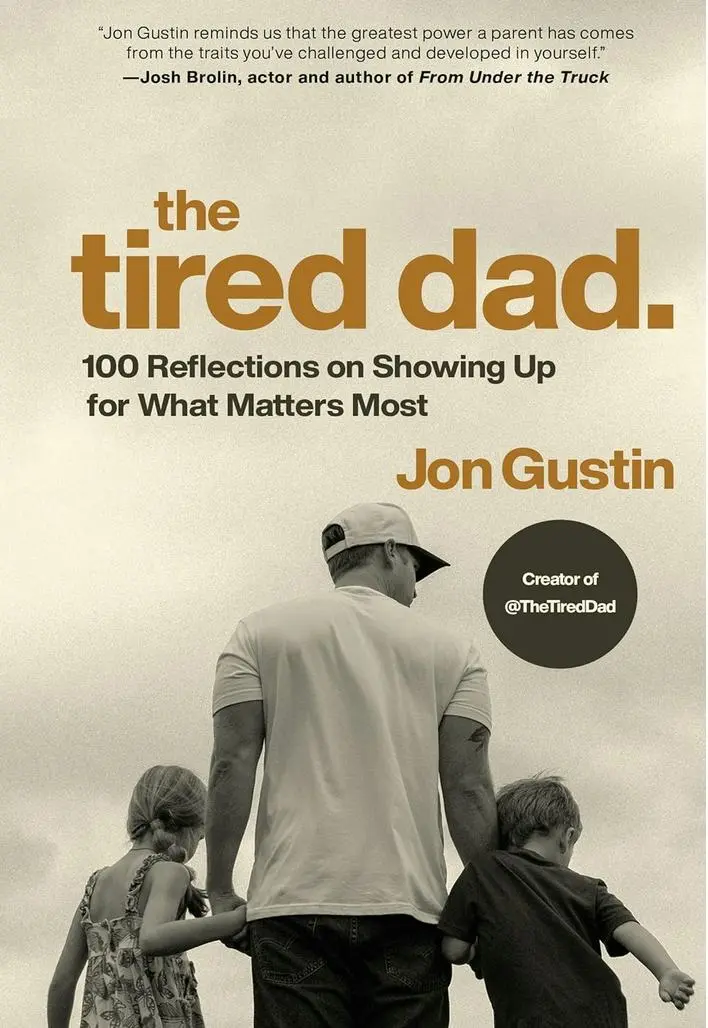
Jon Gustin is tired, but he is certainly not complaining. Better known to hundreds of thousands of followers online as The Tired Dad, Gustin wears his physical and mental fatigue not as a burden, but as a badge of honor. To him, tiredness is proof that a parent is showing up fully in every area of life—balancing the relentless demands of raising children, nurturing a relationship, succeeding at work, and being emotionally present for family. While exhaustion serves as his signature brand, it also functions as a powerful conversation starter, offering a safe avenue to unpack and assess the immense strain that modern family life places on parents.
Gustin’s social media feeds operate almost like sacred spaces. They feature a distinctively melancholy, confessional tone where he shares candid thoughts such as, “I’m constantly thinking about what I’m leaving behind…” It is a familiar sentiment for many adults, yet it remains one that people rarely dare to face head-on. In this sense, The Tired Dad carries an almost dystopian resonance, positioning Gustin akin to the protagonist in Lois Lowry’s The Giver, acting as a receiver of memory who absorbs the unspoken pains of society. Yet, out of that emotional darkness, Gustin frequently pivots into the role of a motivational speaker, coach, and teacher. By confronting the darkness directly, he uncovers the light, typically concluding his posts with a grounding mantra like, “Keep showing up.”
Now, Gustin has translated his viral social media philosophy into a newly published book, The Tired Dad: 100 Reflections on Showing Up for What Matters Most. Inside the pages of the book, readers will find fully fleshed-out contemplations, personal histories, and a wealth of candid advice addressing manhood, sobriety, marriage, fatherhood, and the transformative power of vulnerability.
Just a week out from his official book release, Gustin sat down for an interview. Eschewing the high-octane promotional energy often expected from internet influencers, he approached the conversation with a signature sincerity that quickly revealed itself to be an intrinsic part of his daily practice. “Vulnerability is freedom,” Gustin noted early in the discussion. “And not only is it freedom for yourself to be vulnerable, but it’s freedom for other people because they feel less alone.”
Reflecting on his own upbringing, Gustin opened up about his father, who entered the United States Marine Corps at the age of 17 after his parents signed for him. By 18, his father was deployed to Vietnam, spending over two years in the thick of the conflict—a reality Gustin still finds difficult to fully comprehend. The primary lesson imparted by his father was character, a value passed down from Gustin’s grandfather, who served in the Navy during World War II. Coming from a structured military background defined by men who rarely displayed outward emotion, Gustin recalls seeing his father cry only about five times in his life, with three of those instances occurring in just the past couple of years.
Instead of emotional displays, his father taught through steadfast action, emphasizing that true character means always doing the right thing even when no one is looking. If his father promised to play catch or attend an event, he invariably made it happen.
That legacy of quiet strength extended to Gustin’s grandfather, whom he held in great esteem. While writing his new book, Gustin’s grandfather passed away at the age of 99, prompting a deeply reflective passage in the text. In his later years, his grandfather dropped his emotional shields entirely, becoming increasingly expressive and unfiltered in his affection, especially when speaking of his enduring love story with Gustin’s grandmother. Described as a man of immense wisdom who consumed the daily newspaper and read up to two books a day, his grandfather cared little for material possessions, focusing entirely on the core question of personal integrity: who a person is as a man at their foundational level. Belonging to a different generation that did not openly display exuberant emotion, his grandfather expressed his kindness through actions, such as traveling the country in a retirement motor home to visit descendants and donating so much of his income to charitable causes that government tax agencies routinely audited him out of disbelief.
Addressing the broader societal issue of paternal absenteeism, Gustin acknowledges that fathers play a vital and irreplaceable role in the family dynamic. However, he also points to friends who endured terrible relationships with their absent fathers, using that painful void as profound motivation to break generational curses. Rather than repeating history, these men have resolved to show up fully for their own families, acting as the catalyst for generational healing. Although Gustin admits he still views calling himself a role model with a degree of hesitation—noting his own imperfections and early mistakes—he embraces the responsibility.
That commitment ties directly back to his core philosophy that vulnerability grants freedom. When individuals express their struggles openly, other parents realize they are not alone or losing their minds. The ultimate goal, according to Gustin, is not to have life completely figured out, but to remain on a lifelong journey of personal progression, leading with wisdom and intentionality to model resilience for children and peers alike.
This emphasis on openness naturally prompts questions regarding modern stoicism, a philosophy historically associated with traditional masculinity and the suppression of emotion. While stoicism has often been criticized for fostering emotional repression, it has recently experienced a resurgence among individuals searching for perseverance and resilience. Discussing the topic following conversations with modern stoicism writers like Ryan Holiday, Gustin admits he once viewed stoicism as an overly rigid, hyper-masculine framework resembling unfeeling statues chipping away at life. However, he has since come to recognize that genuine stoicism allows room for vulnerability and acknowledging defeat. Men frequently feel pressured to have all the answers, fearing that admitting uncertainty makes them weak or unintelligent, yet true strength can lie simply in admitting ignorance.
At the same time, Gustin cautions against the extreme interpretations of stoicism, noting that adopting a perpetual wartime mentality—such as the ancient Roman practice of envisioning death daily—can become unhealthy. Rather than dwelling on mortality constantly, he prefers to plan for a long future while living deliberately in the present, warning against the human tendency to seek rigid, black-and-white answers where none exist. While many men gravitate toward identity labels like warrior, Spartan, or stoic through pursuits like martial arts or cold plunges—activities Gustin himself engages in—he stresses that these practices should not mask underlying insecurities or the ego.
Expanding on the theme of extreme identities, Gustin addressed the darker corners of the modern "manosphere," arguing that its culture is fundamentally birthed from insecurity and a lack of authentic identity. Drawing from his own early twenties, when he gravitated toward egotistical notions of manhood before recognizing the red flags of overcompensation, he warns how impressionable young men fall prey to loud, hyper-masculine facades. Whether seeking power through wealth or viewing women as inferior, these behaviors stem from a profound internal weakness. Over the span of two decades, Gustin’s personal values shifted dramatically; he now views time as the ultimate currency, recognizing that an obsession with material status, luxury cars, or endless validation ultimately leads to emptiness rather than fulfillment.
Despite sharing extensive advice, Gustin firmly rejects the title of expert in parenting, masculinity, or relationships. Embracing the label of an expert, he notes, implies reaching a final destination, whereas life requires continuous learning, reading, and personal adaptation.
Focusing on the unique pressures placed on marriages after children enter the picture, Gustin emphasizes that effective communication and the eradication of the ego are paramount. Ego serves no productive purpose in a partnership; instead of trying to fix a spouse, individuals must focus on improving themselves. By eliminating defensiveness and approaching problems as a team rather than competitors, couples can navigate conflicts constructively.
Finally, while Gustin observes more fathers participating in public parenting spaces like playgrounds, he believes cultural expectations still have a long way to go. He challenges men to abandon the outdated mindset that their exclusive familial contribution is financial provision, urging them to view fatherhood as their most critical responsibility. Reflecting on his own experience raising children far from extended family support alongside his wife, Gustin acknowledges the exhaustion of playing an endless tag-team routine without a traditional village. Yet, looking back, he sees those draining mornings and domestic responsibilities as a profound blessing that forged deep, lifelong memories with his kids. For Gustin, dropping client calls to care for a sick child encapsulates the true badge of honor of a tired dad: showing up completely until the day is done.