
The stock market has a persistent habit of surprising investors, leaving financial commentators scrambling to dust off familiar phrases about unprecedented valuations. When markets crash, retirement portfolios shrink, triggering immediate anxiety. Yet, even when stocks climb to record heights and valuations reach seemingly dizzying levels, a different kind of worry sets in. Investors begin to wonder if an even larger correction is looming on the horizon, particularly when the current economic boom is fueled by something as high-octane as the ongoing Artificial Intelligence frenzy.
While individuals who have tuned out financial media entirely can blissfully ignore the daily drama, the broader investment community finds itself wrestling with a familiar set of anxieties. Critics worry that while AI is undoubtedly a transformative technological advancement, the surrounding market mania is moving too fast and reaching too far. This has triggered widespread fears of a replay—or an even larger version—of the dot-com bubble collapse from the early 2000s. That particular historical boom helped shape the early career path of financial commentator and early-retirement advocate Mr. Money Mustache, before the subsequent crash nearly derailed his employment and citizenship applications.

Addressing these recurring anxieties has become a focal point for veterans of past market cycles. Recently presenting these insights at the Camp FI Midwest event, and preparing an expanded version for an upcoming appearance at the Bogleheads conference in November, financial commentators are once again fielding questions about how to weather modern market volatility. To understand whether today’s AI-driven market is genuinely unique, it helps to look backward at how past generations of investors processed identical fears.
Will the AI Bubble Ruin Our Retirement?
Reaching milestones like two decades of retirement brings a certain level of comfort with market fluctuations, yet friends and peers often ask how anyone can sleep at night given the state of global affairs. Turn on the news today, and the list of catastrophic worries is seemingly endless: political instability, surging inflation, the towering United States national debt, and international conflicts threatening global stability, all compounded by the looming shadow of the AI bubble.

Yet, this brand of existential dread is hardly new. Looking back twenty years to 2006 reveals a remarkably similar landscape of perceived crises. Back then, investors worried about contentious political leaders, wars in the Middle East, escalating national debt, and inflation. The overvalued stock market of the mid-2000s was fueled by a dangerous housing bubble rather than artificial intelligence, and the dominant fear of job loss centered on corporate outsourcing to India and China rather than automated software. There was even widespread panic over peak oil, with forecasts warning that a dwindling fossil fuel supply would inevitably doom global civilization.
What followed those anxieties in 2006 was the Great Financial Crisis, triggered by irrational exuberance over real estate and a dangerous reliance on leveraged financial instruments. It stands as the largest economic downturn since the Great Depression. Yet, viewed through the lens of a multi-decade timeline, even that monumental crash appears as a temporary dip. A hypothetical investment of one hundred thousand dollars made during that era of peak anxiety would have experienced substantial growth over the subsequent twenty years, weathering both the 2008 crash and the subsequent market disruption during the 2020 pandemic.

Simultaneously, broader global indicators showed remarkable long-term improvement. Extreme poverty rates dropped significantly over a twenty-year span, infant mortality rates were cut in half, and clean energy alternatives expanded dramatically as solar panel manufacturing costs plummeted. The rapid adoption of solar power and electric vehicles demonstrated that human ingenuity consistently addresses resource constraints in ways that doomer forecasts fail to predict.
This historical perspective raises a fundamental question about whether the present moment is truly different. Financial media outlets thrive on generating alarming narratives, consistently overlooking a core economic reality: true prosperity does not originate from abstract financial systems or stock market tickers, which are ultimately just numbers tracked on computers. Genuine prosperity stems directly from human productivity.

Productivity, Prosperity, and the Nature of Fear
The underlying mechanics of capitalist economies are inherently volatile, prone to cyclical booms and sharp corrections. Beneath the churning surface waves of the financial markets, however, real people continue to perform tangible work and develop practical inventions. The financial system itself is a human construct; if existing monetary metrics falter due to widespread panic, society has historically adapted by recalibrating the system and returning to productive labor, much like it did following the disruptions of 2008.
Human productivity remains anchored by continuous technological evolution, driving improvements in living standards and economic growth. However, once a society achieves a baseline level of modern material comfort, human happiness ceases to scale purely with wealth accumulation. First-world populations surpassed those basic material thresholds decades ago, shifting the primary determinants of well-being toward non-financial factors.

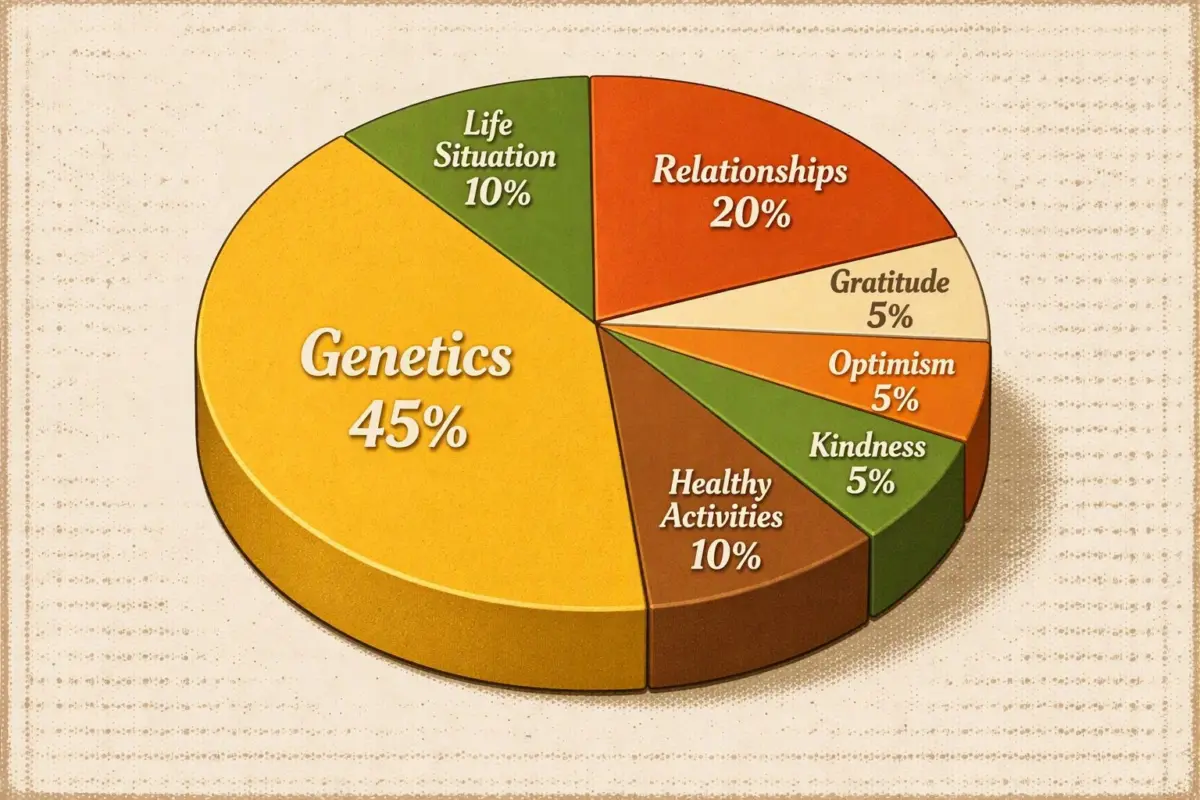
Psychological research suggests that overall life satisfaction is largely influenced by a combination of innate temperament, supportive personal relationships, the practice of gratitude, and maintaining an active, outdoor lifestyle. Despite these well-established principles, many individuals remain consumed by financial anxiety and uncertainty about the future.
The root cause of this persistent dread is human evolutionary biology. Modern humans are, at their core, sophisticated danger-detection machines. This background fear developed as an essential survival trait to protect early humans from environmental threats. However, a distinct glitch in this psychological machinery causes humans to keep searching for things to worry about even after genuine physical dangers have been resolved.

When basic survival needs are met, the human mind pivots to worrying about resource scarcity, social exclusion within a tribe, or abstract financial metrics. In advanced economies, this anxiety eventually manifests in hyper-specific concerns, such as tax optimization strategies, estate planning complexities, or managing government-mandated required minimum distributions on accumulated retirement wealth.
Combatting Fear Through Action and Perspective
Combating this pervasive fear requires deliberate self-awareness and rational evaluation. Understanding personal history—such as growing up in households shaped by the economic scarcity of the Great Depression or dealing with personal trauma—can illuminate why certain financial triggers elicit outsized emotional responses.

Once specific fears are identified, examining the realistic worst-case scenario often reveals that the imagined catastrophe is manageable. Taking direct action is widely recognized as one of the most effective cures for fear, transforming the unfamiliar into the manageable and building personal resilience. Developing cognitive and emotional adaptability ensures that unexpected life changes lose their terrifying edge.
Another vital step in reducing anxiety involves filtering out the constant stream of sensationalized media diets designed to provoke emotional reactions through a daily selection of alarming headlines. Human beings were biologically engineered to solve physical and mental problems actively, ideally in outdoor environments. Spending prolonged hours indoors in sedentary office settings frequently degrades mental well-being, producing stress that cannot be solved by passive media consumption alone.

Aligning daily behaviors with fundamental human needs—such as regular physical movement, continuous learning, and surrounding oneself with optimistic, productive peers—significantly alters an individual’s outlook on the future. Within communities centered around financial independence and intentional living, the focus typically shifts away from fear and toward optimizing quality of life and supporting others.
Adopting an experimental mindset toward major life transitions—whether changing careers, relocating, or stepping away from traditional employment into early retirement—helps reframe uncertainty from a threat into an opportunity for discovery.

The AI Era as a Technological Experiment
Applying this experimental framework to the current artificial intelligence boom transforms a source of widespread anxiety into a subject of profound technological fascination. Rather than yielding to doom-scrolling and ominous media coverage, understanding the underlying drivers of AI reveals its primary function: a highly advanced form of cognitive efficiency enhancement.
Much like past technological revolutions, artificial intelligence will inevitably boost societal productivity while displacing specific job categories, particularly in entry-level administrative, financial, and transportation sectors. Historically, such technological shifts reduce the costs of goods and services while simultaneously spawning entirely new industries, paralleling the economic expansion unleashed by the internet and mobile computing revolutions.

While the financial rewards of these innovations frequently concentrate among technology owners and corporate shareholders—who often include everyday investors holding broad market index funds—the overarching trajectory remains consistent with centuries of industrial progress. Artificial intelligence represents another major technological pivot offering individuals a choice: view the evolution with paralyzing fear, or utilize it as a catalyst for continuous learning, personal adaptation, and a more engaged approach to modern life.