
The stock market continues to astonish observers, regularly defying expectations as it climbs to unprecedented valuations. For many investors, however, these record highs bring a familiar and lingering anxiety. When the market crashes, portfolios shrink and retirement plans are thrown into question. Yet even during periods of historic growth, a sense of unease prevails among market participants who fear that a massive correction is inevitable—particularly when the current economic boom is fueled by the frenzied and rapid expansion of artificial intelligence.
While large segments of the population remain blissfully detached from daily market fluctuations and financial media narratives, those tuned into the financial world are grappling with a familiar dilemma. The prevailing fear is that while artificial intelligence is unquestionably a monumental technological advancement, the current market mania is happening too fast and on too grand a scale. This dynamic has many analysts and everyday investors warning of a potential repetition of the early 2000s dot-com crash on an even larger scale.

For early retirement advocates and veteran financial commentators, this cycle feels deeply familiar. The dot-com boom of the late 1990s helped launch early careers and paved the way for financial independence, even as the subsequent crash nearly derailed employment and immigration aspirations. As questions surrounding the current investment cycle multiply, financial educators and long-term retirees are stepping forward to address the underlying psychology of market panic, offering public talks at gatherings such as Camp FI Midwest and upcoming industry events like the Bogleheads conference.
Will the AI Bubble Ruin Our Retirement?
Achieving long-term financial independence and spending over two decades in retirement brings a certain comfort with market volatility, yet observers frequently encounter deeply anxious inquiries from peers. The core of these conversations often revolves around a simple, pressing sentiment: how anyone can remain retired and sleep soundly at night amid global uncertainty, economic instability, and market turbulence.

A quick scan of modern headlines reveals no shortage of catalysts for concern. News feeds are dominated by geopolitical tensions involving prominent global leaders, persistent inflation eroding purchasing power, escalating national debt levels, and simmering international conflicts threatening broader stability. Yet when similar anxieties were examined two decades ago, the specific actors and economic drivers were different, though the underlying emotional response remained remarkably consistent.
Back in 2006, investors and the general public were grappling with their own set of existential worries. The geopolitical landscape featured different leaders and conflicts in the Middle East. Concerns over national debt, inflation, and an overvalued stock market were just as prevalent then as they are today. However, the focal point of real estate anxiety was the housing bubble rather than an artificial intelligence bubble, and fears of job displacement centered on international outsourcing rather than automated software. There was even widespread panic over peak oil, with prevailing theories predicting that fossil fuel consumption would inevitably outstrip supply and lead to global economic collapse—an outcome that ultimately reversed as technological innovations unlocked new energy sources.

Looking back across the subsequent twenty years reveals a striking reality about long-term market performance. Despite the unprecedented shock of the Great Financial Crisis—triggered by irrational exuberance in the housing market and excessive financial leverage—and the subsequent market disruptions during the COVID-19 pandemic in 2020, historical charts demonstrate the remarkable resilience of broad market indexes. A baseline investment made during the peak anxiety of 2006 would have experienced substantial growth over the next two decades, absorbing major crises along the way.
Beyond financial portfolios, broader global metrics over the past twenty years also reflect profound structural improvements. The proportion of the global population living in extreme poverty dropped significantly from roughly twenty percent to single digits over a twenty-year span. Childhood mortality rates were cut in half, while clean energy adoption accelerated dramatically as solar panel manufacturing costs plummeted, allowing solar generation to become a dominant source of new electrical capacity worldwide. Meanwhile, electric vehicle adoption surged from negligible levels to a substantial fraction of global auto sales.

Prosperity, Productivity, and the Nature of Fear
This historical perspective raises a fundamental question: whether current anxieties are genuinely different this time around. Skeptics point to towering national debt levels, the unprecedented valuation multiples of tech giants, or theoretical risks associated with autonomous artificial intelligence. Financial media outlets regularly amplify these fears, but they frequently overlook a core economic principle: true societal prosperity is fundamentally rooted in productivity rather than financial market sentiment.
Economic systems and stock markets are fundamentally human constructs—numerical representations of underlying commercial activity. If a financial system faces a severe correction, history demonstrates that societies adapt, restructure, and continue working. The underlying tools that drive economic growth, standard of living, and the capacity for early retirement—namely, human productivity, ingenuity, and technological innovation—remain intact regardless of short-term market fluctuations.

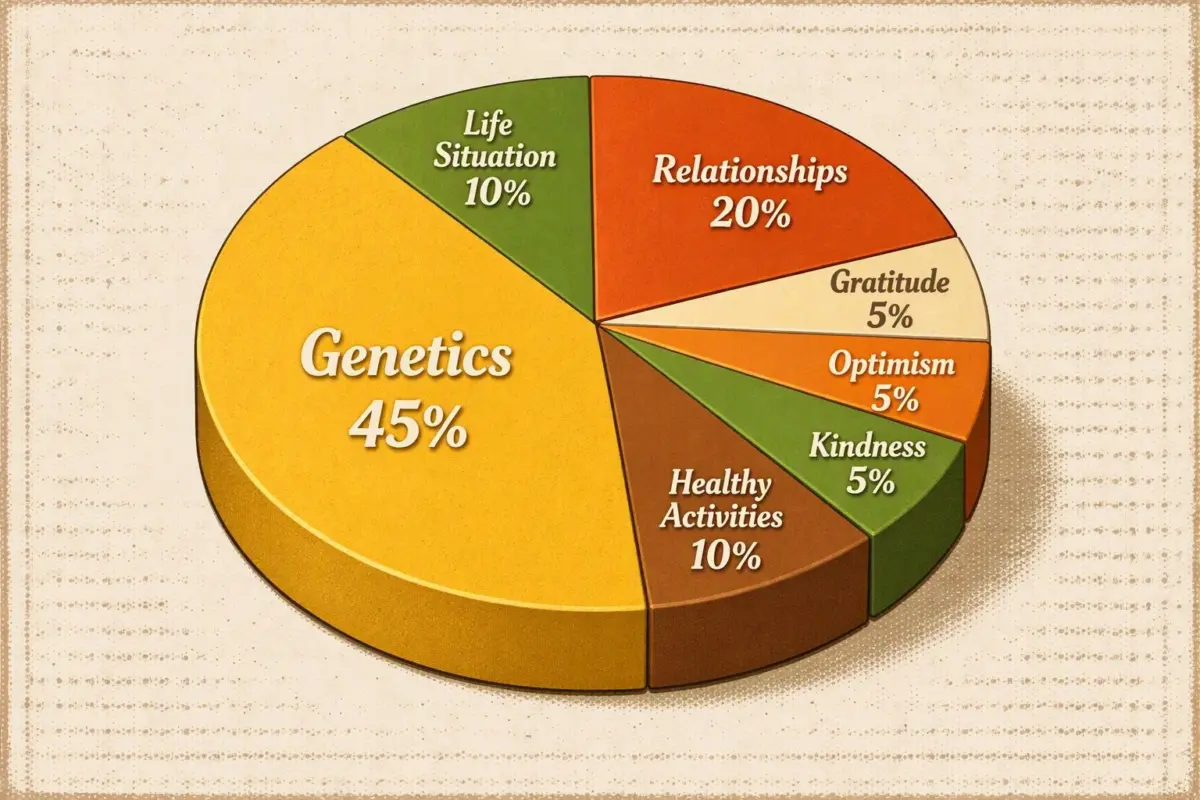
Furthermore, once a society achieves a baseline level of material prosperity, additional wealth ceases to be the primary driver of human happiness. Psychological research and long-term studies indicate that human well-being is largely influenced by factors well beyond financial portfolios, including genetics, strong personal relationships, lifelong optimism, and healthy physical routines.
Despite these reassuring realities, background anxiety persists among investors. This phenomenon is deeply rooted in human evolution. Humans functioned historically as danger-detection machines, developing a pervasive background vigilance to protect against predators, disease, and scarcity. When modern society successfully mitigates these fundamental survival threats, the human brain does not simply turn off its detection machinery; instead, it moves the goalposts.

Once physical survival and basic food security are achieved, anxiety shifts toward social standing, peer comparison, and eventually abstract financial milestones. Individuals who attain comfortable upper-middle-class stability often pivot their worry toward tax strategies, estate planning, or regulatory requirements like required minimum distributions, occasionally experiencing genuine distress over having accumulated too much wealth for government comfort.
Combating Fear Through Awareness and Action
Overcoming this pervasive cycle of fear requires active self-awareness and a rational approach to personal history and emotional triggers. Financial anxiety often stems from childhood experiences, family narratives surrounding scarcity shaped by historical events like the Great Depression, or personal trauma. Recognizing that these fears are frequently echoes of the past rather than objective assessments of the present is a vital first step toward emotional resilience.

Identifying specific worst-case scenarios through methodical financial planning helps demystify the unknown. When individuals analyze what would actually happen if their financial projections fell short, they typically discover that the worst-case outcomes are far more manageable than anticipated. Taking direct, proactive measures in daily life helps transform the unfamiliar into the familiar, fostering a deep sense of personal resilience and capability.
For many, shifting away from a constant diet of sensationalized daily news is an essential component of mental health. Modern media ecosystems rely on amplifying the most alarming stories to capture attention, which can distort perceptions of risk. True progress is driven not by consuming pessimistic news cycles, but by constructive personal behaviors, physical engagement with the physical world, and surrounding oneself with optimistic, forward-thinking peers within supportive communities.

Adopting an experimental mindset toward life transitions—whether changing careers, relocating, or entering early retirement—allows individuals to view uncertainty as a source of curiosity rather than a threat.
The Artificial Intelligence Era as a Technological Experiment
This experimental perspective applies directly to the current artificial intelligence boom, which has captured the public imagination and sparked widespread apprehension. Rather than surrendering to doom-scrolling and pessimistic prognostications, examining the underlying technology reveals a familiar pattern of industrial evolution.

Artificial intelligence functions fundamentally as a sophisticated cognitive tool designed to enhance human efficiency. Much like historical productivity breakthroughs, it streamlines workflows, reduces friction in complex tasks, and drives economic productivity. While it inevitably disrupts specific job sectors—particularly entry-level administrative, financial, and technical roles—technological revolutions have historically displaced certain occupations while simultaneously lowering consumer costs and catalyzing entirely new industries, mirroring the transformative impact of the internet and mobile computing.
The concentration of wealth generated by these technological shifts often benefits capital owners and shareholders, including everyday retirement investors who hold broad-market index funds. Ultimately, artificial intelligence represents another major technological transition, offering individuals an opportunity to choose between fear-driven paralysis and proactive engagement. By addressing the root causes of anxiety and focusing on learning, adaptability, and human connection, individuals can navigate market volatility and technological change while pursuing a balanced and fulfilling life.