
The stock market has an enduring habit of surprising even the most seasoned observers. Over decades of financial evolution, market indices continue to scale unprecedented heights, regularly defying expectations and setting new records. Yet, this persistent upward trajectory often breeds a distinct brand of anxiety among investors. When markets crash, retirement portfolios shrink, triggering immediate panic. Conversely, when valuations soar to stratospheric levels, a different kind of worry takes root—the lingering dread that an even larger and more destructive crash is just around the corner, particularly when the current bull market is fueled by the frenzied excitement surrounding artificial intelligence.
For those who have tuned out the daily financial drama to focus on everyday life, this cautious detachment remains a wise strategy. However, understanding the current economic landscape requires context. Investors across the globe are growing increasingly nervous, worrying that while artificial intelligence is undoubtedly a monumental technological advancement, the surrounding market mania is moving far too fast and too aggressively. This dynamic sparks uncomfortable comparisons to the dot-com bubble of the early 2000s—a historic market boom that coincidentally launched the early career and financial independence journey of prominent online financial commentator Mr. Money Mustache, before the subsequent crash nearly derailed his employment and citizenship application.

As a veteran figure in the financial independence space, he frequently fields questions regarding this current investment cycle, mirroring inquiries from past booms and busts. To address these widespread concerns head-on, he developed a dedicated presentation titled "Will the AI Bubble Ruin our Retirement?", which premiered at the Camp FI Midwest event and is slated for an expanded presentation at the upcoming Bogleheads conference in November. This ongoing conversation highlights a timeless human dilemma: how to maintain financial peace of mind amid relentless economic uncertainty.
Putting Modern Market Anxieties Into Historical Perspective
Reaching over two decades of retirement provides a unique vantage point on market volatility. Yet, even those comfortable with long-term financial independence occasionally encounter questions that highlight pervasive societal anxieties. Friends and observers frequently ask how anyone can remain retired and sleep soundly at night given the state of the world, assuming that an endless list of global crises should keep retirees awake.

A comprehensive list of modern worries typically includes volatile political figures menacing the global stage, persistent inflation eroding household purchasing power, the looming artificial intelligence bubble, soaring national debt levels, and ongoing geopolitical conflicts in the Middle East and Eastern Europe that threaten wider escalation. Yet, these contemporary anxieties mirror remarkably familiar refrains from decades past.
Reflecting on the year 2006, the prevailing worries of the era included entirely different headlines, yet remarkably similar themes. Back then, society wrestled with controversial political leaders, ongoing Middle Eastern conflicts, ballooning national debt, and stubborn inflation. The stock market was similarly viewed with suspicion, though the primary culprit was a swelling housing bubble rather than an artificial intelligence craze. Instead of fears regarding artificial intelligence displacing modern workers, the prevailing anxiety centered on white-collar jobs being outsourced overseas to India and China. Furthermore, intense public debates raged over "Peak Oil," with dire predictions that escalating fossil fuel demand would inevitably outstrip dwindling global supplies—an outcome that ultimately reversed course entirely.

Following the heavy anxiety of 2006, the global financial system did indeed experience the Great Financial Crisis, driven by irrational exuberance in housing prices and excessive financial leverage. It was widely recorded as the most severe economic downturn since the Great Depression. Yet, when viewed through the lens of a long-term multi-decade chart, even that historic crisis represents a relatively minor dip in an otherwise massive upward trajectory. A standard long-term investment grew exponentially despite intervening downturns, including the economic disruption caused by the COVID-19 pandemic in 2020.
Beyond financial markets, the broader world experienced substantial improvements over the same twenty-year span. The global proportion of people living in extreme poverty dropped dramatically from approximately twenty percent in 2005 down to single digits in subsequent decades. Global infant mortality rates were cut in half. Meanwhile, clean energy emerged as a dominant economic force, driven by solar panels becoming significantly cheaper and cleaner. Solar generation now accounts for the vast majority of all new electrical capacity added globally, while sales of pure electric vehicles have surged from near-zero to substantial market shares worldwide.

Understanding the True Source of Prosperity
These historical realities raise a fundamental question: does focusing energy on an uncertain future yield better results than maintaining long-term optimism? Skeptics frequently ask whether the current environment is fundamentally different—whether the U.S. national debt has finally grown large enough to destabilize the economy, or if the artificial intelligence boom will fail to rebound following a future market correction.
Financial media outlets thrive on generating compelling narratives of impending doom, yet these pessimistic forecasts routinely overlook a core economic truth: true prosperity does not originate from the financial system or the stock market, which fundamentally represent quantifiable representations tracked on computer servers. Genuine prosperity is rooted directly in productivity.

The core principle remains straightforward—capitalism is inherently volatile and prone to wild cyclical swings, but beneath the turbulent surface, real people engage in meaningful work, drive innovation, and invent new technologies. The concept of an economy or a financial system is ultimately another human-made construct. If financial systems experience severe corrections due to shifting mathematical valuations, societies routinely adapt, establish new baselines, and resume productive labor, exactly as occurred following the 2008 financial crisis and numerous historical downturns.
Every productivity-enhancing tool humanity has ever invented remains intact. Standard living conditions, economic growth, and the feasibility of early retirement are all direct products of high productivity. Furthermore, once societies achieve a baseline standard of living, human happiness tends to plateau along that specific financial dimension. Developed nations surpassed those baseline requirements decades ago, shifting the focus of well-being toward non-financial factors designed to maximize overall life satisfaction.

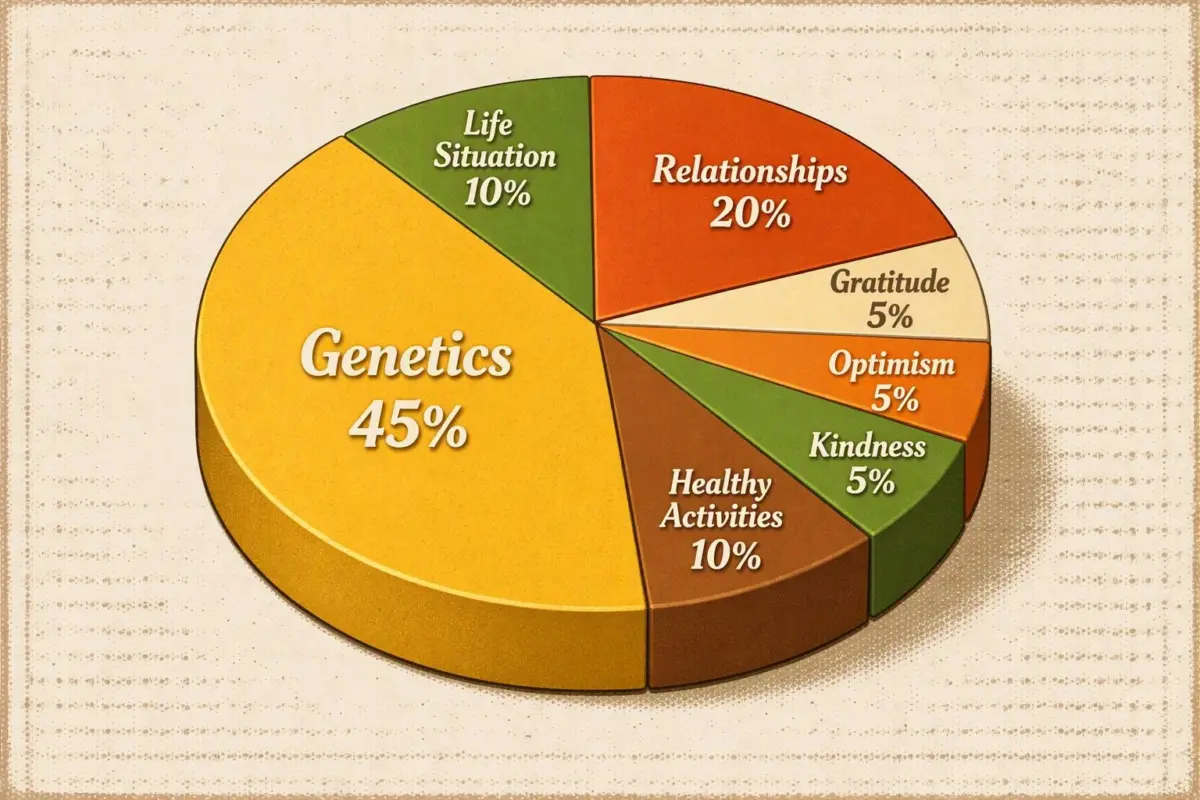
Scientific research into human happiness consistently points to a mix of internal and external factors. While genetic predispositions play a major role in baseline temperament, individuals retain significant control over their choices. Cultivating strong personal relationships, practicing gratitude, maintaining an optimistic outlook, and incorporating regular outdoor physical activity into daily routines consistently rank among the most effective drivers of long-term personal fulfillment.
Confronting Fear and Managing Uncertainty
Despite the accessibility of these foundational principles, persistent anxiety remains common, even among those committed to financial independence. The root cause frequently traces back to the evolutionary wiring of human beings as sophisticated danger-detection machines. This background fear served an essential historical purpose in protecting early humans from external threats. However, a distinct behavioral quirk emerges when physical dangers recede—human psychology continues actively searching for new sources of worry, effectively shifting the goalposts of anxiety.

Once immediate physical survival needs, food security, and shelter are securely established, anxiety often pivots toward social belonging, adherence to community norms, and refined financial worries. These concerns can range from complex tax strategies and investment preservation rules to entirely mundane neighborhood matters. Yet, individuals retain the capacity to push back against irrational fear through self-awareness and rational thought.
Understanding personal history represents a critical first step in neutralizing chronic anxiety. Preexisting financial fears often originate from childhood environments, family scarcity mindsets, or historical generational trauma passed down from families who lived through severe economic depressions. Acknowledging that these feelings stem from past experiences rather than an objective evaluation of the present moment helps clarify current realities.

Identifying the specific nature of a feared scenario through detailed analysis frequently reveals that worst-case outcomes are far less catastrophic than initially imagined. Taking deliberate action serves as an effective antidote to fear, transforming the unfamiliar into the manageable and building personal resilience. When individuals develop the mental, physical, and emotional adaptability to navigate unexpected situations, systemic fear naturally diminishes.
Consciously curating one’s mental diet by limiting exposure to sensationalized daily news streams further reduces unnecessary background stress. Because human beings are biologically wired to solve practical problems using both physical and mental capabilities, spending excessive time in isolated indoor environments naturally introduces mental health strains. Shifting focus toward active learning, physical movement, and engaging with optimistic, productive communities helps restore a sense of balance.

Viewing Artificial Intelligence Through the Lens of Experimentation
Adopting an experimental mindset toward major life changes—whether shifting careers, relocating, or navigating new economic eras—transforms potential anxiety into intellectual curiosity. Rather than succumbing to doom-scrolling and pessimistic headlines regarding artificial intelligence, examining the underlying technology reveals both potential risks and substantial upside.
Artificial intelligence functions fundamentally as a powerful cognitive tool designed to amplify human efficiency. By boosting overall efficiency, it drives productivity gains that ultimately translate into broader economic prosperity. Like any major technological revolution—including the rise of the internet and the widespread adoption of smartphones—automation inevitably displaces specific entry-level administrative and operational roles, prompting structural shifts in the labor market. Concurrently, it reduces service costs and catalyzes the creation of entirely new industries and economic opportunities.

While productivity rewards tend to concentrate among system owners and corporate shareholders—who often include everyday investors holding broad market index funds—artificial intelligence ultimately represents another technological pivot point. It offers individuals an explicit choice: to view emerging innovations with paralyzing fear or to utilize them as a catalyst for continuous learning, positive adaptation, and a more engaged, intentional life.