

The global financial world has undergone a profound shift. After roughly fourteen years of remarkably stable, near-zero borrowing costs that persisted since before 2011, central banks have dramatically altered course, pushing interest rates to 20-year highs. This sudden pivot has left consumers, investors, and policymakers grappling with a fundamentally different economic environment.
While financial news outlets have meticulously chronicled every incremental rate hike by the Federal Reserve, much of the public discourse has missed the most critical practical question: With borrowing costs significantly higher, what should everyday individuals actually do about it? Examining the underlying mechanics of this shift offers valuable perspective on strategy, investments, and the housing market.

Why Is This Happening, and What Got Us Here?
To understand the current economic climate, it helps to view interest rates as a massive gas pedal controlling the speed of the economy, with Federal Reserve Chairman Jerome Powell at the wheel. For the better part of two decades, the central bank kept that pedal pressed firmly to the floor, injecting an ongoing stream of easy money into the system through near-zero benchmark rates.
This policy made mortgages exceptionally affordable, fueling high demand for both existing homes and new construction. It similarly catalyzed business investment; with venture capital and borrowed money readily available and inexpensive, entrepreneurs founded countless new companies. These enterprises rented office space, constructed facilities, and hired workers, who in turn purchased homes, vehicles, and the everyday goods that drive a robust consumer economy.
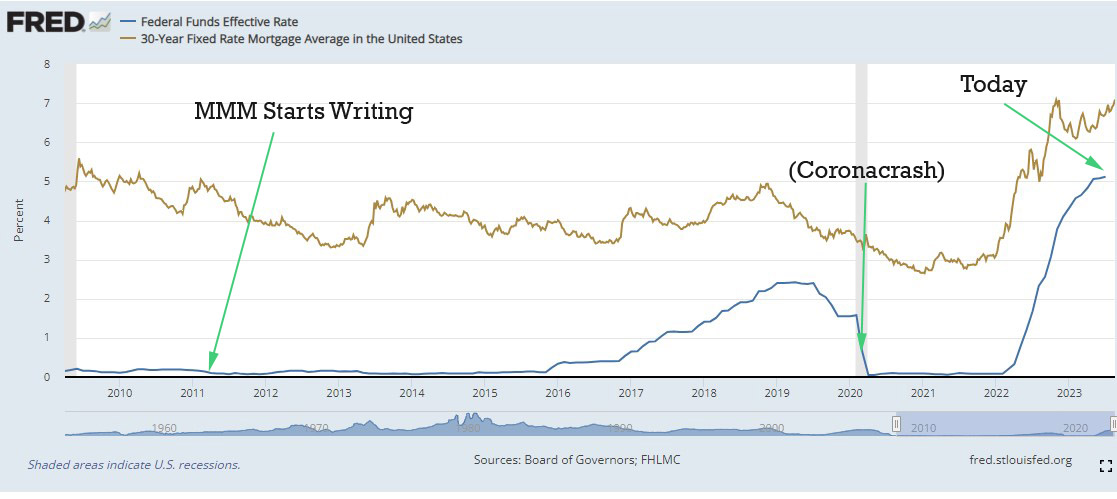
This extended period of loose monetary policy underpinned two decades of broad economic growth, technological innovation, and general prosperity. However, the prolonged party eventually pushed demand beyond productive capacity, resulting in too much money chasing too few goods—particularly housing. This imbalance drove a surge in inflation, prompting the Federal Reserve to ease its foot off the monetary gas pedal.
As interest rates climbed, economic activity naturally began to decelerate. Mortgages grew considerably more expensive, leading prospective homebuyers to delay their purchases. Corporations faced with higher costs for debt financing scaled back factory expansions and slowed hiring, resulting in significant corporate layoffs across major technology firms like Meta and Amazon. The financial sector also experienced a minor banking crisis as several mid-sized institutions folded, briefly stoking fears of broader systemic contagion.

Public discourse surrounding these shifts often paints a bleak picture, with various political and ideological factions labeling the current climate as a period of severe economic hardship. Yet, this narrative stands in stark contrast to broader economic indicators, such as unemployment rates dropping to 50-year lows. In reality, the current cooling period functions as a natural mechanism to stabilize an economy that rapidly absorbed a massive influx of liquidity. Such adjustments occur periodically and represent a standard economic cycle rather than a structural crisis.
Evaluating Stock Market Strategy Amid Higher Rates
A primary concern for retail investors is whether to exit the stock market ahead of a potential crash. Historical precedent suggests a clear answer: abandoning equity investments entirely due to near-term volatility rarely serves long-term financial health. The stock market has consistently trended upward over extended horizons, punctuated by unpredictable corrections that are virtually impossible to time successfully.

Market performance over the two-year period following the initial rate hikes reflected this tension. After peaking at the start of 2022, the broader U.S. stock market experienced a modest contraction, remaining relatively flat when accounting for total dividends. For long-term investors utilizing systematic purchasing strategies, lower asset prices effectively represent a discount on equity index funds compared to previous market peaks.
At the same time, the emergence of high-yield savings accounts and money market funds paying upwards of four to five percent introduces a new consideration for cash allocation. In an era of sub-one-percent interest rates, keeping large sums in cash was mathematically suboptimal. However, as risk-free yields rise, savers must weigh guaranteed short-term returns against the long-term compounding potential of equities, particularly when the stock market itself is trading at a discount. Maintaining a balanced approach allows investors to capture reasonable yields on cash reserves while continuing to accumulate equity shares at attractive valuations.

The Impact on the Housing Market
The sector most acutely impacted by rising interest rates is real estate. Financing a home purchase through a mortgage has become significantly more expensive, rental property investments yield lower profit margins, and homeowners with locked-in low mortgage rates face a strong disincentive to sell. As benchmark interest rates climbed from roughly three percent to over seven percent, the mathematics of homeownership shifted dramatically for average buyers making standard down payments.
While higher borrowing costs present immediate hurdles for buyers, they fulfill their intended economic purpose by cooling overheated demand. The broader mechanism of tighter monetary policy is designed to halt runaway price appreciation, curb excessive speculative construction, and stabilize the broader real estate market. Over time, these pressures are expected to moderate home prices in many regions, even if the adjustment manifests as a prolonged period of flat valuations rather than a sharp price correction.
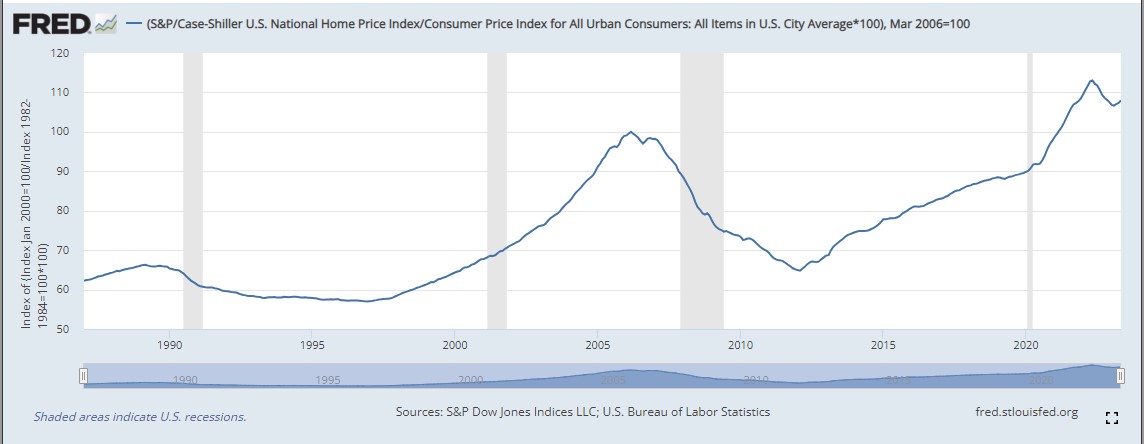
Long-term housing fundamentals ultimately rely on supply and demand, which are influenced by construction costs and regulatory environments. Technological advancements and global trade have historically helped lower the cost of building materials and components, making certain aspects of construction more efficient. Conversely, regulatory hurdles, complex zoning laws, and local restrictions have introduced significant friction into the development process, constraining housing supply and keeping baseline prices elevated in many metropolitan areas.
When Will Interest Rates and House Prices Shift?
Despite being characterized as high, current interest rates are largely in line with historical averages over the past seventy years. The perception of elevated rates stems primarily from the anomalous decade of near-zero rates that followed the 2008 financial crisis. Consequently, borrowing costs may remain at current levels until economic indicators signal a definitive slowdown.
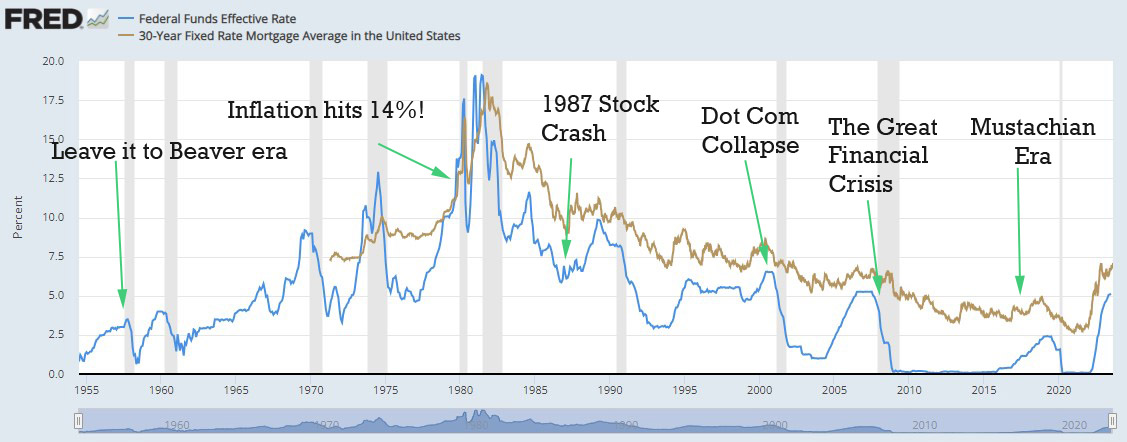
Future rate cuts will likely depend on the central bank responding to cooling inflation and rising unemployment—hallmarks of an incoming economic contraction. This anticipation is reflected in the U.S. Treasury yield curve, which inverted as short-term yields surpassed long-term yields. An inverted yield curve has historically served as a reliable indicator of an impending recession, suggesting that bond market participants expect the central bank to lower rates in the medium term to stimulate a slowing economy.
Ultimately, navigating this financial environment requires focusing on controllable fundamentals rather than macroeconomic speculation. Maintaining personal financial resilience, keeping a lean lifestyle, and holding adequate cash reserves enable individuals to capitalize on market opportunities regardless of prevailing interest rates. By prioritizing long-term habits in earning, saving, and smart housing choices, the broader noise of financial news and shifting interest rate cycles diminishes into manageable background ripples.