
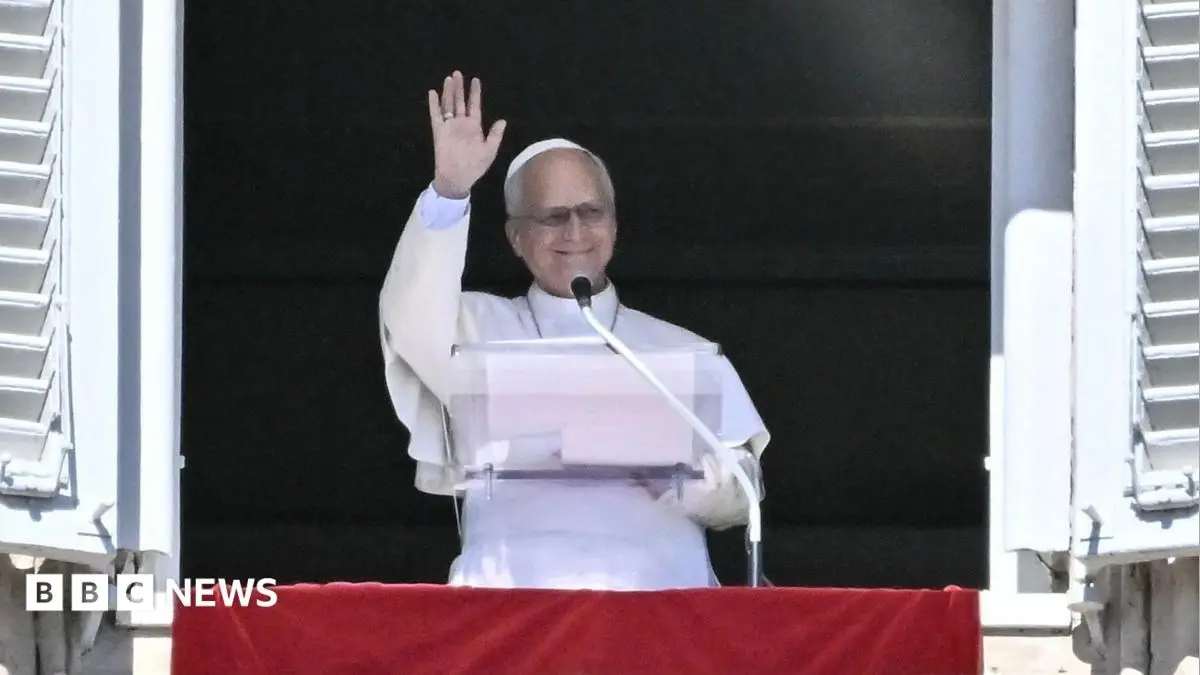
Pope Leo XIV has announced that he will undergo a surgical procedure in the coming days after doctors detected an early-stage, well-localised nodule on his lung during a routine medical examination. The 71-year-old pontiff personally shared the health update with thousands of faithful and pilgrims gathered in St. Peter’s Square in Rome during his traditional weekly Sunday Angelus prayers, offering a calm and reassuring message about his condition while requesting spiritual support from the global Catholic community.
Speaking directly to the crowd assembled beneath the papal apartments, the pontiff explained that recent medical evaluations led to the discovery of the small mass. He noted that his medical team evaluated the findings and advised that a targeted surgical procedure would be the most effective course of action to address the issue swiftly and completely. The Pope confirmed that he had fully agreed with his doctors’ recommendation to proceed with the operation, taking care to alleviate public concern by emphasizing that the growth was caught at an exceptionally early stage and remains strictly confined to a single, localized area.
Addressing the crowd from his window overlooking the square, the Pope emphasized that his medical advisors believe it is right to intervene at this moment to ensure his long-term health and wellbeing. He expressed profound gratitude to the gathered crowd and the broader global church, concluding his Angelus address by thanking everyone for their spiritual closeness and stating that he was entrusting himself fully to the prayers of the faithful as he prepares to enter the hospital.
Following the Pope’s public statement, Holy See Press Office spokesman Matteo Bruni briefed journalists, providing further administrative and clinical details regarding the planned medical intervention. Bruni confirmed that the surgery is scheduled to take place during the first few days of next week. According to the Holy See’s press statement, the pontiff is expected to remain under medical supervision and require approximately one week of post-operative recovery time before resuming his full schedule of public engagements and routine administrative duties at the Vatican.
The surgical procedure will be performed at the Agostino Gemelli University Hospital in Rome, a prominent medical facility with a long-standing history of caring for the leaders of the Roman Catholic Church. According to Vatican News, the official news portal of the Holy See, the Pope will be admitted to the specialized papal suite situated on the hospital’s tenth floor. This dedicated medical suite was originally established following the failed assassination attempt on Pope John Paul II in May 1981, designed specifically to provide maximum security, privacy, and immediate high-level clinical care for the Bishop of Rome. The facility has remained fully operational and equipped over the decades, standing ready whenever a pontiff requires specialized hospital treatment or surgical intervention.
News of the pontiff’s upcoming surgery drew immediate expressions of support, solidarity, and warm wishes from political and religious leaders across Italy and around the world. Italian Prime Minister Giorgia Meloni publicly conveyed her personal solidarity to the Pope, offering her thoughts as he prepares to face the medical ordeal in the coming days. Her sentiments were echoed by Italian President Sergio Mattarella, who offered his sincerest wishes for a peaceful recovery and expressed his hopes for a speedy and complete return to health for the head of the Catholic Church.
International political figures also joined in extending their support to the Holy See. Isaac Herzog, the President of Israel, sent a formal message wishing the pontiff a full and rapid recovery, highlighting the broad global concern and goodwill surrounding the Pope’s health status.
Despite the scheduled surgical procedure and the brief period of convalescence that will follow, the Vatican confirmed that the Pope’s long-term international engagements remain on schedule. During his Sunday address, Pope Leo XIV personally reaffirmed that his major apostolic visit to South America, scheduled for November, will go ahead as planned. The upcoming papal tour will take him to Uruguay, Argentina, and Peru, marking an important chapter in his papacy and a return to a region where he spent many years of his life.
Church officials in South America greeted the news with both prayerful solidarity and renewed commitment to the scheduled travel plans. The Archbishop of Montevideo, Daniel Sturla, responded to the announcement by confirming that preparations for the pontiff’s visit to Uruguay and neighboring nations will continue forward with even greater enthusiasm. Archbishop Sturla called upon clergy and the lay faithful across the region to unite in prayer for the Pope’s swift recovery, expressing full confidence in the pontiff’s health and the upcoming pastoral journey.
Pope Leo XIV, who was born Robert Francis Provost, occupies a historic place in modern Church history as the 267th occupant of the throne of St. Peter. His election brought a landmark moment to the Catholic Church, as he became the first citizen of the United States ever to be chosen to lead the world’s 1.3 billion Catholics. Ordained to the priesthood in 1982, his decades of ministry have been defined by extensive missionary and pastoral work. A significant portion of his priestly ministry was spent in Peru, where he served for many years living and working closely alongside marginalized, low-income, and vulnerable communities. His long tenure in South America earned him widespread respect as a dedicated pastor devoted to social justice, community outreach, and the care of the underprivileged—qualities that continue to shape his pontifical priority
list.
The announcement that the Pope requires surgical intervention comes nearly a year and a half after he succeeded the late Pope Francis. The timing has drawn attention to the physical demands placed upon the papacy, particularly given the medical history of his predecessor. Pope Francis also experienced prominent and recurring health challenges involving his lungs and respiratory system throughout his pontificate, requiring multiple hospitalizations and clinical interventions during his final years in office.
From a clinical standpoint, a lung nodule is defined as a small, rounded growth or lump of tissue within the lung tissue. According to medical guidelines published by healthcare authorities such as the UK’s National Health Service (NHS), lung nodules are frequently detected incidentally when a patient undergoes diagnostic imaging of the chest, such as an X-ray or a high-resolution CT scan, often performed during standard preventative health checks or evaluations for unrelated conditions.
Most lung nodules are relatively small and localized, rarely causing noticeable physical symptoms like coughing, shortness of breath, or chest pain in their early stages. Because they are often asymptomatic, routine medical monitoring and advanced diagnostic imaging play a crucial role in identifying them early. When a nodule is identified as well-localised and caught at an early stage, doctors frequently recommend surgical removal or targeted intervention as a proactive measures to prevent future complications and to allow for precise diagnostic assessment of the tissue.
As the Vatican prepares for the pontiff’s hospital admission early next week, the mood in St. Peter’s Square remains one of calm optimism. The Holy See Press Office indicated that further official updates regarding the Pope’s medical status, the progress of the procedure at Gemelli Hospital, and his post-operative recovery schedule will be provided through standard press channels once the surgery has taken place. In the meantime, religious communities worldwide have answered the Pope’s call, joining together in prayer for his successful surgery and a swift return to his apostolic duties.