
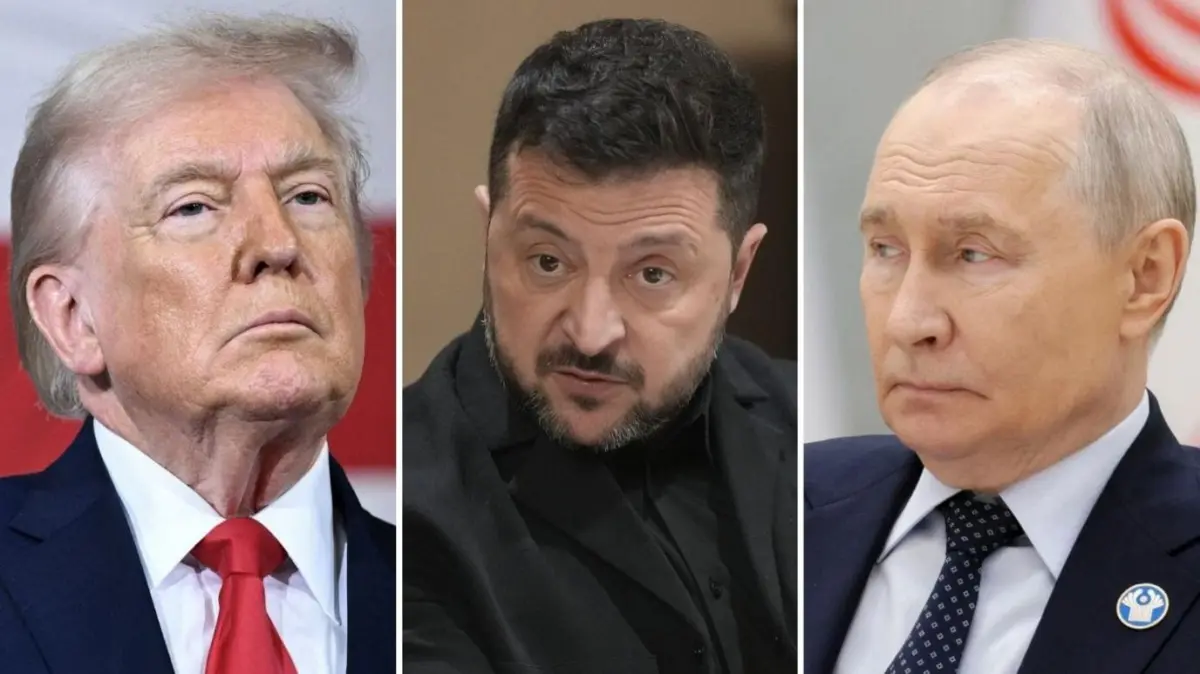
US President Donald Trump has asserted that Russia and Ukraine have agreed to an immediate "energy ceasefire," claiming that a temporary truce targeting power and oil infrastructure is now active. However, the announcement has been met with immediate skepticism, silence from Moscow, continued military strikes on the ground, and fierce pushback from domestic lawmakers and international allies over an underlying trade deal with Russia.
While Ukrainian President Volodymyr Zelensky stated that Kyiv would be willing to abide by an energy truce if Moscow genuinely agreed to one, he expressed initial surprise at Trump’s declaration, noting that he had not been informed beforehand. Furthermore, within hours of the announcement, Russian forces launched fresh strikes against critical Ukrainian energy facilities, casting immediate doubt on whether any operational understanding exists between the warring nations.
The development comes amidst escalating diplomatic tension between Washington and Kyiv over a recent US-Russia diesel arrangement. President Trump has been actively pressuring Ukraine to halt its long-range attacks on Russian energy targets—attacks Kyiv considers crucial to cutting off Moscow’s military funding—in order to allow Russia to export fuel to global markets under a temporary US sanctions waiver.
Unilateral Declaration and Escalating Ground Attacks
President Trump declared that the energy truce was "effective immediately," though the White House provided no official framework, operational parameters, or implementation details regarding how the agreement was reached or how it would be monitored. When asked for clarification on the mechanics of the claimed arrangement or the nature of US-Russia negotiations, the administration did not immediately provide additional specifics.
In an interview with news outlet Axios, President Zelensky admitted that Trump’s announcement came as a complete surprise, stating that the concept of an active energy truce was entirely "news" to him. Writing on social media shortly thereafter, Zelensky clarified Ukraine’s position, indicating that while Kyiv had not initiated a bilateral agreement, it remained open to the concept provided Russia ceased its own systematic attacks on Ukrainian power infrastructure.
"Ukraine is ready not to strike at Russian energy and we count on Russia’s similar readiness and on the agreement of the president of the United States of America on this," Zelensky stated, adding that Ukrainian officials "look forward to clear details of America’s dialogue with Russia."
However, any expectation of an immediate cessation of hostilities against energy infrastructure was swiftly undermined by actions on the battlefield. Shortly after Trump’s public statement, Russian forces launched a series of aerial strikes targeting Ukrainian energy assets. According to Zelensky, a Russian drone strike hit a major power plant in Kyiv, resulting in localized power outages, while additional Russian strikes targeted critical energy infrastructure in the north-eastern Kharkiv region.
"All of this happened after the president of the United States made his statement about an energy ceasefire," Zelensky observed, highlighting the stark disconnect between Washington’s public claims and conditions on the ground.
The Controversial US-Russia Diesel Accord
At the center of the diplomatic friction is a controversial arrangement orchestrated by the Trump administration to import Russian diesel fuel into the United States and global markets. Under the terms of the deal, the US has temporarily lifted certain sanctions on Russian oil products, allowing Moscow to supply diesel in an effort to stabilize global energy supplies.

The administration’s primary motivation stems from mounting domestic economic and political pressures in the United States. President Trump has spent months navigating the political fallout from rising pump prices and broader, across-the-board inflation, which has severely impacted American consumers and diminished his standing with the public ahead of the upcoming US midterm elections. The economic strain has been further exacerbated by ongoing military conflict with Iran, which disrupted international shipping lanes and caused a sharp spike in global fuel costs, particularly for refined products like diesel.
To ensure Russia can meet its commitments under the supply deal, Trump has repeatedly called on Ukraine to cease its campaign of deep-precision drone strikes targeting Russian oil refineries, such as the major Slavneft-Yanos refinery and other critical processing facilities.
From Kyiv’s perspective, these strikes are a vital strategic component of its defense strategy, designed to impair Russia’s domestic fuel logistics and deprive the Kremlin of vital export revenues used to finance its invasion. Consequently, Trump’s demand that Ukraine halt these operations to facilitate Russian energy exports has drawn sharp criticism from Kyiv and its traditional Western partners.
Widespread Backlash from Western Allies and Capitol Hill
The US-Russia diesel agreement and the broader shift in American policy have triggered significant pushback from international leaders and US lawmakers from both major political parties.
President Zelensky strongly condemned the diesel deal, characterizing the temporary lifting of sanctions as a major concession and a financial "gift" to Russian President Vladimir Putin. European leaders expressed similar reservations. European Union foreign policy chief Kaja Kallas echoed Zelensky’s criticisms, questioning the wisdom of granting Moscow sanction relief while its military actions in Ukraine persist.
Within the United Kingdom, government officials offered starkly differing assessments of the administration’s policy trajectory. UK Defence Secretary Wes Streeting publicly stated that Britain did not support the diesel arrangement with Russia, emphasizing the need to maintain financial pressure on the Kremlin. However, UK Prime Minister Andy Burnham offered a more diplomatic response regarding the proposed truce itself, stating that Britain "strongly supports President Trump’s call today for a sustained energy ceasefire to start now." Other international partners, including France, Canada, and executive representatives of the European Union, also expressed support for the general concept of halting attacks on energy infrastructure, even as concerns remained over the underlying energy deal.
In Washington, resistance to the administration’s policy has manifested in direct legislative opposition. A bipartisan group of seven high-profile US senators—comprising three Democrats and four Republicans—issued a joint statement forcefully rejecting the agreement to ease restrictions on Russian diesel.
The senators argued that the administration’s waiver violates existing federal statutes specifically enacted to restrict trade with Moscow during its war of aggression. "Congress was clear: the US should not import oil from Russia until it ends its aggression against Ukraine and ceases threats against our Nato Allies," the lawmakers declared in their statement, calling on the White House to immediately reverse course.
Highlighting the national security concerns surrounding the arrangement, Republican Senator Thom Tillis, one of the co-signers of the bipartisan statement, warned in an interview with NBC News that softening the economic stance against Moscow "absolutely will" place American lives and broader international security at heightened risk.
Personal Rhetoric and Political Strains
The dispute over energy strategy has led to an increasingly sharp personal and political disagreement between President Trump and President Zelensky. Following Zelensky’s public criticism of the diesel arrangement, Trump lashed out at the Ukrainian leader, accusing him of attempting to "make problems for the world" by persisting with long-range drone strikes against Russian oil facilities.

In a striking departure from standard diplomatic protocol regarding allied leadership, Trump suggested that "it was time for Ukraine to get a new president," accusing Zelensky of using the ongoing conflict as a pretext to defer national elections and maintain his hold on power.
In response to Trump’s remarks, Zelensky reiterated his readiness to hold presidential elections, provided specific security conditions were guaranteed. While Ukraine’s constitution explicitly prohibits holding national elections during wartime martial law—citing the practical and security impossibility of conducting a fair vote while millions of citizens are displaced, fighting on the front lines, or living under Russian occupation—Zelensky offered a conditional path forward. He stated that Ukraine would proceed with organizing presidential elections if Russia agreed to a comprehensive, 60-day total ceasefire across all fronts.
Zelensky had previously resisted pressure to host elections amid active combat, pointing out that Russian forces occupy significant portions of Ukrainian territory and continually bombard civilian areas, making safe voting access impossible without a verified halt to hostilities.
Strategic Context of the Energy War
The operational dispute over energy targets reflects a broader, highly consequential dimension of the four-year-long war. For months, both Russia and Ukraine have engaged in targeted campaigns against each other’s energy infrastructure, recognizing the direct link between energy capacity and military sustainability.
For Russia, targeting Ukraine’s power grid, electrical substations, and generation plants has served as a strategic method to disrupt domestic logistics, weaken industrial output, and strain civilian endurance during severe weather conditions. Moscow has repeatedly defended these strikes, asserting that Ukraine’s power network directly supports military operations and defense manufacturing, making energy facilities legitimate military targets.
Conversely, Ukraine’s strategy of targeting Russian oil processing plants, storage depots, and refineries deep inside Russian territory aims to reduce the Kremlin’s capacity to refine crude oil for military vehicles and restrict foreign currency revenues generated through petroleum exports.
As diplomatic debate over the proposed energy ceasefire continues, military operations and civilian casualties persist across the frontline regions. Regional authorities reported that ongoing shelling and drone strikes resulted in the deaths of six people across two Ukrainian cities. On the Russian side of the border, officials reported that one person was killed in the Belgorod region due to incoming fire, while another man was killed in a drone strike in the Russian-occupied Donetsk region.
With Moscow maintaining complete silence regarding Trump’s ceasefire claims and continuing its targeting of Ukrainian utility sites, the prospects for a verifiable, sustained energy truce remain deeply uncertain.