
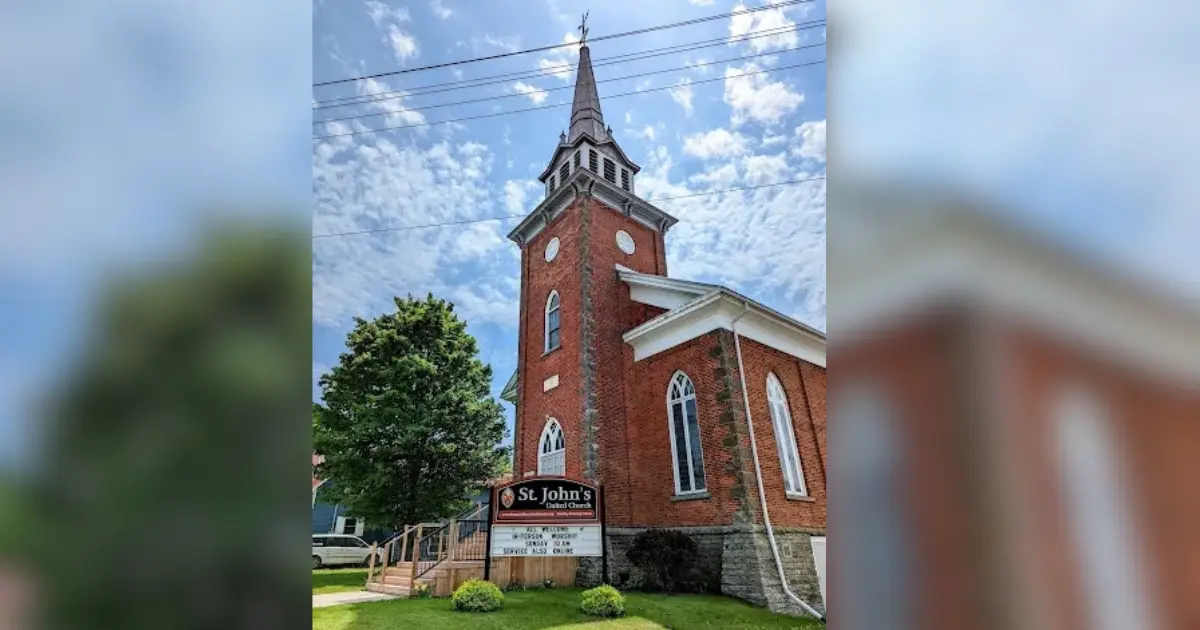
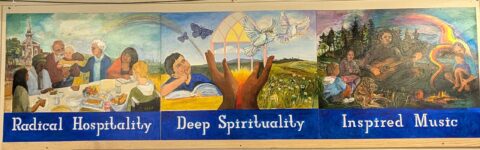
Above the kitchen window of St. John’s United Church in Kemptville, Ontario, a small mural tells a visual story of a congregation in transition. Created by two artists from the local community, Jennifer Gow and Kathleen Morbey, the artwork depicts a diverse group of people sharing a meal, a family gathered around a campfire in fellowship, and a young boy lost in quiet reflection as a dove flies overhead. It is a striking piece of storytelling, but more than that, it was designed specifically to help the church imagine its next chapter—a thoughtful, deliberate process that quietly unfolded during the unprecedented disruptions of the COVID-19 pandemic.
When global health restrictions forced the suspension of in-person gatherings, many faith communities struggled simply to maintain their existing operations. St. John’s United Church, however, chose to look forward. Faced with closed doors and empty pews, the church formed a dedicated visioning committee to reach out to its approximately 220 congregants. Rather than waiting for the pandemic to pass and hoping things would simply return to normal, church leaders used the pause in regular programming to evaluate who they were, who they wanted to be, and how they could better serve the surrounding community in Eastern Ontario.
The visioning committee conducted extensive phone interviews with members of the congregation. They asked foundational questions about what participants thought the church could become, what kind of hands-on work they wanted it to pursue, and what mattered most to them regarding community outreach and spiritual atmosphere. Instead of imposing a top-down agenda from the leadership board, the church listened closely to the collective desires of its people. Using the qualitative feedback gathered from these conversations, the church developed a new, forward-looking vision statement centred firmly on three core values: radical hospitality, deep spirituality, and inspired music.
The participatory approach sparked an immediate shift in morale and engagement among the membership. People suddenly became quite energized about what was possible, even during a time of widespread social isolation and uncertainty. As Helen MacGregor, the administrator at St. John’s, points out, the process breathed new life into the community. Jennifer Gow, one of the muralists, echoes that sentiment, noting that there was a palpable feeling among members that they were personally in charge of designing whatever the future of the church was going to be.
With a renewed sense of purpose and a clear set of guiding values, the congregation moved from abstract visioning to concrete structural change. They collectively decided to overhaul how the church operated on a day-to-day basis by creating a collaborative system of what they termed "faith circles." Under this new organizational model, each household within the congregation was assigned to one of seven distinct groups. These seven circles rotate responsibility for the various duties required during Sunday worship services, sharing the load equitably across the community.
The rotation covers a wide range of essential weekly tasks, from scripture readings and greeting arriving worshippers to food and beverage preparation for fellowship times. By distributing these operational duties more broadly, the church transformed worship from a spectator event managed by a select few into a truly communal endeavor. According to MacGregor, involving more people in the weekly mechanics of the church has made participation increasingly organic.
This grassroots momentum quickly spilled over into other areas of church life. When St. John’s plans additional events, special services, or expanded community outreach initiatives—including its popular and regular friendship lunches and community cafés—MacGregor has noticed a remarkable shift in volunteerism. Instead of staff having to scramble to find people to help, congregants are now excited to step forward, take the initiative, and make things happen on their own. Today, the church routinely boasts robust rosters of between 10 and 20 dedicated volunteers for each individual event it hosts.
The transformation at St. John’s United Church illustrates a broader shift occurring in many progressive faith communities, where traditional institutional models are giving way to more collaborative, decentralized networks of care and engagement. By turning inward during a crisis to listen to the voices of their people, the Kemptville congregation managed not only to weather the challenges of the pandemic, but to lay down a sturdy foundation for the future.
As MacGregor reflects on the journey from those early phone interviews during lockdown to the vibrant, volunteer-driven community operating today, the underlying philosophy remains clear. The members are truly in charge of defining who the church is, how it will behave, and listening intently to where they feel they are being called by God.