
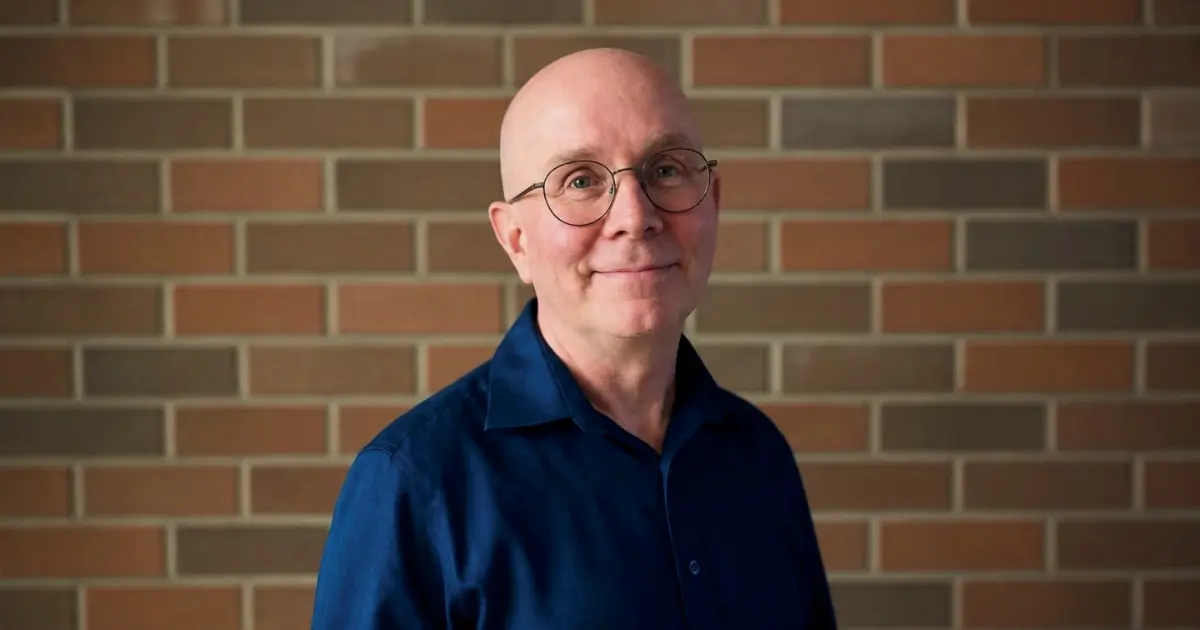
As he prepares to officially assume office on January 1, Rev. Éric Hébert-Daly is already hitting the ground running. Appointed following a rigorous seven-month search to succeed the retiring Rev. Michael Blair, Hébert-Daly was officially confirmed during a General Council Executive meeting held in September. Between transit connections and strategic consultations, Broadview editor Janice Young recently caught up with the incoming general secretary at a bustling Montreal train station to discuss his path to leadership, his political roots, and his ambitious vision for the future of the United Church of Canada.
Why Did You Want This Job?
Stepping into a national leadership role during a time of institutional transition is no small undertaking, but Hébert-Daly approaches the challenge with a distinct sense of purpose and boundless energy.
"I’m really enthusiastic about the different ways we can break out of our well-worn paths," Hébert-Daly explained to Broadview. "I started to imagine what that could look like on a national scale and how I could hopefully bring a little bit of optimism and enthusiasm to the church over the next little while. For me, it comes from that natural place of where I think God is calling us."
A Vision for a Smaller, Yet Deeply Connected Church
When discussing the future of the denomination, Hébert-Daly does not shy away from the shifting religious landscape in Canada. Instead, he sees a profound opportunity hidden within contemporary cultural trends. Polls consistently indicate a widespread, deep-seated spiritual hunger among Canadians—an appetite for connecting with something larger than themselves.
"And here we are, in a place that talks about deep stuff and is all about community, yet we’re not meeting that need somehow," he noted.
Rather than chasing past eras of massive physical attendance, Hébert-Daly harbors a different aspiration. He envisions a denomination that may be physically smaller in scale, yet nationally recognized—even by those who do not regularly attend services—as an invaluable sanctuary for deep spiritual experiences, profound conversations, and genuine community. "Wouldn’t it be great if that were our reputation?" he asked.
Lessons from Political Leadership
Before answering the call to ministry, Hébert-Daly built a robust career in political and nonprofit leadership. Most notably, he served as the national director of the New Democratic Party (NDP) under the late Jack Layton during a pivotal era for Canadian progressive politics.
Reflecting on those years, Hébert-Daly draws a direct parallel between the political underdog status of the NDP under Layton and the contemporary challenges facing mainline Protestant denominations. When Layton first assumed leadership, many pundits and voters had written off the party as a spent force.
"Jack sort of said, ‘Let’s not get hung up on what used to be or what was. Let’s start to imagine where we go from here,’" Hébert-Daly recalled. Because Layton was an avid runner, he often used athletic metaphors to keep his team focused: "When you’re in a race, you don’t look back; you look forward. You look to where you’re going."
Carrying those hard-earned lessons forward, Hébert-Daly rejects the fatalistic narrative that church decline is an inevitable, prewritten conclusion. Having witnessed political movements written off and subsequently achieve historic breakthroughs, he believes the church possesses the same capacity for renewal.
Fostering Intercultural Community and Indigenous Relations
As the first francophone general secretary in the history of the denomination, Hébert-Daly occupies a unique position regarding linguistic and cultural representation. Historically, the vast majority of the francophone population in Canada has been Roman Catholic, meaning the United Church has naturally taken time to fully integrate francophone communities into its broader structure. However, Hébert-Daly is quick to emphasize that systemic inclusion is a collective responsibility that cannot rest on the shoulders of any single individual.
Expanding on the theme of inclusion—encompassing francophone, Indigenous, migrant, and diasporic communities—Hébert-Daly stresses that ministry must focus on genuinely meeting people’s needs rather than inward-looking institutional preservation.
"One of the key things we need to understand, especially with intercultural communities—even in an English-French sense—is that the encounter has to be transformational," he said.
This philosophy applies equally to the ongoing reconciliation work with the Indigenous church. Referring to the metaphor of "two canoes" that must navigate independently without a colonial mindset, Hébert-Daly emphasized the necessity of shared moments of connection. "We also occasionally need to tie our boats together, have lunch, and then continue, because those encounters and relationships will be transformative for both of us. We need to find ways where the church is being transformed as a whole, not ‘you stay over there, and I stay over here and we’ll do our thing.’"
Confronting Institutional Challenges and Embracing Evangelism
Addressing the immediate hurdles facing the general secretary’s office, Hébert-Daly points to the evolving relationship with the Indigenous church. Following the National Indigenous Spiritual Gathering held over the summer, he views this chapter not as a burdensome challenge, but as an essential, grace-filled opportunity for mutual growth.
Another internal concern is how individual congregations perceive their own ministries. Hébert-Daly worries that modern worship services can sometimes mirror administrative meetings, complete with rigid agendas and ordered bulletins that leave little room for spontaneity. "Where are we leaving space for the Spirit?" he asked.
This desire for spiritual vitality directly ties into the concept of evangelism—a term that has historically made many members of the United Church deeply uncomfortable. Given how aggressive or exclusionary forms of evangelism have manifested over past generations, Hébert-Daly understands that hesitation. Yet, he believes the denomination must reclaim the word on its own terms.
"If we are in a relationship with God and we’ve had an impact through our communities of faith or through prayer or through our connection with the divine, it’s unfortunate that we’re not sharing that. It’s unfortunate that we’re not screaming that from the rooftops," he argued. "I think there is a way of doing evangelism in a uniquely United Church way, and I really want to get us going in that direction."
Empowering Lay Leadership and Supporting Ministers
Looking ahead to the structural opportunities of his tenure, Hébert-Daly highlights the vital importance of the ministry of the whole people of God. This involves elevating the role of lay leadership within the denomination, while simultaneously ensuring that ministry personnel receive robust support, inspiration, and resilience resources during a notoriously difficult era for clergy across the Canadian Christian landscape.
Drawing from his four years of experience as a regional executive minister working closely with smaller communities of faith, Hébert-Daly finds daily inspiration in rural congregations. Unlike urban or suburban settings that often feature rigid architectural and social barriers, rural churches frequently maintain a porous, natural boundary with their surrounding neighborhoods.
"Between the community outside the church and the community inside it, there isn’t as hard a distinction… There’s this real sense of broader community and I really love that. You don’t have to be a rocking megachurch to be an inspiration," he observed.
A Personal Journey to the United Church
Hébert-Daly’s commitment to inclusive Christian community is deeply personal. Born into a francophone Roman Catholic family during the cultural shifts of Quebec’s Quiet Revolution, his parents actively discouraged religious participation. It was his grandparents who ensured he remained connected to his faith by taking him to church.
Eventually, however, Hébert-Daly found himself grappling with institutional Catholic policies, particularly regarding the ordination of women, the treatment of divorced individuals, and the inclusion of the queer community. Discovering the United Church provided a spiritual home where he could reconcile his identity while sitting in pews alongside people who might hold differing viewpoints.
In an era defined by societal polarization and entrenched hostility, Hébert-Daly believes the church can serve as a vital antidote—a sacred space of encounter where people learn how to listen to one another again.
"Can you imagine if the church was known for being a school for how to love one another?" Hébert-Daly reflected. "What an amazing legacy for us to have as a church—as a great societally transforming place. That’s the ultimate call of Christ, right? That gives me shivers."