
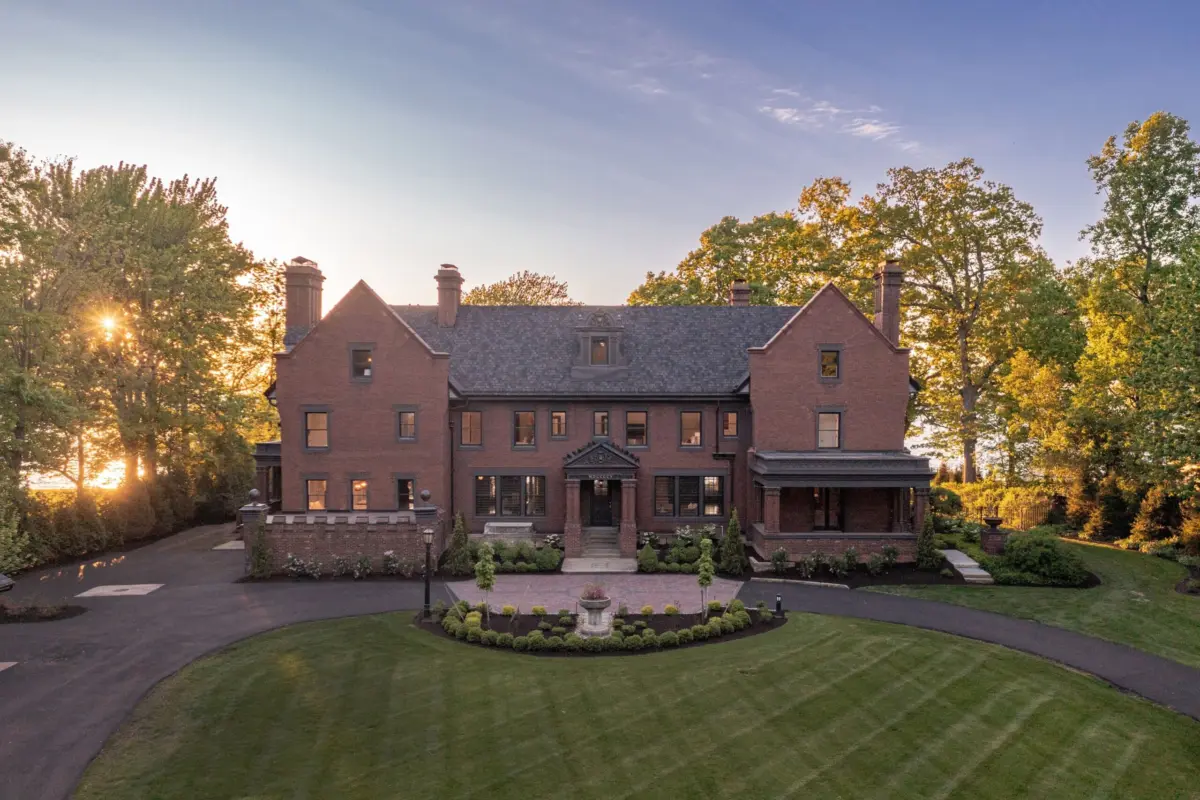
Does Taylor Swift ever experience writer’s block? It is a question that has crossed the minds of millions of fans worldwide, though the pop superstar’s prolific catalog suggests the answer is a definitive no. However, should she ever require a fresh spark of creativity, an ideal source of inspiration sits right within her personal orbit: the expansive new Cleveland-area Gilded Age estate recently acquired by her partner, NFL star Travis Kelce.
Just like Swift’s own famous Rhode Island home—which famously served as the narrative foundation for her song "The Last Great American Dynasty"—her partner’s newly purchased 21,000-square-foot Tudor-style dwelling is brimming with centuries of history, local lore, and architectural drama ripe for storytelling.
The Kansas City Chiefs tight end acquired the grand Ohio residence for $5.35 million this past spring. The purchase came shortly after news broke that Kelce and Swift were searching for a permanent "forever home" in the greater Cleveland area. Known historically as Moyenage, the property represents a remarkable piece of architectural heritage. David Ayers of The Agency Cleveland, who served as one of the listing agents for the estate, describes the dwelling as "a real testament to a time that doesn’t exist anymore."

The century-old mansion carries a rich tapestry of rumors, a distinguished roster of previous owners, and enduring speculations regarding its supposed past as a Prohibition-era speakeasy. Given Swift’s well-documented penchant for weaving intricate narratives from historical details and real-world lore into her Grammy-winning discography, observers would hardly be surprised if elements of Moyenage eventually find their way into a future hit track.
Two Well-Known Architects Worked Together on the Home
The history of Moyenage dates back to 1902, when prominent industrialist Jay Morse commissioned Chicago architect Jarvis Hunt to bring the grand estate to life. Hunt’s surname carries significant weight in American architectural history; he was the nephew of Richard Morris Hunt, the legendary mastermind behind the Biltmore estate, America’s largest privately owned home.
Because Jarvis Hunt was not officially licensed to practice architecture in Cleveland, he enlisted local talent Charles Schweinfurth to partner on the ambitious project. Architectural historian Angelina Bair, who spent three years researching the historic residence and serves on the board of Western Reserve Architectural Historians, notes that Schweinfurth was widely regarded as "one of the most influential architects of Cleveland."

Moyenage Has an Older Sister
While Moyenage is safely off the market following Kelce’s purchase, design enthusiasts seeking a similar historic experience need not look entirely empty-handed. The estate features an older sister property: a 10,000-square-foot Jacobean mansion known as the Seven Gable House, located in Wheaton, Illinois. Jarvis Hunt originally built the Seven Gable House for Morse’s daughter. Morse reportedly grew so fond of the suburban Illinois estate that he specifically requested that Moyenage draw direct inspiration from it.
According to Bob Goldborough, a Jarvis Hunt scholar, both estates represent a notable departure from the architect’s standard body of work. While Hunt typically specialized in designing striking stucco houses, both Moyenage and the Seven Gable House were constructed using brick, marking a unique stylistic pivot in his career.
A Number of Influential Businesspeople Have Called Moyenage Home

The lineage of those who have owned and inhabited Moyenage reads like a roll call of industrial royalty. Tragically, just one year after the grand residence was completed, Jay Morse passed away from health complications. He left the sprawling estate to his wife, Seville Morse. Demonstrating remarkable business acumen for the era, the widow was appointed as a partner at her late husband’s prominent iron mining and shipping firm, Pickands Mather & Co.
Thomas Matowitz, an architectural historian and board director of the Cleveland Architecture Foundation, highlights her formidable reputation. "She was a very skilled businessperson," Matowitz says, noting that Seville successfully helmed the major company for more than two decades. Beyond her corporate achievements, she was a dedicated philanthropist. Following her death in 1927, she bequeathed $410,000 to Cleveland charities—an endowment equivalent to nearly $8 million in today’s currency.
Moyenage’s subsequent owner was another titan of industry: George Martin, who eventually ascended to the presidency of Sherwin-Williams. During his tenure, Martin also served on the board of the Cleveland Indians baseball franchise (now known as the Guardians), where he was famously responsible for signing legendary Hall of Fame shortstop Lou Boudreau.
This Manse Is Subject to the Rumor Mill

Despite its respectable corporate lineage, Moyenage has long been a favorite subject of local gossip and sensational news reports. Rumors have persisted for generations claiming that the home’s expansive third-floor ballroom operated as a clandestine speakeasy during the height of Prohibition.
Matowitz, however, casts significant doubt upon this colorful theory. The Prohibition era spanned from 1920 to 1933, a timeline that directly overlaps with the residencies of Seville Morse and George Martin. The historian argues that these esteemed figures make highly unlikely candidates for bootlegging operations. "I doubt [Seville] was running a liquor establishment, I find that very far-fetched," Matowitz remarks.
The Entryway and Staircase Were Featured in a TV Show
Moyenage’s cinematic appeal extends beyond its architecture, having made an appearance on the small screen during the 1960s. The grand entry of the home was featured prominently in the classic television program Route 66. In one memorable sequence, a couple is captured sharing a tender moment, kissing in the doorway beneath the estate’s intricately carved pediment.

The imagery easily evokes romantic lyricism, calling to mind Swiftian themes of hesitant romance and threshold moments.
Swift’s Cats May Enjoy the Decor
As a self-professed cat lover who famously revealed to Time magazine that she is "obsessed" with felines because "they’re very dignified, they’re independent, they’re very capable of dealing with their own life," Swift might find herself amused by the home’s subtle nods to the animal kingdom. While it remains unconfirmed whether her affinity extends specifically to lions, the property features striking big cat motifs throughout its interior and exterior.
Visitors are greeted by a heavy lion’s head front door knocker, while eight carved lions stand guard atop the newel posts of the grand entrance hall’s stairway. Bair, the architectural historian, notes that the craftsman responsible for the elaborate woodwork remains officially unknown. However, she holds a strong hunch that the carvings may be the work of the same artisan who crafted the lions at The Hermit Club in Cleveland’s theater district—a historic venue built around the same period that remains open to the public today.

For those who take the time to inspect the intricate woodwork and stonework up close, the estate reveals one final, enduring sentiment carved into its structure: the Latin inscription "In Deo solo confido," which translates directly to "In God alone I trust."