
In 1949, fresh from a transformative tour of Scandinavia, the visionary French designer Jean Royère sat down to pen a detailed account of his journey for the pages of the influential design magazine Le Decor d’Aujourd’hui. Among the stops that left a lasting impression on him was Stockholm, where he encountered the vibrant, eclectic design emporium Svenskt Tenn, managed by the legendary Josef Frank. Royère was utterly captivated by the immersive, jungle-like atmosphere of the shop, which rejected the sterile minimalism often associated with modern interiors in favor of a lush, organic warmth.
"One must lift aside vines and branches to select a candy dish," Royère wrote in his glowing review, capturing the whimsical yet deeply comforting environment. He went on to observe a broader cultural phenomenon across the Nordic countries, noting that it was a charming custom to deliberately incorporate climbing plants directly into interior living spaces. "I have seen living rooms where ivy zigzags around paintings and mirrors, circling the walls several times, and dining rooms where Virginia creeper trails down into the chandeliers."

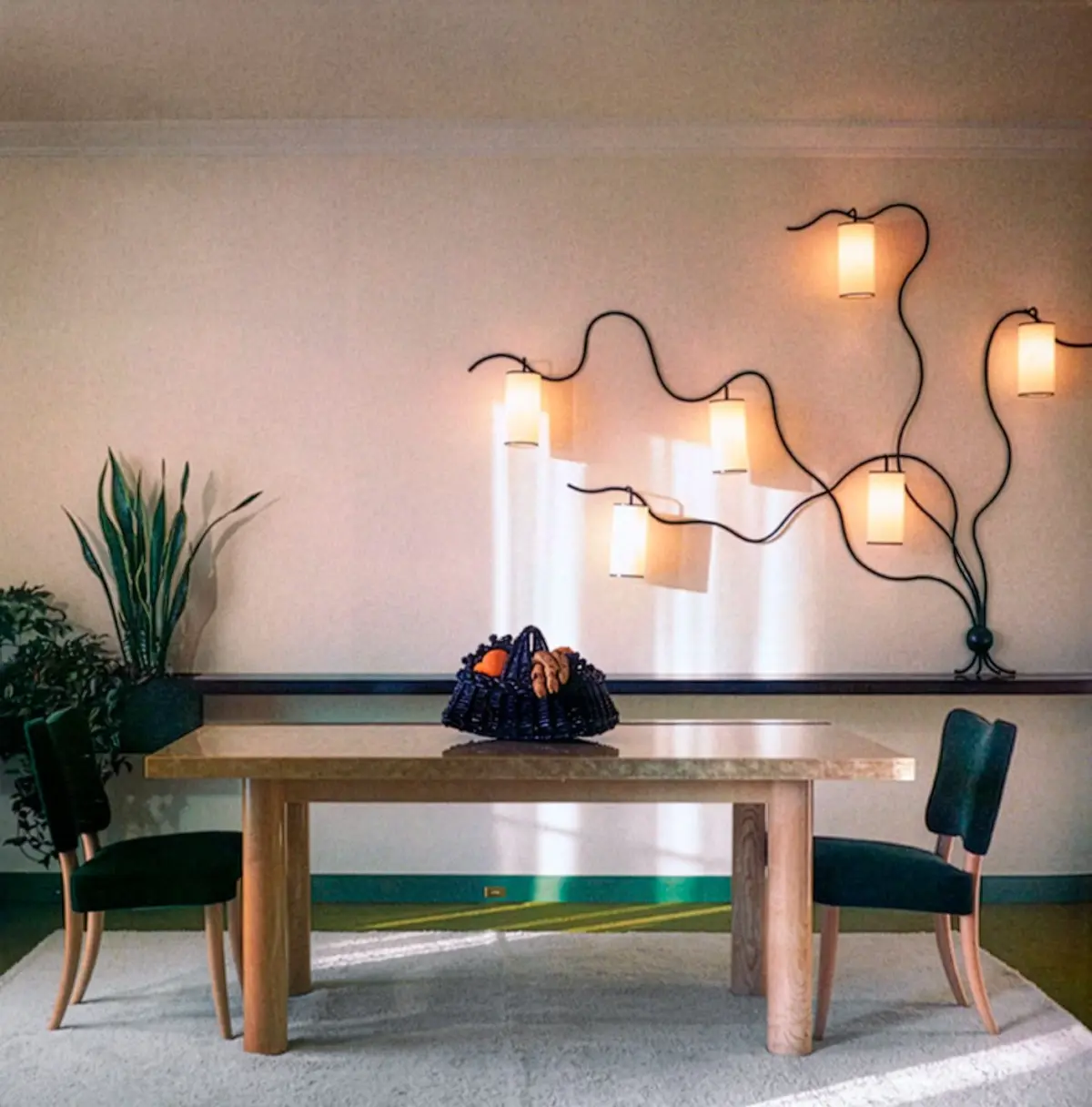
This immersive encounter with Scandinavian plant life struck a profound chord with the French designer, acting as a catalyst for one of his most celebrated and enduring lighting creations. Shortly after his return to France, Royère began conceptualizing and designing the Liane—the French word for vine—a remarkable series of squiggly, hand-forged tubular steel lamps that seemed to literally crawl across the interior walls much like wild ivy. In these imaginative pieces, the metallic stems were gathered together in a stylized bouquet held by a distinct block at the base, bridging the gap between rigorous industrial fabrication and fluid, organic sculpture.
The initial site-specific wall pieces, which Royère brought to life during the mid-1950s, quickly evolved into an expansive family of lighting fixtures. Over time, the concept expanded to encompass dramatic chandeliers, intricate wall sconces, and even a delightfully tangled floor lamp that stood like a metallic sapling rooted to the floor. To complete the organic illusion, these steel creations were typically finished with a coat of vibrant house paint—frequently rendered in striking shades of coral, blue, or sophisticated black—which provided the metal with a unique, textured, and subtly aged patina. A select few of these rare fixtures were finished with delicate gold leaf. The fixtures were paired with cylindrical shades constructed from cellulose acetate, complete with color-matched paper trims that harmonized seamlessly with the painted metal frameworks beneath.

Royère’s fluency with tubular steel was an industrial technique that had gained significant traction through the pioneering work of the Bauhaus movement. However, rather than adhering to the strict, clinical, and geometric rationalism favored by many of his modernist contemporaries, Royère chose to enliven the industrial material with his signature playful touch. His exploration of curved metal began modestly with a controlled, rhythmic wiggle during the 1930s, but as the decades progressed, his manipulation of the medium became progressively freer, more expressive, and decidedly more naturalistic.
This distinct approach is reflected in the philosophy of the modern brand. "It’s never purely expressive," notes Jonathan Wray, the creative director at Jean Royère, pointing out the rigorous engineering that underpinned the designer’s whimsy. The esteemed brand was successfully revived in 2018 by Vladimir Markovic, who happens to be the great-nephew of Royère’s long-time business partner, Micha Djordjevic. "The decorative elements are always structural," Wray explains, emphasizing that every curve and twist served a functional purpose in distributing light and supporting the fixture’s physical form.

In the contemporary design market, the enduring appeal of the Liane collection has inevitably drawn unwanted imitators, with shoddy look-alikes periodically proliferating across the secondary market and auction houses. For serious collectors and enthusiasts—often affectionately referred to as "Royère-heads"—authenticity remains paramount. Today, verified buyers can order directly from an official catalog featuring thirty-five original Liane varietals. These authentic pieces are meticulously crafted using modern powder-coated steel and fitted with traditional Japanese paper shades.
However, in keeping with the artistic integrity of the original commissions, clients today are no longer permitted to specify bespoke or customized versions of the Liane. Each piece in the catalog is maintained as a faithful homage to the designer’s original vision, preserving the integrity of his historic drawings. Inspecting an elaborate, historic installation plan in the studio, Wray reflects on the sheer graphic quality of the finished product. "It’s an expression of his hand," he observes, looking closely at the fluid lines. "The result really feels like a wall drawing."