
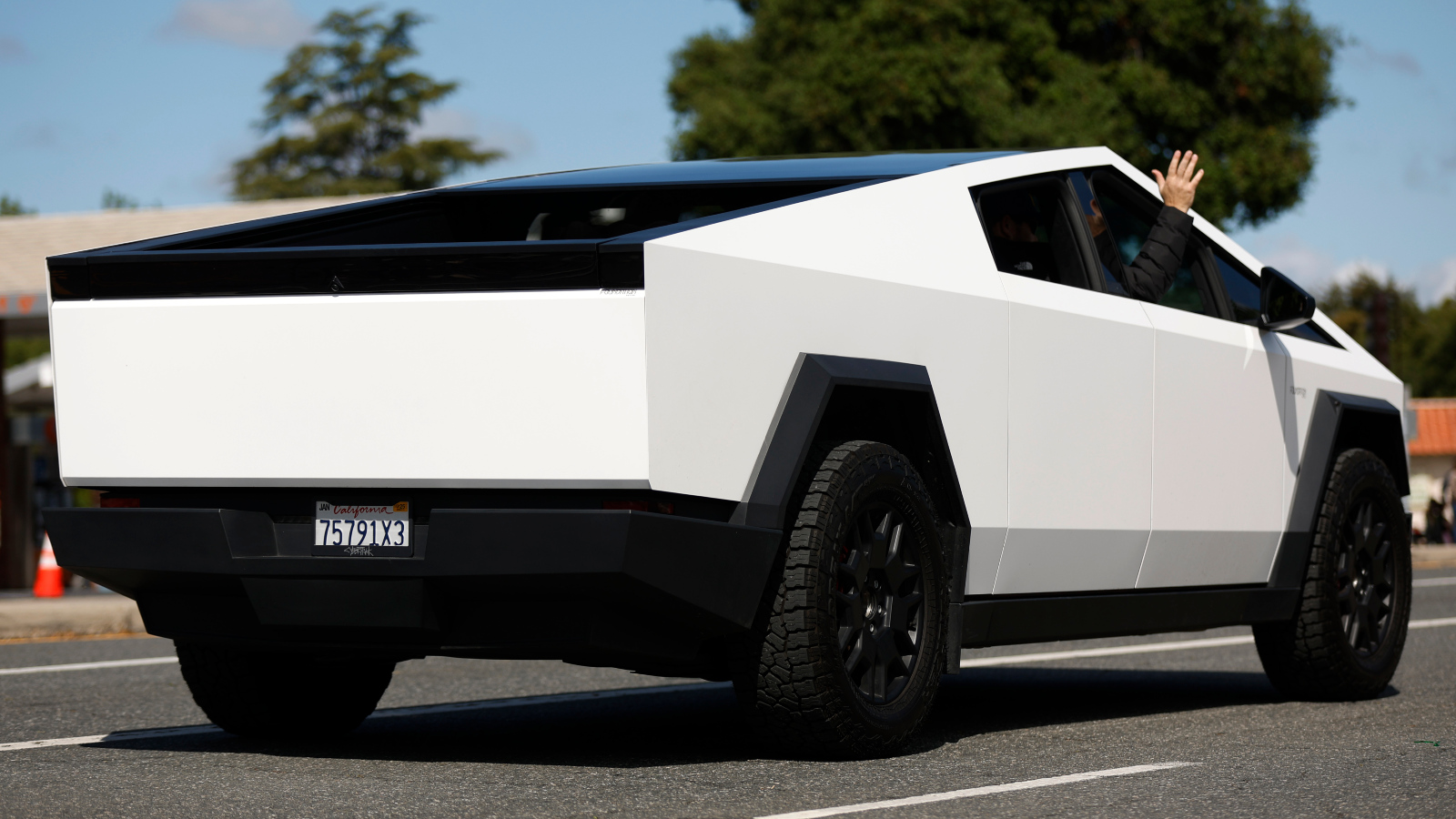
After barely three years on the open road, Tesla is preparing to send the Cybertruck to an early retirement following a prolonged slump in sales and a shifting corporate focus. Elon Musk announced on Friday that the company would wind down production of its polarizing stainless-steel pickup next year at the Texas Gigafactory. The move is designed to clear manufacturing floor space for the upcoming Cybercab, the autonomous robotaxi fleet that Tesla hopes will fundamentally reshape the future of urban and suburban transportation.
In its remarkably brief lifespan, the Cybertruck managed to secure a spot as perhaps the most polarizing vehicle in modern automotive history. Critics lambasted its aggressive, angular design—with some dubbing it a "MAGA hat on wheels" and others comparing it to a common household dumpster, a resemblance that may have tragically fooled a group of hungry raccoons in Minnesota that once chewed on the vehicle’s exposed rear vault. Detractors have already begun declaring it one of the greatest commercial flops in automotive history, ranking it alongside historic misfires like Ford’s ill-fated 1957 Edsel.
Yet, the polygonal, allegedly bulletproof machine undeniably struck a nerve with a specific demographic of buyers who saw it as a realization of futuristic sci-fi fantasies. Dan Krassner, executive director of the American EV Jobs Alliance—an advocacy organization striving to bridge the partisan divide over electric vehicles—noted the vehicle’s unique cultural footprint. A Republican and an avid wrestling fan, Krassner pointed out that several prominent professional wrestlers proudly drove Cybertrucks, including married WWE superstars Seth Rollins and Becky Lynch, alongside The Miz and Liv Morgan. Morgan, however, notably offered a stark counterpoint to the vehicle’s allure, later publicly lamenting her purchase as the worst investment she had ever made.
The commercial reality of the truck stood in stark contrast to the initial hype. Weeks before the Cybertruck officially rolled out to customers in late 2023, Musk boldly told investors that Tesla would eventually scale production to sell 250,000 vehicles a year. The vehicle never came anywhere close to those ambitious targets. Last year, Tesla managed to sell just over 20,000 units.
This dramatic scaling back is only the latest indicator that Detroit and Silicon Valley’s broader attempt to market ultra-macho electric pickup trucks is falling flat. The struggles are industry-wide. Last December, Ford announced that it was discontinuing its F-150 Lightning pickup truck—the all-electric variant of America’s single most popular vehicle—after realizing the model had become a persistent money-loser. Meanwhile, market data shows that sales of Rivian’s electric pickup have slid downward every single year since 2023, while demand has dropped precipitously for GMC’s Hummer EV, a massive vehicle that earned the dubious distinction of being labeled the worst-selling pickup truck of 2026.
Automakers have spent years trying to move past the saintly, environmentally conscious image historically associated with the Toyota Prius. The pivot toward massive, aggressive electric trucks was a calculated effort to win over traditional American pickup truck buyers who valued utility, towing capacity, and road presence. However, manufacturers quickly discovered they were fighting a war on multiple fronts. Not only did they have to contend with deep-seated conservative hesitations and skepticism regarding electric vehicles, but they also had to persuade a general public—increasingly anxious about the cost of living—to swallow heavy sticker shock. Buyers were expected to fork over thousands, and in many cases tens of thousands, of dollars more to acquire an electric pickup compared to its traditional gas-powered equivalent. A comparable gas-powered Ford pickup starts at around $52,000, roughly $11,000 less than the Lightning cost before Ford ultimately pulled the plug.
As Krassner observed, the early wave of electric trucks simply wasn’t priced for the everyday people who actually buy and rely on pickup trucks. At the same time, prospective buyers maintained entirely fair and practical questions regarding real-world charging infrastructure and heavy towing capabilities. As Krassner bluntly put it, flashy and macho advertising simply cannot fix a painful monthly payment.
The economic hurdles remained stubbornly high. The starting price for the 2026 Tesla Cybertruck was recently raised to a staggering $92,500, while the cheapest available Hummer EV commands a base price of $97,200. Full-size electric pickup trucks require exceptionally large, heavy battery packs to deliver the range and raw towing power that truck buyers demand, a technological reality that guarantees higher manufacturing costs and elevated retail prices.
Despite these heavy setbacks, the broader market is not standing still, and significantly cheaper models are already on the horizon. Ford’s upcoming electric pickup truck, code-named the Fathom and slated for release next year, is expected to start at an accessible $28,400—positioning it well below the price point of the average gas-powered pickup. Meanwhile, with the F-150 Lightning officially out of production, remaining used models are trading at a steep 50 percent discount off their original sticker prices. According to transportation news outlet Electrek, these secondhand units are currently selling like hotcakes.
As electric trucks become more directly comparable in price to traditional gas trucks, industry observers expect them to mature into superior products that will eventually win over mainstream American consumers.
A profound partisan divide continues to shadow the adoption of electric vehicles in the United States. Roughly half of all new EV registrations between 2012 and 2023 were concentrated in the ten percent most Democratic counties in the country, according to comprehensive research from the MIT Center for Energy and Environmental Policy Research. Because electric trucks actually performed slightly better in Republican-leaning regions—even if they failed to meet the lofty sales expectations of Tesla and Ford—researchers suggested that pickups still held unique potential to broaden EV adoption across political lines.
Furthermore, some elements of conservative resistance to electric vehicles have begun to soften. Polling conducted by EVs for All America reveals that the share of Republicans who agree with the statement that EVs are "for people who see the world differently than I do" dropped from 59 percent in November 2023 down to 49 percent by November 2025.
As the chapter on the Cybertruck draws to a close, automotive analysts urge nuance before declaring the entire electric pickup experiment an absolute failure. Alexander Edwards, president of the research consultancy Strategic Vision, views the struggles of the F-150 Lightning as an instructive lesson in ensuring that electric trucks can seamlessly perform the rigorous jobs their owners purchased them for, such as towing a heavy camper across multiple state lines without inducing panic over charging access and driving range.
The Cybertruck, by contrast, relied heavily on cultivating an aura of individual rebellion, technological innovation, and sheer excitement. Ultimately, however, that strategy appealed to only a relatively small, niche group of buyers willing to pay an exorbitant price for the experience. That vulnerability was compounded as Tesla increasingly became a political lightning rod, driven in part by Musk’s high-profile government efficiency initiatives under the DOGE banner. Edwards noted that pricing pressures, everyday product frustrations, Musk’s polarizing politics, and the shifting cultural meaning of ownership all played a role in the vehicle’s trajectory.
Meanwhile, external economic pressures are shifting the automotive landscape yet again. Persistently high gas prices, sparked by conflict in the Middle East and lingering for months, have driven consumers toward hybrid vehicles, even as overall sales of pure electric vehicles have slumped following the Trump administration’s elimination of federal EV tax credits last year. Industry advocates like Krassner remain optimistic about an emerging generation of range-extended electric trucks—vehicles equipped with onboard gas-powered generators designed to eliminate range anxiety entirely.
In short, America’s turbulent experiment with electrified pickup trucks is far from finished. As Krassner summarized, the opening round clearly went to the traditional gas-powered truck, but round two has yet to begin.