
How about that stock market? It is a phrase financial commentators and everyday investors find themselves dusting off with regular cadence as the years pass and equities continue to defy expectations. During market downturns, anxiety is a predictable response as retirement portfolios shrink. Yet, even when the market scales record highs and hits lofty valuations, a different kind of worry emerges: the nagging suspicion that an even bigger crash is inevitably on the horizon. This sentiment is particularly acute today, as the current economic expansion rests heavily on the frenzied momentum of the artificial intelligence boom.
For those who have tuned out the financial news cycle to simply enjoy their lives, this detachment remains an enviable position. However, looking at the broader economic landscape reveals a familiar narrative. Investors worry that while artificial intelligence is unquestionably a major technological milestone, the speculative mania surrounding it is moving too fast and reaching too far. This has sparked frequent comparisons to the dot-com bubble of the early 2000s—a boom that launched many early careers into the path of financial independence, only for the subsequent crash to threaten jobs and stability.

As financial observers look back over decades of market cycles, questions about how to navigate these investment booms and busts remain constant. Discussions addressing these anxieties take center stage at financial independence gatherings, such as Camp FI Midwest and the broader Bogleheads conference circuit, where experts dissect the intersection of market psychology and long-term investing.
Will the AI Bubble Ruin Our Retirement?
Reaching decades of retirement brings a comfortable familiarity with market volatility, yet questions from concerned peers often highlight a persistent unease. Friends and family members frequently ask how anyone can remain retired and sleep soundly at night amid global uncertainty, wondering if modern risks should trigger sleepless nights.

A snapshot of current anxieties reveals a familiar list of global concerns: geopolitical tensions involving prominent international leaders, persistent inflation eroding purchasing power, the looming artificial intelligence bubble, towering national debt levels, and simmering international conflicts threatening broader instability. Yet, this psychological state is far from new.
Looking back twenty years to the mid-2000s reveals a parallel set of worries. During that era, the headlines were dominated by different geopolitical figures, ongoing conflicts in the Middle East, national debt concerns, and a vastly overvalued housing market rather than an AI bubble. Back then, anxieties focused on the outsourcing of domestic jobs to emerging economies like India and China, alongside fierce debates over "peak oil" and whether finite fossil fuel supplies would doom global economic growth.

What followed those anxieties was indeed the Great Financial Crisis—the largest market crash since the Great Depression, catalyzed by irrational exuberance over housing prices and complex financial leverage. Yet, when viewed through the lens of a twenty-year horizon, even that historic crisis appears as a temporary dip in a much larger upward trajectory. A diversified investment portfolio weathered not only the financial crisis but subsequent shocks like the 2020 pandemic crash, continuing a historical trend of long-term capital growth.
Simultaneously, the broader world experienced remarkable human progress. Global extreme poverty rates dropped significantly over a twenty-year span, infant mortality rates were halved, and clean energy adoption surged as solar panel costs plummeted. Solar generation emerged as a dominant source of new energy capacity, while electric vehicle sales grew from a negligible fraction to a substantial portion of global automobile manufacturing.

This historical perspective challenges the narrative of persistent doom. While financial media heavily promotes scary stories about impending market destruction, economic prosperity fundamentally stems from human productivity rather than the abstract numbers flickering across computer screens in the financial system.
Prosperity, Productivity, and the Reality of Human Happiness
The foundational driver of economic growth has always been productivity. Financial systems and stock markets are human inventions; if a market system experiences a severe correction, history shows that society adapts, recalibrates, and continues forward. The standard of living, economic growth, and the viability of early retirement are all underpinned by high levels of human productivity and technological ingenuity.

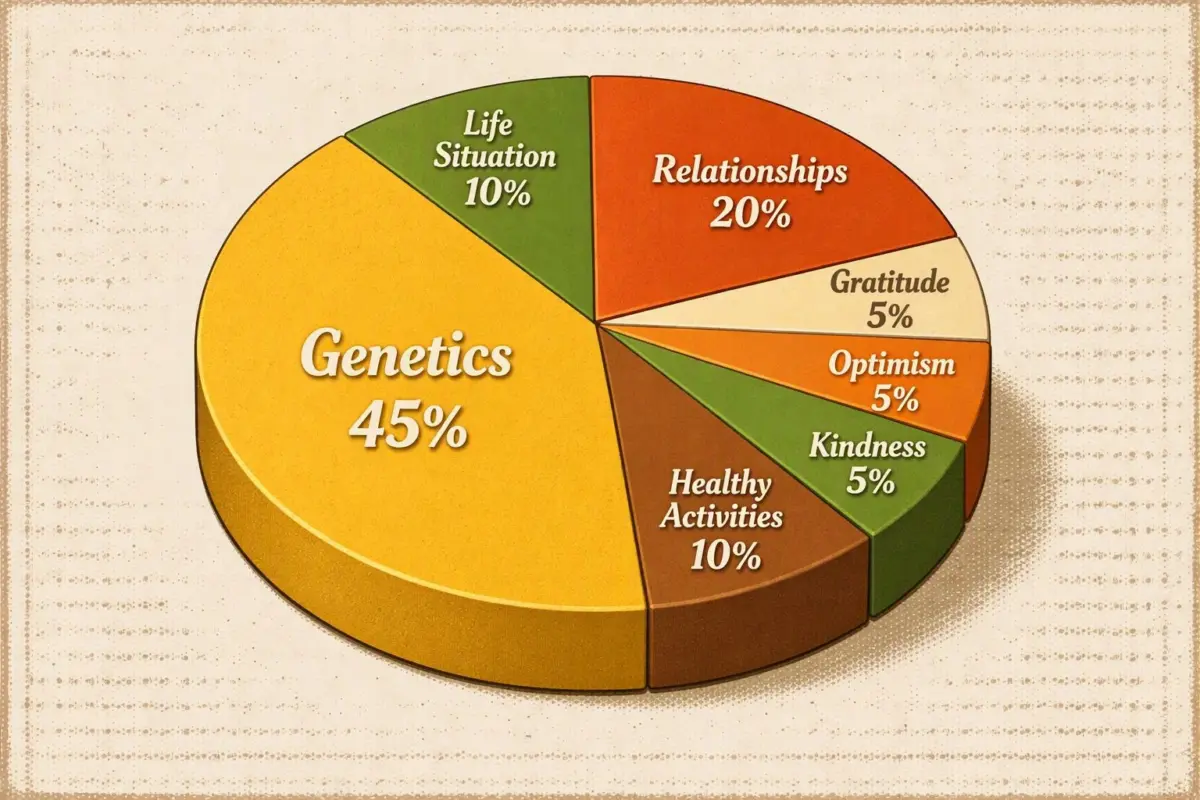
However, once a society achieves a certain baseline standard of living, human happiness tends to plateau along the material dimension. First-world populations surpassed those minimum material requirements decades ago, shifting the focus of well-being toward non-financial factors. Psychological research suggests that wealth is merely one component of a broader life situation, sitting alongside genetics, strong social relationships, lifelong optimism, and healthy outdoor physical activity.
Despite these established realities, fear remains a powerful baseline emotion. Human beings evolved as sophisticated danger-detection machines designed to protect against immediate threats. When physical dangers like predators and acute scarcity are mitigated, the human mind often adapts by seeking out new targets for worry—ranging from economic shifts and social standing to minor neighborhood grievances and complex tax strategies like required minimum distributions for retirees who have accumulated surplus wealth.

Combating this pervasive anxiety requires self-awareness and an understanding of personal and familial history. Many individuals inherit scarcity mindsets from older generations who lived through historic hardships like the Great Depression. Recognizing that these fears are often rooted in the past rather than an objective assessment of the present is a critical first step.
Action remains one of the most effective antidotes to fear. By engaging directly with unfamiliar challenges, individuals build resilience and adaptability—traits that render abstract worries less threatening. Furthermore, curating one’s mental diet by tuning out sensationalized daily news and focusing on positive behaviors, continuous learning, and supportive communities can profoundly shift one’s outlook.

Everything Is an Experiment: Navigating the AI Era
Adopting an experimental mindset can fundamentally change how individuals approach major life transitions and technological shifts. Whether applied to personal choices, career changes, or early retirement, treating life’s uncertainties as controlled experiments reduces the paralyzing grip of fear.
This philosophy applies directly to the artificial intelligence boom, which many view with apprehension. Rather than succumbing to doom-scrolling and ominous news coverage, examining the underlying technology reveals a tool designed to enhance human efficiency and productivity. AI functions essentially as a cognitive tool that amplifies human capability, much like historical productivity innovations of the past.

While technological revolutions inevitably displace certain types of labor—particularly entry-level administrative and technical tasks—they simultaneously reduce service costs and spark the creation of entirely new industries, mirroring the transformative impact of the internet and mobile computing. At the same time, the economic rewards of these innovations often concentrate among asset owners and shareholders, reinforcing the importance of broad market participation and financial resilience.
Ultimately, artificial intelligence represents another opportunity for modern society to make deliberate choices. By examining fear at its root, recognizing the historical resilience of the global economy, and focusing on productivity and positive human behavior, individuals can navigate technological disruptions and market bubbles with clarity, curiosity, and confidence.