
Witness
Nearly ten years after the military campaign to liberate Mosul from the grip of ISIL (ISIS), the ancient Iraqi city remains marked by the physical and emotional scars of war. Long celebrated for an extraordinary history stretching back 8,000 years, Mosul suffered catastrophic destruction during the intense fighting that eventually freed it from extremist rule. As the city slowly navigates the complex path of reconstruction, the struggle to preserve its identity is being waged not only through large-scale infrastructure efforts, but through the quiet, deeply personal determination of its residents.
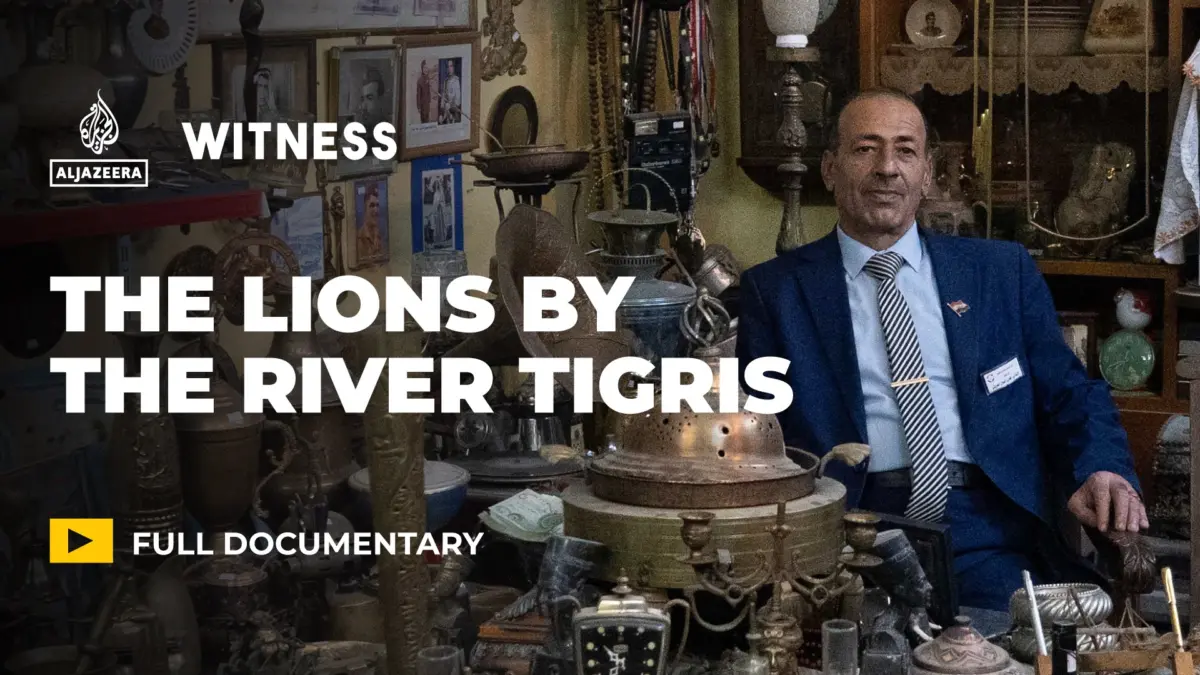
This delicate balance between memory, preservation, and human survival lies at the center of The Lions by the River Tigris, a documentary film by acclaimed director Zaradasht Ahmed, featured on Al Jazeera’s Witness platform. The film follows three men navigating the aftermath of liberation, illustrating how a city with millennia of history attempts to heal its wounds while honoring the profound loss experienced by its people.
A Fragile Link to a Shattered Past
For Bashar, a local fisherman whose life has long been tied to the waters of the River Tigris, the destruction of Mosul is not an abstract concept or a historical statistic. It is a daily, visible reality. During the devastating battle to liberate Mosul from ISIL nearly a decade ago, Bashar lost his once-grand family home. The neighborhood where generations of his family had lived was reduced to ruins, leaving behind an empty landscape of rubble and memory.
Amid the vast destruction of his property, only one tangible structure survived: a marble gate crowned by two delicately carved lions. Situated near the banks of the river, this surviving entrance stands as a solitary, fragile connection to Bashar’s shattered past and the magnificent home that once defined his family’s place in the city.
For Bashar, the marble gate is far more than an impressive piece of stone. It represents the last physical proof of his former life, an irreplaceable link to his heritage, and a monument to everything he lost during the conflict. Recognizing its deep sentimental and historical value, Bashar fiercely guards the gate, refusing to let it be dismantled, removed, or forgotten. In a city where so much has been erased, protecting this final remnant of his ancestral home has become an act of devotion and quiet defiance.
The Collector and the Quest for Preservation
While Bashar guards his gate as a personal sanctuary of memory, another resident of Mosul views the remaining fragments of the city through a broader, institutional lens. Fakhri is a dedicated local collector who has made it his life’s mission to salvage Mosul’s imperiled heritage before it vanishes entirely. Distressed by the widespread destruction of historical architecture and cultural treasures during ISIL’s occupation and the subsequent battles, Fakhri works tirelessly to gather remnants of the city’s past for his unofficial museum.
In Fakhri’s view, the physical artifacts scattered across Mosul’s ruined neighborhoods are essential components of a collective identity that spans 8,000 years. He believes that without active efforts to collect and preserve these items, the city risks losing its historical soul amid the urgent rush to clear debris and modernize.
Fakhri’s mission eventually leads him to Bashar’s waterfront property. Captivated by the craftsmanship and historical significance of the marble gate crowned by the two carved lions, Fakhri becomes obsessed with acquiring the piece for his collection. He sees the lions gate as a centerpiece for his unofficial museum—a visible testament to Mosul’s artistic craftsmanship that could be safeguarded for future generations to study and admire.
However, Fakhri’s pursuit of the gate creates a profound tension between public preservation and private grief. Where Fakhri sees a valuable cultural relic that belongs in a curated space to protect the city’s shared memory, Bashar sees the final, non-negotiable anchor to his personal home and family history.
The Human Cost Behind the Relics
As Fakhri pushes forward with his attempt to secure the lions gate, his efforts are challenged by a close friend who understands the deep emotional weight of Mosul’s recent history from a different perspective. Fadil, a local musician, carries his own permanent scars from the period of ISIL occupation.
Under the oppressive rule of ISIL, artistic expression was severely restricted, and music was strictly banned. For Fadil, those years were defined by enforced silence and the total suppression of his creative identity. Having survived the stifling environment of extremist rule, Fadil views post-liberation Mosul through a perspective shaped by deep personal loss and artistic deprivation.
Observing Fakhri’s growing obsession with acquiring the marble lions gate, Fadil intervenes to offer a powerful counterweight to his friend’s zeal for collection. He urges Fakhri to look beyond the aesthetic and historical value of the carved stone and consider the human reality tied to the object. Fadil challenges the collector to recognize that every artifact remaining in the city’s ruins carries an inescapable human cost—a story of family disruption, grief, and displaced lives.
Through his conversations with Fakhri, Fadil highlights the delicate ethics of heritage collection in a post-conflict zone. He argues that in the eagerness to save physical history, one must never trivialize or ignore the living survivors who attach their memories and grief to those objects. For Bashar, parting with the gate would mean surrendering the last physical evidence of his family’s existence along the Tigris, a price that no public museum project can easily offset.
A Quiet Cultural Revival Along the Tigris
The narrative captured in Zaradasht Ahmed’s The Lions by the River Tigris reflects the broader, nuanced reality of Mosul today. The city’s identity has been forged across 8,000 years of civilization along the banks of the River Tigris, enduring numerous conquests, transformations, and historical crises. Yet, the devastation wrought by ISIL and the battle for liberation presented one of the most severe tests to Mosul’s historical continuity in modern history.
In the face of such overwhelming loss, the efforts of citizens like Bashar, Fakhri, and Fadil demonstrate that cultural preservation is not a uniform process. It takes place in contrasting, sometimes conflicting ways. It is found in the determination of an individual to safeguard the ruins of his home, in the ambitious drive of a collector to document a vanishing past, and in the reflective wisdom of an artist who insists that human dignity must remain at the center of recovery.
As physical rebuilding continues across Mosul, these individual struggles give rise to a quiet but persistent cultural revival. The city’s resilience is manifested not merely in concrete and steel, but in the ongoing dialogue among its people regarding how to honor the past while building a future.
By focusing on the compelling dynamics surrounding two carved lions on the banks of the Tigris, Ahmed’s documentary provides an intimate, clear-eyed examination of a society working to heal. Through the intersecting lives of a fisherman guarding his past, a collector pursuing historical preservation, and a musician advocating for human empathy, The Lions by the River Tigris offers a poignant reflection on memory, identity, and survival in post-war Iraq.