
Top economic and trade officials in United States President Donald Trump’s administration have renewed pressure on Beijing, demanding that China move “fully and immediately” to honor the pledges made under a bilateral trade pact reached between the two superpowers in 2025.
The renewed push centered heavily on critical technological supply chains and American agricultural exports, with Washington pointing directly to Beijing’s commitments regarding rare earth elements and other critical minerals, as well as purchases of key commodities such as soybeans.
The formal call for compliance was delivered during high-level bilateral discussions on Friday, when US Treasury Secretary Scott Bessent and US Trade Representative Jamieson Greer convened a videoconference with Chinese Vice Premier He Lifeng. The meeting was arranged to review the state of economic and commercial relations between the world’s two largest economies and to evaluate whether the terms negotiated to defuse earlier tariff crossfire are being faithfully implemented.
According to a readout released by the Office of the United States Trade Representative, Greer was direct in communicating Washington’s expectations for immediate progress. The trade representative emphasized the critical necessity of Beijing demonstrating tangible progress, pressing China to take concrete actions to fully execute its outstanding obligations. The administration placed special emphasis on Beijing’s past pledges concerning agricultural procurement, alongside its supply agreements governing rare earths and other minerals vital to modern industrial manufacturing.
Following the discussion, Treasury Secretary Bessent reinforced the administration’s negotiating stance in a public statement posted on X. Bessent wrote that the Trump administration would remain steadfast in advancing economic policies designed to support American workers, agricultural producers, and commercial enterprises, framing trade compliance as an essential pillar of the nation’s broader economic and national security strategy.
The US-China Trade Agreement
The friction addressed during Friday’s videoconference stems directly from the implementation of the bilateral trade framework forged between Washington and Beijing in 2025. That agreement was finalized during an in-person meeting between Trump and Chinese President Xi Jinping on the sidelines of the Asia-Pacific Economic Cooperation (APEC) summit held in Busan, South Korea.
The Busan gathering followed an intense phase of trade brinkmanship between the two global powers. Throughout that period, the United States and China had engaged in a series of reciprocal tariff increases triggered by the Trump administration’s broad-based tariff strategy. That strategy had levied significant duties on foreign goods entering the United States, placing an acute focus on imports originating from China.
The resulting accord reached in South Korea was designed to temporarily steady bilateral commercial flows and establish enforceable guardrails against endless economic escalation. Under the terms hammered out by Trump and Xi, Washington agreed to cap the elevated tariffs that had been imposed on Chinese imports during Trump’s second presidential term at approximately 20 percent. The tariff ceiling provided Chinese exporters with an element of predictability, halting what had threatened to become an unmanageable cycle of upward adjustments.
In exchange for tariff relief and structural limits on US border levies, China agreed to clear terms intended to balance bilateral trade flows. Chief among Beijing’s commitments was a significant agricultural purchasing program: China pledged to acquire 25 million metric tons of American soybeans over a three-year period. For American agricultural producers, particularly those throughout the Midwest, the soybean commitment represented a vital market outlet following months of severe market disruption and shifting global commodity flows.
Alongside agricultural commitments, Beijing agreed to address acute Western concerns regarding its dominant position in global mineral supply chains. Under the terms reached in Busan, China committed to keeping its shipments of rare earth elements flowing consistently to global markets, agreeing to suspend the introduction of new export curbs.
Rare earths and related critical minerals represent fundamental inputs for modern technology. They are indispensable for everything from commercial consumer electronics and telecommunications hardware to advanced semiconductors, electric vehicle components, aerospace assemblies, and sophisticated national defense hardware.
Because China maintains overwhelming control over the global extraction, refining, and processing of these elements, access to its export markets is a matter of profound economic and strategic sensitivity in Washington. Prior to Friday’s exchange, the Trump administration had repeatedly raised grievances regarding the flow of critical supplies, expressing frustration that Beijing was falling short of its supply obligations and failing to implement the Busan understanding in good faith.
By tying agricultural purchases directly to critical mineral supply chains during Friday’s videoconference, Washington signaled that it continues to treat resource access and farm exports as interconnected benchmarks for evaluating Beijing’s overall trade compliance.
China Raises Concern Over US Trade Restrictions
While Washington focused its agenda on enforcement and procurement figures, Beijing used Friday’s high-level exchange to lodge its own objections to ongoing economic policies pursued by the United States. Vice Premier He Lifeng, who serves as China’s chief economic negotiator for trade relations with Washington, expressed "serious concern" regarding a series of recent trade restrictions enacted by the US government that specifically target Chinese commerce, according to an account published by China’s state-run Xinhua news agency.
The state media report did not identify the precise trade measures, regulatory curbs, or enforcement actions that prompted the vice premier’s formal objections. However, the comments highlighted the persistent undercurrent of friction that continues to complicate economic relations between the two capitals, even within the framework of a negotiated trade pact.
Despite the pointed exchange of complaints, official accounts from Beijing suggested an effort to maintain open channels of diplomatic engagement and prevent current disputes from derailing the broader bilateral structure. According to Xinhua, both delegations agreed during the virtual meeting to continuously strengthen cooperation and to properly manage differences in order to foster a stable and constructive commercial relationship between the two nations.
The bilateral trade agreement reached in Busan was originally envisioned as a short-term, one-year mechanism aimed at halting immediate trade escalation. However, the diplomatic horizon of the pact was subsequently widened.
When Trump hosted Xi at the White House for a high-profile summit in September, the two leaders agreed to extend the formal duration of the trade accord until January 10 of next year. That extension provided both governments with an extended runway to navigate contentious supply chain, tariff, and procurement issues while exploring whether a more permanent trade framework might be achievable.
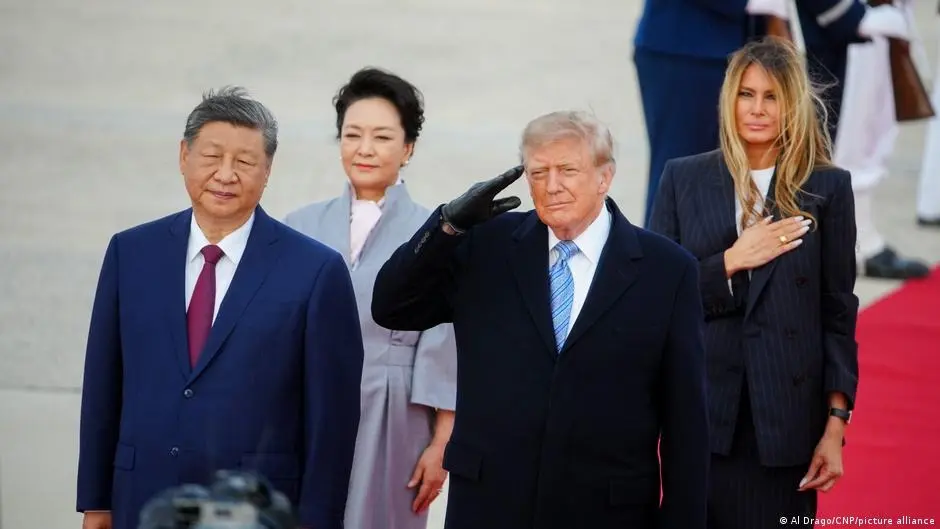
The discussions between Bessent, Greer, and He serve as critical groundwork ahead of the next anticipated personal meeting between the two heads of state. Trump and Xi are scheduled to cross paths again at the upcoming APEC leaders’ summit, which will be hosted in the southern Chinese metropolis of Shenzhen on November 18 and 19. The Shenzhen gathering is expected to provide an immediate venue for direct discussions on whether the Busan pact’s commitments have been honored to Washington’s satisfaction, or whether further economic measures could be triggered as the extended January deadline approaches.
The diplomatic landscape surrounding the Shenzhen summit has also grown increasingly intricate due to broader geopolitical maneuvers. In a separate announcement, China confirmed for the first time that active diplomatic discussions are underway regarding the possibility of convening a historic trilateral summit between Xi, Trump, and Russian President Vladimir Putin on the sidelines of the APEC meetings.
Addressing the prospect of bringing the three world leaders together to a single negotiating table, Chinese Foreign Ministry spokesperson Mao Ning confirmed during a regular media briefing in Beijing that Chinese authorities are actively communicating with relevant parties regarding the potential trilateral gathering. The prospect of such talks has added a profound layer of diplomatic consequence to the upcoming gatherings in Shenzhen, where international security architecture and the unresolved commercial tensions between the world’s leading economies will collide.