
After 37 years of dedicated pastoral ministry, the Rev. Christopher White made a decision that many clergy members contemplate quietly during their careers: he left the church. Emotionally exhausted and grappling with profound burnout, he chose to step down, officially retiring and consciously steering clear of any congregational life after relocating to his new community in Hamilton. For a man who had spent decades embedded in the rhythm of church services, committees, pastoral care, and community leadership, the silence was initially a welcome relief.
However, as the broader world grew increasingly threatening, complex, and culturally confusing, White found himself experiencing an unexpected void. The isolation of retirement could not fully replace the deep-seated pull of communal life. By February, he felt the tug back toward ministry and accepted a part-time position at Faith United, stepping back into a world he thought he had permanently left behind.
Around the exact same time he returned to the pulpit, White began hearing rumblings from colleagues and reports across the country indicating a curious phenomenon: new people were walking through the doors of worship services in communities nationwide. At first, he was intensely skeptical. Much of his professional ministry had been defined by the arduous task of managing and adapting to the steady, seemingly inexorable decline of the United Church of Canada. With the denomination’s average Sunday attendance dropping to just 47 people by 2024, the math was stark and undeniable. No one could pretend that the United Church was anything other than a small denomination today.
Yet, beyond the sobering statistics and the decades-long narrative of institutional contraction, White sensed a distinct shift in the air. Walking through the doors of Faith United himself, he was genuinely surprised to encounter a steady stream of fresh faces. The demographic makeup of Sunday mornings was changing. When the church leadership officially announced a dedicated new-member Sunday, White experienced a moment of genuine shock when 15 individuals stepped forward to join the congregation.
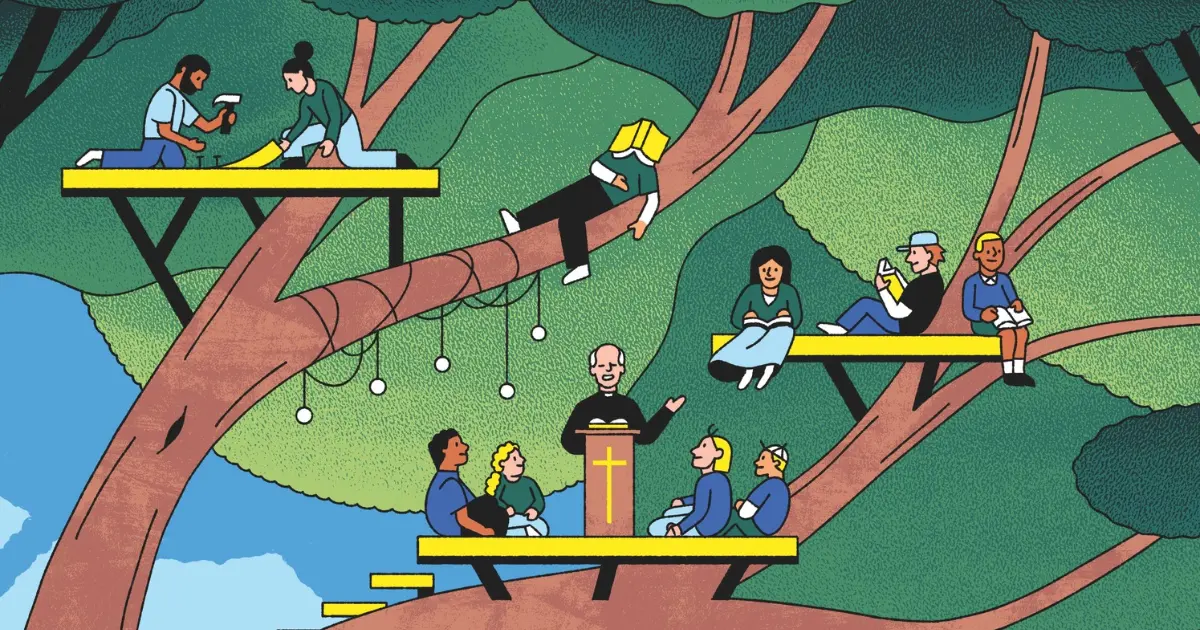
Today, White has developed a radically hopeful perspective on the current state of religious life. He believes that the Spirit is actively reconstituting the church, and that the sweeping denominational transformation from large institutions to small, localized communities actually presents an unprecedented opportunity. Rather than mourning the loss of the past, he argues that the church finally has the chance to write a new story—one that it desperately needs. Stripped of the overhead and expectations of massive, sprawling operations, small congregations can freely experiment with all aspects of what it means to be a authentic community of faith. And, contrary to the persistent narrative that religious decline is irreversible, these spaces are proving capable of attracting new members.
Understanding this revival requires looking closely at who is actually walking into these small churches, what they are searching for when they cross the threshold for the first time, and what these modest congregations have to offer that contemporary mainstream culture simply cannot provide.
Among the newcomers White has encountered at Faith United, the demographic profile is wonderfully diverse. Some are young adults seeking grounding in a fast-paced world, while others are older individuals looking for deeper connection. Some arrive with backgrounds in other Christian denominations, while others have no prior religious affiliation whatsoever. The congregation includes members of the 2SLGBTQ+ community, as well as newcomers and refugees who have recently arrived from Africa.
What unites these diverse individuals is what they are explicitly avoiding. They are not looking for a massive church where they can remain anonymous faces in a crowd, blending into the background of a stadium-sized sanctuary. Furthermore, traditional denominational labels—such as the historic identity of the United Church—are largely irrelevant to them.
Instead, what these newcomers want is an intimate church community where they can truly be seen and heard. They are searching for a place where they can develop genuine, lasting relationships and quickly integrate into the active life and work of the congregation. Crucially, they want to understand and experience the divine within a community that actively lives out its faith through tangible actions, rather than merely speaking about it in abstract theological terms.
This raises a fundamental question for contemporary religious life: What do small churches offer that people cannot easily find anywhere else in modern society? According to ministry leaders, the answer lies in five distinct qualities that run directly counter to the grain of modern culture.
1. Small churches are countercultural
Newcomers arrive at church seeking a way to navigate the overwhelming pressures of modern life. Across society, people are experiencing an economic system explicitly designed to extract maximum productivity while offering precarious employment, soaring housing costs, and relentless financial inflation. Individuals face systemic forces that consistently dehumanize, commodify, and marginalize them. The pervasive cultural belief that market forces and privatization hold the answers to virtually every human problem has become so deeply embedded that it is rarely questioned, operating with a control as pervasive as any authoritarian regime.
The church offers a profound institutional rejection of this worldview. By inviting people to follow the path of Jesus—who consistently drew people away from self-destructive and selfish behaviors—the church offers a transformative alternative. For newcomers wading through the modern economic and social morass, the Gospels offer a fresh set of genuinely countercultural values. Small churches provide the intimate scale necessary to deeply explore these ancient stories, ask difficult questions, and deliberately forge meaningful, intentional values for their daily lives.
2. Small churches treat people as beloved members of a community
Modern commercial advertising and social media platforms thrive on a psychological model that constantly tells individuals they are not enough. For-profit digital companies and consumer markets will never offer the reassurance that a person is unconditionally loved and that they genuinely belong. The prevailing cultural message of the digital age is that every individual is entirely on their own, competing in a crowded marketplace where genuine, unconditional community does not truly exist.
In stark contrast, a small church offers an environment where an individual is seen, loved, and accepted exactly as they are. Participants are reminded that they are created not in the image of a curated social media profile on TikTok or Instagram, but in the image of the divine. They are treated as sacred beings of immense value to God and to the immediate community around them.
These affirmations serve as powerful antidotes to the pervasive isolation, crushing loneliness, and chronic sense of inadequacy that characterize contemporary life. In a small church, the community acts as a support system, carrying individuals when life’s blows become too heavy to bear alone.
3. Small churches turn despair into repair
It is remarkably easy for modern citizens to be entirely overwhelmed by the sheer scale of the global challenges facing humanity today: rising economic inequality, the accelerating climate crisis, and widespread international conflict, to name only a few. This complex phenomenon, increasingly termed the "polycrisis," frequently generates an all-encompassing sense of helplessness and apathy.
The small church provides a practical antidote by offering an opportunity to reshape the world through tangible, local action. Even a modest congregation can host impactful ministries—whether working toward meaningful reconciliation with Indigenous Peoples, supporting neighbors struggling to make ends meet in a brutal economy, or providing a safe haven for the 2SLGBTQ+ community. By participating in concrete, small-scale actions designed to help repair the brokenness of the world, individuals find that they simultaneously help heal their own souls.
4. Small churches offer sacred practices
Engaging in communal prayer is a profound acknowledgment that there is a reality far greater than oneself, anchoring individuals in a sense of gratitude and accountability to a Creator while keeping the needs of others front and center.
In a compact church setting, communal prayer takes on an intimate quality because the participants actually know the people for whom they are praying. They are friends, neighbors, and family members whose faces are easily visualized during moments of silence. Similarly, those receiving prayers experience a much deeper sense of being enveloped by the genuine love and care of a community that knows them intimately.
Furthermore, there is a distinct power in communal song. Hearing a small congregation belt out a familiar hymn with imperfect, authentic human voices is a deeply moving experience. The very walls of these historic buildings seem to reflect the generations of families who have sung the exact same spaces week after week, creating an atmosphere that can easily bring tears to the eyes. In a culture where performance is demanded everywhere, the church offers a rare space where people can sing weekly simply for the joy of it, without needing to perform.
5. Small churches are resilient
By their very nature, small churches are nimble, highly relational, and deeply creative. Free from the heavy layers of corporate bureaucracy that often paralyze larger institutions, small congregations can make decisions rapidly and pivot instantly to meet the immediate pastoral needs of their people. Many small churches possess a long, institutional history of surviving and even thriving despite diminished numbers and ongoing financial hurdles. They understand the art of adaptation.
Rev. Daniel Reed, the associate director of mission, property and finance for the Toronto United Church Council, understands this dynamic well. As a minister in his 30s, Reed has spent his entire career within a declining denomination, allowing him to function comfortably in a landscape of re-creation and innovation. In his regional role, he frequently collaborates with small communities of faith that he characterizes as "scrappy and innovative" and actively engaged in "doing really cool things."
Reed points to concrete examples across Ontario: Sprucedale United, a tiny church that successfully established a community café to draw neighbors together; Mount Zion United in London, Ontario, which has worked on erecting a new building to house an EarlyON Centre providing vital services for families with small children; and a collaborative initiative in London where four distinct churches jointly employ three ministers to share leadership resources.
"I am seeing churches prayerfully moving outside their comfort zone and letting themselves be open to both failure and transformation through the movement of the Spirit," Reed observes. "In my work, I see that resurrection is real."
After decades marked metaphorically by Good Fridays of decline, the Easter hope for small churches may not look like a return to the massive institutional strength of the mid-20th century. Instead, it may manifest as something much humbler yet far more surprising: a willingness to loosen a protective grip on outdated operational models, and a readiness to discover a fresh purpose by genuinely welcoming newcomers—allowing their presence, their honest questions, and their unique gifts to help shape whatever comes next.