
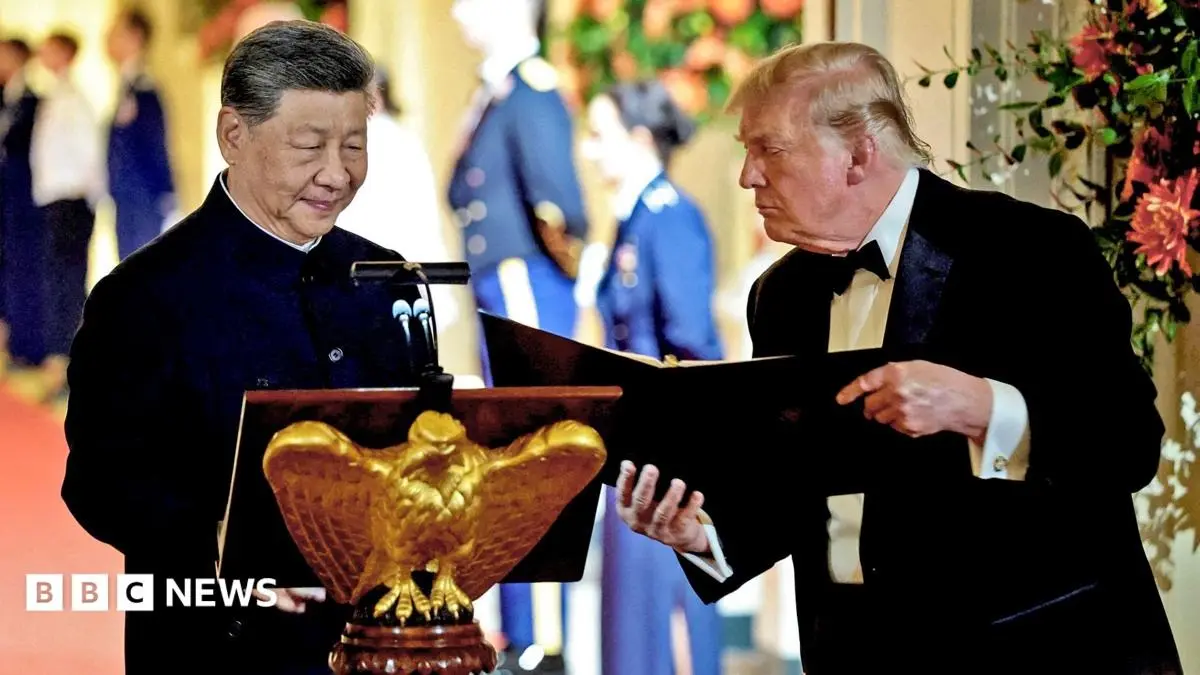
WASHINGTON — United States President Donald Trump warmly hosted Chinese President Xi Jinping for a high-profile dinner gathering that brought together top diplomatic figures, cabinet officials, and an unprecedented array of American corporate and technology executives. The summit dinner featured expressions of mutual personal respect, symbolic exchanges, historical reflections, and an unscripted peak into White House construction projects, highlighting both the complex relationship between the world’s two largest economies and the immense corporate interest surrounding the bilateral engagements.
Addressing the assembled room of dignitaries, business leaders, and public figures, President Trump opened his remarks by offering explicit gratitude to President Xi for making the long journey across the Pacific to the United States. Speaking warmly of his personal dynamic with the Chinese leader, Trump underscored the strength of their interpersonal connection, declaring to those in attendance that the two heads of state had reached an unprecedented level of mutual understanding. "We’ve never gotten along better," Trump said, reflecting on the state of his personal relationship with Xi.
Throughout his welcoming address, Trump praised the expansive history of relations between the United States and China, emphasizing the importance of ongoing communication between Washington and Beijing. However, in a characteristic break from formal diplomatic scripting, the American president took a brief detour from his foreign policy remarks to spotlight his ongoing White House ballroom construction project. The ambitious architectural project, which remains approximately a year away from completion, became an unexpected focal point of the president’s welcoming address.
Offering what he described as a "special treat" to the visiting head of state, Trump extended an exclusive invitation to President Xi and his wife to become the very first guests to step inside the unfinished venue. In an off-the-cuff invitation to the foreign delegation, Trump invited them to inspect the work in progress despite its active status as a building site. "Anybody who wants to walk into a construction site that’s nice and clean and sparkling, it’s our honour to have you do so," Trump remarked, blending hospitality with his trademark focus on large-scale real estate endeavors.
Beyond the verbal pleasantries and architectural commentary, the ceremonial highlight of Trump’s opening remarks came with the presentation of an official state gift to the Chinese leader. Trump unveiled a custom sculpture of a bald eagle—the iconic national symbol of the United States. Explaining the deeper significance behind the artwork, Trump noted that the statue was chosen because it embodied "the free and soaring spirit of America."
The president revealed that the gift carried a personal touch, sharing that he and First Lady Melania Trump had actively participated in the design and creation process of the eagle sculpture. Presenting the piece to President Xi, Trump expressed his hope that the artwork would be prominently displayed upon the Chinese delegation’s return home. "We hope it will find a nice, wonderful place in Beijing. It’s your honour," Trump stated, placing the symbolic token of American heritage into the hands of his counterpart.
When President Xi took the podium to deliver his response, the Chinese leader delivered a speech rich in diplomatic phrasing, expressing profound appreciation for the hospitality shown to him and his wife throughout their visit. Xi praised his American hosts for receiving the Chinese delegation with "meticulous care and consideration," noting that the attentive reception had succeeded in making them "feel truly at home" despite the significant distance from Beijing.
Turning to the geopolitical weight of the gathering, President Xi framed the ongoing dialogues between Washington and Beijing as a historic juncture in modern diplomacy. He declared that both leaders were actively "making history in our bilateral engagements," framing their direct dialogues as a pivotal moment for international stability.
Xi revealed that during their private discussions, the two leaders had reached a foundational consensus regarding the trajectory of future relations. "We agreed to build a constructive China-US relationship of strategic stability," Xi stated, characterizing their talks as "sincere and in-depth exchanges" designed to fortify ties and enhance cooperation between the two global powers.
Much like the remarks delivered by his host, President Xi’s speech relied heavily on expressions of goodwill, emphasizing shared cultural touchstones and key historical milestones that have bound the United States and China together over the decades. In particular, Xi anchored his vision of modern cooperation in the deep historical memory of joint struggle and landmark diplomatic breakthroughs.
Xi highlighted the foundational bond forged during the Second World War, recalling how the strategic relationship between the American and Chinese peoples was initially "forged in blood and fire" during their shared military fight against Japan. Moving forward in history, the Chinese president referenced the famous era of "ping pong" diplomacy during the administration of President Richard Nixon, which famously broke decades of diplomatic ice and laid the groundwork for modern Sino-American relations.
Looking toward the future, Xi argued that the long-term ambitions of the United States and China do not need to be inherently adversarial. Towards the conclusion of his speech, Xi emphasized that the goals of both nations can in fact be "mutually reinforcing." To achieve this vision, he called on leadership in both Washington and Beijing to abandon outdated paradigms and actively explore a "new approach for major countries to get along" in an increasingly interconnected global landscape.
Beyond the formal podium remarks, the atmosphere inside the dining hall offered a vivid glimpse into the intersection of high diplomacy, political power, and corporate dominance. As observers entered the grand dining space, the room buzzed with lively interaction among some of the world’s most powerful business figures and political officials.
In one prominent corner of the hall, SpaceX Chief Executive Officer Elon Musk was seen commanding the attention of surrounding guests over a dinner table. Musk appeared to be recounting an entertaining story, captivating his immediate audience to the point where two nearby dinner guests were seen doubled over with laughter at his anecdote. Musk’s prominent presence at the event followed his previous role within the Trump administration, where he led targeted government initiatives aimed at shrinking the scope and spending of federal operations.
Elsewhere in the room, the mood appeared distinctly more solemn at adjacent tables. Defense Secretary Pete Hegseth was observed maintaining a serious expression as he took his seat alongside his wife. Seated in close proximity to the Defense Secretary were key political figures and administration insiders, including Jared Kushner and White House Chief of Staff Monica Crowley.
The guest list for the evening reflected a conscious effort by the White House to bring together a broad coalition of government authority, conservative media, and corporate leadership. Scores of high-ranking U.S. government officials sat alongside influential conservative broadcasters, prominent tech sector executives, social media platform leaders, and top corporate chiefs from major multinational firms.
Members of President Trump’s immediate family were also prominently integrated into the evening’s proceedings. Among the attendees were the president’s children, Ivanka Trump, Eric Trump, and Tiffany Trump, all seated among the foreign dignitaries and corporate leaders.
The concentration of executive power from the technology sector was particularly striking. The room contained the chief executives of the world’s most dominant tech enterprises, including Apple CEO Tim Cook, OpenAI CEO Sam Altman, Google CEO Sundar Pichai, Amazon founder Jeff Bezos, and Nvidia CEO Jensen Huang.
The seating arrangements at the head table reflected the extraordinary economic weight assembled for the dinner. Seated directly at the central table alongside President Trump and President Xi were Apple’s Tim Cook and Nvidia’s Jensen Huang, placing two of the world’s most valuable technology leaders at the immediate center of the diplomatic engagement. Elon Musk was also seated at the main table with the two heads of state.
Beyond the tech industry, the guest list extended deep into traditional American commerce, finance, and industrial power. High-level executives representing major corporations such as General Motors, Visa, Paramount Skydance, and ExxonMobil were distributed throughout the dining hall. Social media mogul Mark Zuckerberg was also in attendance, alongside American billionaire Jeff Yass, whose financial firm holds a significant investment stake in the social media platform TikTok.
Addressing reporters prior to the commencement of the dinner, President Trump boasted about the extraordinary draw of the gathering, emphasizing the unmatched concentration of corporate influence that had assembled under one roof. "Everybody wanted to be there," Trump said before the event began. "I would say you have the entire tech world, the entire banking world, and a lot more."
Despite the sweeping presence of Silicon Valley leadership, the guest list was also notable for who was missing. One conspicuous absence from the high-profile gathering was Anthropic, recognized globally as one of the largest, most valuable, and most influential artificial intelligence research firms operating today. The absence of representation from the AI powerhouse stood out amid the dense gathering of rival tech leaders. Inquiries were submitted to Anthropic regarding whether the firm had received an official White House invitation or if the company had ultimately opted not to attend the event.