
TOKYO — Japanese police on Okinawa have arrested a 20-year-old U.S. Marine on suspicion of robbing and murdering a local woman in a hotel room, a development that has reignited intense local anger and threatened to complicate the delicate geopolitical alliance between Tokyo and Washington. The arrest, which took place in the prefecture’s capital of Naha, comes at a time of heightened strategic importance for the southern island chain, where the heavy and long-standing presence of American military forces remains a highly sensitive and deeply polarizing issue for the local population.
According to officials from the Okinawa prefectural police, the suspect is a Marine stationed at the Marine Corps Air Station Futenma. He stands accused of killing a 39-year-old Japanese woman at a hotel in Naha during the early hours of Saturday morning. Investigators allege that after committing the murder, the suspect stole the victim’s wallet and backpack before fleeing the scene. Japan’s Kyodo News agency, citing police sources, reported that the victim’s body was discovered by staff inside her hotel room, with initial forensic assessments indicating that she had been strangled to death.
The police investigation quickly centered on the suspect after a review of the hotel’s security camera footage. The surveillance recordings reportedly captured the Marine entering the hotel alongside the victim, but later showed him exiting the premises alone. Armed with this footage and a description of the suspect, law enforcement officers launched a search in the surrounding areas. Late Saturday night, an officer spotted a man matching the suspect’s description walking alone on a street in Naha’s bustling entertainment district. The officer intercepted the individual and placed him under arrest, bringing a swift end to the initial phase of the manhunt.
The incident has sent shockwaves through the island prefecture, prompting fierce condemnation from local leadership. Newly elected Okinawa Governor Genta Koja did not hold back in his criticism when speaking to reporters on Sunday. "The case deals a major shock and adds fear to the Okinawans who have already been forced to live next to U.S. bases," Koja said, expressing the deep-seated anxiety and resentment felt by many residents. "It is absolutely unforgivable and we are outraged." The governor also took aim at the U.S. military’s repeated promises to improve service member behavior in the wake of previous incidents. "I must say, discipline and troop education are not working at all," Koja added, highlighting what local authorities view as a systemic failure to control personnel stationed on the island.

The outrage in Okinawa quickly reverberated to the highest levels of government in Tokyo, where national leaders scrambled to address the diplomatic fallout. Prime Minister Sanae Takaichi issued a strong statement on the social media platform X, describing the incident as "extremely regrettable." Takaichi, whose cabinet has actively pushed to fortify Japan’s military presence in the southwest while fostering closer operational ties with the United States, sought to reassure the public that her administration would hold the American military accountable. She confirmed that the Japanese government has lodged a strong protest with U.S. officials and demanded the highest level of cooperation with local and national law enforcement throughout the investigation. Furthermore, Takaichi demanded that the U.S. military implement stricter disciplinary measures and more effective preventive strategies to ensure such a tragedy does not occur again.
In tandem with the Prime Minister’s public statement, Foreign Minister Toshimitsu Motegi took formal diplomatic action by summoning U.S. Ambassador to Japan George Glass to the Foreign Ministry. During the meeting, Motegi conveyed the Japanese government’s deep "outrage" over the killing and emphasized the severe impact such crimes have on public trust. In response, Ambassador Glass used his personal account on X to extend his deepest condolences to the family of the victim. He assured the public that the United States government is actively cooperating with both Japanese national and local authorities as the criminal investigation proceeds.
The U.S. Marine Corps also sought to address the crisis, confirming in an official statement that the arrested serviceman is assigned to the III Marine Expeditionary Force, which is headquartered on Okinawa. Military officials emphasized that they are fully cooperating with the Japanese prefectural police in their investigation. "The Marine Corps takes these allegations very seriously and expects every Marine to adhere to the highest standards of behavior," the statement read, though such assurances have historically done little to mollify local anger in the face of violent crimes.
The murder occurs against a backdrop of complex geopolitical maneuvers in East Asia, where Okinawa plays a central role in the defense strategies of both Japan and the United States. Under the terms of a long-standing bilateral security pact, approximately 50,000 U.S. military troops are deployed across Japan. Roughly half of these forces are stationed on Okinawa, a prefecture that accounts for less than one percent of Japan’s total land area. This heavy concentration of military infrastructure has long been a source of friction, even as the island’s strategic importance has grown. Amid rising regional tensions, particularly with China, Japan’s central government has shifted its defense focus southwestern-ward, heavily centering its military buildup on Okinawa and its outlying islands.
This strategic alignment, however, directly clashes with the daily realities of Okinawan residents, who have spent decades protesting the burdens imposed by the bases. Local communities have long complained about persistent noise, environmental pollution, and safety hazards associated with military operations, but it is the recurring issue of crimes committed by U.S. service members that has caused the most severe and enduring pain. These criminal incidents frequently complicate the delicate relationship between Japan’s central government in Tokyo and the local prefectural administration in Okinawa, with local leaders accusing national politicians of prioritizing the U.S. alliance over the safety and well-being of Okinawan citizens.

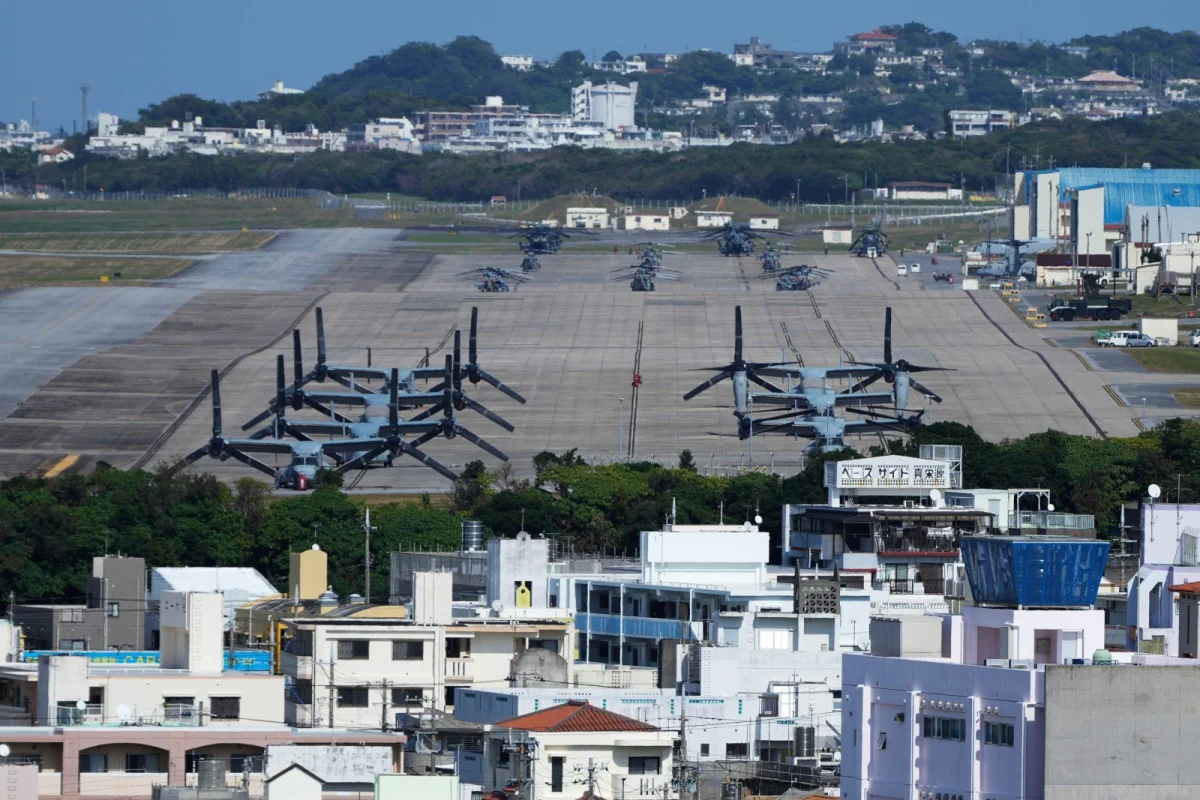
At the heart of this domestic tension is Marine Corps Air Station Futenma, the base where the suspect in the current murder case was stationed. Located in a densely populated urban area of central Okinawa, Futenma has been a major flashpoint for decades. Residents and local officials have long demanded that the base be closed and its operations moved off the island entirely, citing the extreme safety risks of operating military aircraft in close proximity to schools, homes, and businesses. While the central government eventually agreed to relocate the base, it greenlit a plan to construct a new facility at Henoko, a less populated area on Okinawa’s eastern coast. This decision has met with fierce, sustained resistance from local activists and successive prefectural governors who argue that the base should be removed from Okinawa altogether. Despite these protests, the central government has pushed forward with the Henoko project, though the construction has been plagued by massive delays, engineering challenges, and legal battles.
The current outrage is deeply rooted in a history of high-profile crimes that have left deep scars on the Okinawan collective consciousness. Most notable among these was the 1995 rape of a 12-year-old Okinawan schoolgirl by three U.S. service members. That incident triggered massive, unprecedented protests across the island, forcing Washington and Tokyo to renegotiate aspects of the Status of Forces Agreement (SOFA) and promising greater oversight. Yet, decades later, residents argue that little has changed. According to data compiled by the Okinawa prefectural police, the number of arrests involving U.S. service members, civilian base employees, and their family members exceeded 100 last year alone. In recent years, repeated occurrences of sexual crimes, coupled with what local officials describe as delayed disclosures of these incidents by both the U.S. military and the Japanese central government, have further fueled public anger and eroded trust.
The timing of this latest incident is particularly challenging for Prime Minister Sanae Takaichi’s administration. As her cabinet seeks to further fortify Japan’s southwestern military defenses and deepen operational integration with U.S. forces, the murder of a local citizen by a U.S. Marine provides powerful ammunition to critics of the government’s defense policies. For Okinawans, the tragedy serves as a grim reminder of the human cost of hosting a disproportionate share of the security alliance’s burden. The contrast between Tokyo’s strategic imperatives and Okinawa’s domestic security concerns has once again been laid bare, illustrating the precarious nature of an alliance that relies heavily on a local population that feels increasingly neglected and endangered by the very forces sent to protect them.