
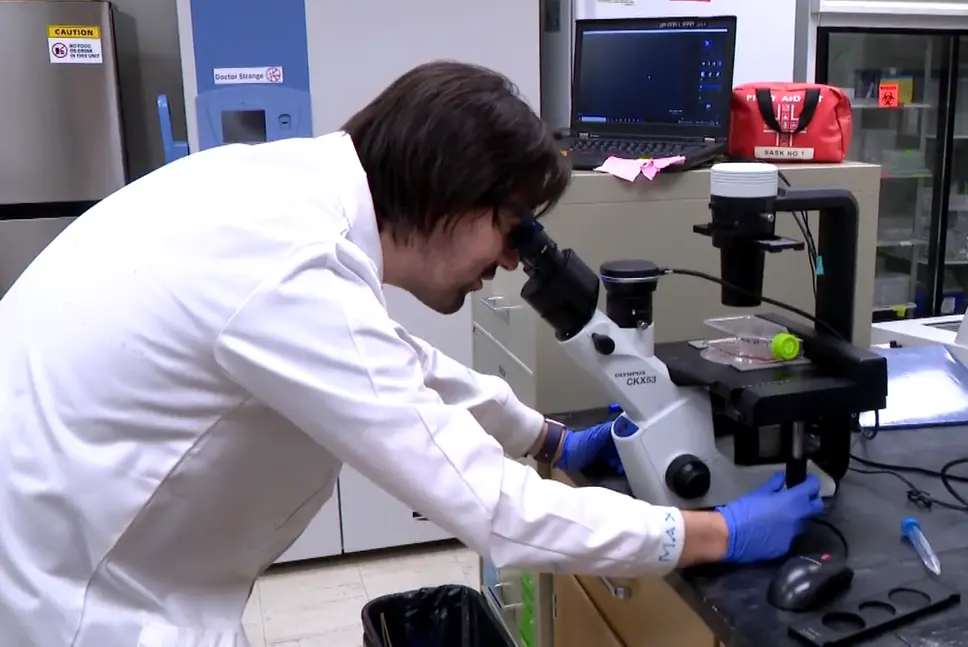
SASKATOON — Significant advancements are being made in the field of pediatric healthcare at the University of Saskatchewan, driven by a researcher whose career path was shaped by a profound desire to help others. Earlier this year, Dr. Tyler Wenzel, an Assistant Professor in the University of Saskatchewan’s Department of Psychiatry, was named a Rising Star Awardee by Canada’s Stem Cell Network. This prestigious national honor recognizes Dr. Wenzel’s outstanding contributions and potential for long-term impact in the rapidly evolving field of regenerative medicine.
For Dr. Wenzel, the journey to the forefront of biomedical research began not in a high-tech laboratory, but in a high school classroom. Before committing to advanced scientific research, Dr. Wenzel worked as a high school science teacher. It was during this time that they witnessed firsthand the devastating impact of severe illness on children and their families. Watching young students fall ill and suddenly disappear from the classroom left a lasting impression on the educator, sparking a lifelong determination to improve healthcare outcomes for children.
Dr. Wenzel recalled that seeing students become so sick that they could no longer attend school was a primary motivator for their career transition. This enduring passion for child health has remained the guiding force behind their transition into academic medicine and psychiatric research, ultimately leading to their current efforts to develop gentler, more effective treatments for rare pediatric diseases.
The recognition from Canada’s Stem Cell Network is a significant milestone, not only for Dr. Wenzel’s laboratory but also for the broader scientific community in Saskatchewan. For generations, the province has been recognized globally as a powerhouse of agricultural production. However, Dr. Wenzel believes this award serves as a powerful message to the international scientific community that Saskatchewan is also becoming a major hub for medical innovation and advanced healthcare.
According to Dr. Wenzel, the award helps demonstrate that the province’s capabilities extend far beyond its traditional agricultural roots. They emphasized that Saskatchewan is home to exceptional hospitals, highly skilled physicians, and state-of-the-art research initiatives that are actively developing sophisticated medical technologies to benefit both local residents and patients worldwide.
At the center of Dr. Wenzel’s current research is a highly focused effort to find a cure for X-linked Adrenoleukodystrophy (ALD), a rare, inherited, and potentially fatal neurodegenerative disease. Currently, patients diagnosed with this devastating condition in Saskatchewan face a difficult reality: the specialized treatment plans required to manage the disease are not available within the province.
The progression of X-linked Adrenoleukodystrophy is exceptionally unpredictable and cruel. Dr. Wenzel explained that the disease carries a lifelong threat of rapid neurological decline. At any point in a patient’s life, from early childhood up to the age of 80, the brain can begin to break down entirely within a brief two-year window. Because of this constant, looming threat, individuals diagnosed with the genetic marker for ALD must undergo routine magnetic resonance imaging (MRI) scans. These regular brain imaging sessions are essential to monitor the patient and detect the very first signs of active brain deterioration before irreversible damage occurs.
If an MRI scan reveals that brain deterioration has indeed begun, patients in Saskatchewan face immediate logistical hurdles. Because the province currently lacks the specialized clinical facilities and the medical capacity to perform the highly complex transplants required to treat the disease, patients must be referred out-of-province. Currently, these individuals are sent to specialized centers in neighboring Alberta or Manitoba to receive their life-saving procedures. This displacement adds an immense layer of emotional, physical, and financial stress to families already dealing with a critical medical crisis.
To address this gap in care, Dr. Wenzel is investigating innovative stem cell transplant methods designed to cure the brain deterioration associated with ALD. Crucially, this research aims to bypass the highly toxic and painful procedures that have traditionally been required to prepare patients for transplants.
Under current medical protocols, treating ALD typically involves subjecting patients—many of whom are young children—to aggressive rounds of chemotherapy and radiation, followed by a traditional bone marrow transplant. While these treatments can halt the progression of the disease, they are incredibly harsh on the human body. Chemotherapy and radiation destroy the patient’s immune system, leaving them highly vulnerable to severe infections, and can cause long-term, debilitating side effects. The Stem Cell Network characterized these traditional methods as highly risky, complex, and painful.
Dr. Wenzel’s laboratory is working to develop a localized transplant method that would allow Saskatchewan patients to completely bypass the need for preparatory chemotherapy and radiation. By utilizing targeted stem cell transplants, the team aims to stop the disease from ever developing or, at the very least, halt the devastating deterioration of the brain without subjecting patients to the trauma of conventional transplant preparation.
According to Canada’s Stem Cell Network, preliminary laboratory data regarding Dr. Wenzel’s method is highly encouraging. Early testing has demonstrated that this specific stem cell transplant approach causes key disease markers to completely disappear in laboratory models. Building on these promising results, Dr. Wenzel is now focused on determining whether the treatment will also cause the physical and neurological symptoms of the disease to vanish.
The potential impact of this research extends far beyond ALD. The Stem Cell Network noted that if Dr. Wenzel’s method is successful, it could provide a therapeutic blueprint to bypass traditional, high-risk treatments for more than a dozen other rare pediatric brain diseases that currently rely on the painful combination of chemotherapy, radiation, and bone marrow transplantation.

While the preliminary results are highly encouraging, translating laboratory discoveries into approved clinical therapies requires a meticulous, step-by-step process. Dr. Wenzel estimates that if all ongoing research, testing, and regulatory reviews proceed smoothly, patients in Saskatchewan could begin receiving this innovative stem cell treatment within a decade.
Dr. Wenzel acknowledged that while ten years may seem like a long wait for families currently affected by the disease, it represents an incredibly rapid timeline in the grand scheme of medical research and drug development. They emphasized that a vast amount of quality control and rigorous safety testing must be completed to ensure the therapy is entirely ready and safe for human use, but expressed optimism about the progress being made.
In the meantime, Dr. Wenzel is actively calling on the public and the patient community for assistance. The research team is encouraging anyone who has been diagnosed with X-linked Adrenoleukodystrophy, or anyone who has ever undergone a stem cell transplant, to reach out to the laboratory through their website. The goal is to connect directly with patients to discuss and learn from their lived experiences, which provides invaluable context for the scientific team.
In addition to sharing their stories, some patients have already contributed to the research in a tangible, clinical way by donating skin biopsies. These tissue samples allow Dr. Wenzel’s team to test the experimental therapy directly on human cells carrying the genetic markers of the disease.
By demonstrating that the therapeutic method successfully works on these patient-derived skin tissue samples, the lab can compile the necessary scientific evidence to present to federal regulators. Dr. Wenzel explained that proving the therapy’s efficacy in these tissue samples is a crucial stepping stone toward securing approval from Health Canada to initiate clinical trials in human patients.
This groundbreaking project is part of a larger, collaborative effort to elevate the scientific infrastructure at the University of Saskatchewan. Dr. Wenzel, along with several other prominent stem cell researchers, is leading the charge to build a robust biomedical team and expand the state-of-the-art research facilities on the USask campus. As the university’s clinical and research capacity grows, Dr. Wenzel and their colleagues will be increasingly well-positioned to develop, test, and deliver powerful regenerative therapies capable of curing or managing a wide range of complex diseases right here in Saskatchewan.