
The stock market has once again proved its capacity to surprise. As valuations reach historic highs driven by the current frenzy surrounding Artificial Intelligence, investors are grappling with a familiar mix of awe and anxiety. When the market crashes, portfolios shrink and panic sets in. But even when equities surge to record levels, a different kind of worry emerges—the nagging suspicion that an even bigger crash is just around the corner, especially when a massive technological boom underpins the valuation.
For those who manage to tune out financial drama and focus on daily life, the peace of mind is palpable. However, for investors tracking the broader economy, the current narrative sounds remarkably familiar. Market observers worry that while AI is undeniably a major technological leap, the mania surrounding it is moving too fast, threatening to trigger a modern, amplified version of the dot-com crash of the early 2000s. That particular boom launched early careers and path-to-retirement plans for many before the subsequent bust threatened livelihoods and financial stability.

As financial commentators and long-term retirees reflect on this latest investment cycle, questions about market resilience mirror those asked during past booms and busts. To address these concerns, veteran financial writers and commentators have taken to the speaker circuit, presenting analyses at events like Camp FI Midwest and upcoming gatherings such as the Bogleheads conference. These discussions delve into whether contemporary market anxieties are genuinely unique or merely a modern iteration of historical panic.
Will the AI Bubble Ruin Our Retirement?
Reaching milestones like two decades of retirement brings a certain comfort with market volatility, yet friends and peers frequently raise anxious queries about how retirees can sleep at night amid global uncertainty. The modern news cycle offers no shortage of alarming headlines: political instability, inflation eroding purchasing power, escalating geopolitical conflicts in the Middle East and Eastern Europe, soaring national debt, and the looming threat of an AI-driven economic bubble.

Yet, this brand of anxiety is hardly new. Looking back twenty years to 2006, the worries dominating public discourse centered on entirely different catalysts. Back then, observers fretted over political leadership, ongoing conflicts in the Middle East, national debt, inflation, and an overvalued stock market driven by the housing bubble rather than AI. Concerns about job security focused on outsourcing to overseas markets rather than algorithmic automation. Discussions even revolved around "Peak Oil," with predictions that fossil fuel consumption would inevitably outstrip supply and doom global civilization.
What followed those 2006 anxieties was the Great Financial Crisis, triggered by a combination of irrational exuberance over housing prices and excessive leverage in mortgage-backed financial instruments. It stands as the largest economic downturn since the Great Depression. Yet, viewed through the lens of a multi-decade timeline, even that monumental crash appears as a temporary dip in a broader upward trajectory. A standard investment portfolio weathering both the 2008 crisis and the 2020 pandemic crash has still experienced substantial long-term growth.

Simultaneously, the broader world made measurable progress across multiple indicators over the same twenty-year span. Global extreme poverty rates dropped significantly, infant mortality rates were drastically reduced, and the adoption of clean energy accelerated as solar panel costs plummeted. Renewable generation now accounts for the vast majority of new energy capacity added globally, while sales of electric vehicles have expanded dramatically from near-zero market penetration to substantial portions of worldwide auto sales.
These historical comparisons raise a fundamental question: should energy be channeled into worrying about an uncertain future, or into long-term optimism? Skeptics naturally ask whether "it is different this time." Perhaps the national debt has finally reached a critical mass, or the AI bubble dwarfs the housing bubble, or artificial intelligence will eventually surpass human control. While financial media outlets thrive on dramatic narratives, these fear-mongering perspectives frequently overlook a core economic truth: true prosperity stems from productivity, not fluctuating financial figures on a computer screen.

The Core Driver of Prosperity
The principle that prosperity originates from productivity rather than abstract financial systems remains a cornerstone of long-term economic understanding. The capitalist world is inherently choppy, prone to wild market swings driven by sentiment. However, beneath the surface waves, real people perform real work and develop tangible inventions.
The concept of an "economy" or a financial system is ultimately a human construct. If a system experiences a severe correction because market participants dislike visible numbers, society retains the capacity to restructure and resume productive labor—a mechanism demonstrated successfully during the 2008 financial crisis and numerous historical precedents. Every productivity-enhancing tool ever invented remains intact, and high productivity continues to drive standard of living improvements, economic growth, and the feasibility of early retirement.

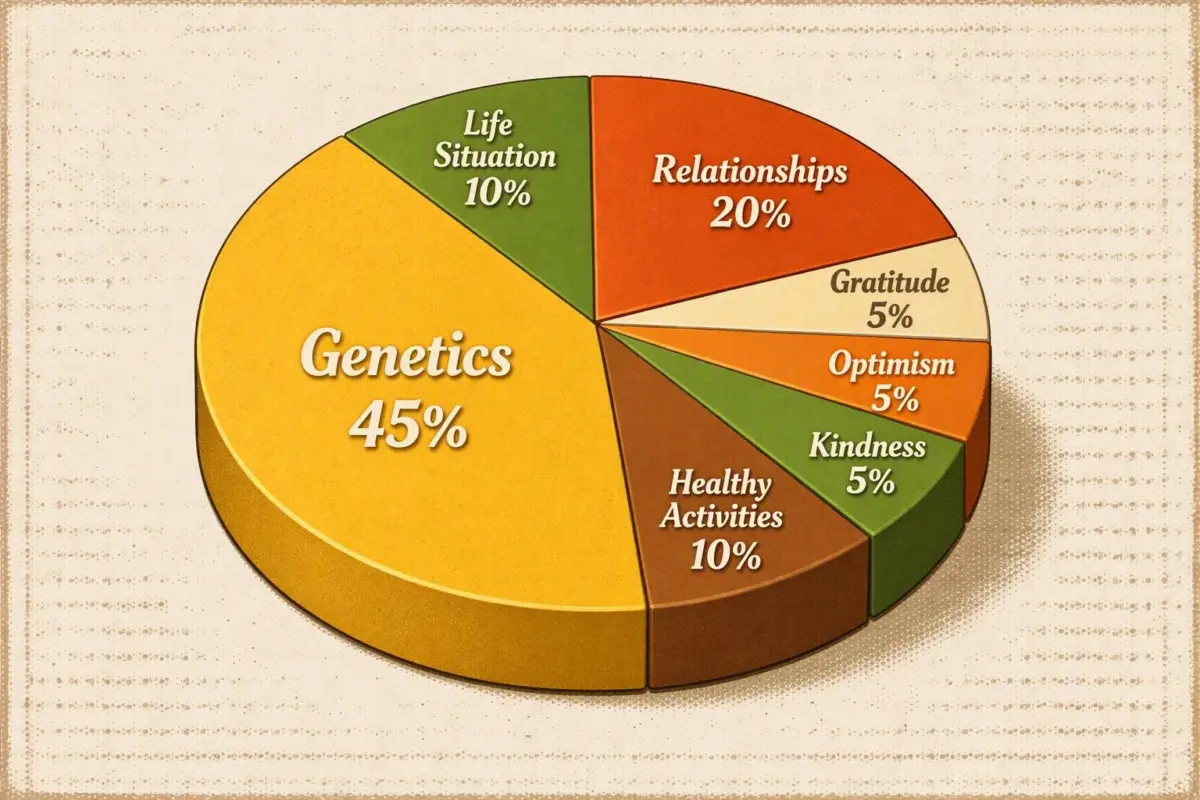
Furthermore, once a society achieves a certain baseline standard of living, human happiness tends to plateau along financial dimensions. Developed nations surpassed those minimum requirements decades ago, shifting the focus of human satisfaction toward non-monetary factors. Wealth ultimately represents just one component of an individual’s overall life situation, sitting alongside genetics, interpersonal relationships, personal philosophy, gratitude, and physical health.
Despite these reassuring realities, baseline anxiety persists even among experienced investors. This phenomenon ties back to basic human evolution: human beings function essentially as danger-detection mechanisms. This pervasive background fear evolved to protect early humans from physical threats. However, a quirk of this evolutionary machinery is that when immediate physical dangers are resolved, the brain continues scanning the environment for new threats, effectively moving the goalposts of worry.

Once predators and disease are mitigated, anxiety shifts toward food scarcity, social exclusion within a tribe, or various financial metrics. When individuals achieve comfortable upper-middle-class stability, anxieties often pivot toward administrative concerns, tax strategies, estate planning, or government-mandated retirement account distributions.
Confronting Fear and Embracing Experimentation
Combating persistent financial and existential fear requires self-awareness and rational evaluation. Examining personal history often reveals the root causes of scarcity mindsets or anxiety, whether inherited from family experiences during historical downturns or shaped by personal trauma. Identifying specific fears by mapping out realistic worst-case scenarios frequently demonstrates that potential outcomes are far less catastrophic than anticipated.

Action serves as a primary antidote to fear, transforming the unfamiliar into the familiar and fostering resilience. Developing mental, physical, and emotional adaptability ensures that changing circumstances become manageable rather than terrifying. Additionally, curating one’s mental diet by reducing consumption of sensationalized daily news helps eliminate persistent negative conditioning. Focusing instead on physical activity, problem-solving, and positive social environments aligns human behavior with natural inclinations.
Viewing life transitions through the lens of experimentation provides a constructive framework for navigating change. Whether applied to minor adjustments or major life decisions—such as changing careers, relocating, or entering retirement—treating choices as experiments removes the catastrophic weight often associated with uncertainty.

This experimental mindset applies directly to the current rise of artificial intelligence. Rather than yielding to doom-scrolling and generalized panic, understanding the technological and economic drivers behind AI reveals substantial potential upside. AI functions essentially as a cognitive efficiency tool, boosting productivity and ultimately driving economic prosperity, much like previous technological revolutions involving the internet and mobile computing.
While new productivity technologies inevitably displace certain administrative and entry-level roles, they simultaneously reduce service costs and catalyze entirely new industries. The rewards of these innovations frequently concentrate among asset owners and shareholders, highlighting the importance of broad market participation. Ultimately, artificial intelligence represents another transitional wave offering opportunities for learning, adaptation, and constructive engagement rather than apprehension.