
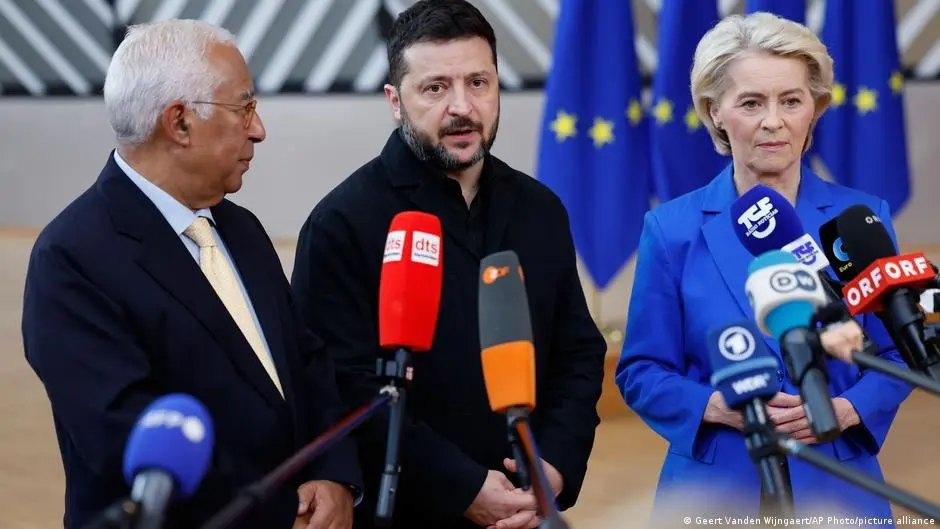
BRUSSELS — Ukrainian President Volodymyr Zelenskyy was greeted with warm applause by European Union leaders as he arrived at this week’s high-stakes European Council summit in Brussels. Behind the symbolic show of solidarity, however, lay an acute and increasingly fraught diplomatic mission. As Kyiv prepares for what experts warn could be the most perilous period of its defense against Moscow, securing the financial, military, and logistical commitments it urgently needs from Europe is proving to be a formidable task, compounded by an increasingly public rift with Washington.
Facing reporters following the discussions, Zelenskyy struck a solemn note, underscoring the severity of the threat confronting his country. He warned plainly that Russian President Vladimir Putin "wants to destroy us" and told allies that Ukraine must brace itself for a brutal winter season marked by ongoing aerial bombardments and depleted infrastructure.
His assessment aligns closely with the evaluations of defense and foreign policy analysts monitoring the conflict. The approaching months are widely anticipated to test Ukraine’s endurance to an unprecedented degree.
"Ukraine is arguably entering the most difficult winter since Russia’s full-scale invasion," Olena Prokopenko, a senior fellow at the German Marshall Fund of the United States, a nonpartisan think tank, told DW. Prokopenko and other observers note that cumulative damage from relentless Russian strikes on energy systems, coupled with battle fatigue along front lines, has significantly narrowed Ukraine’s margin for error.
Against this backdrop, Zelenskyy’s talks with European heads of state and top officials in Brussels centered on three critical and sensitive topics: the changing dynamics of United States relations with Russia, mounting vulnerabilities regarding battlefield communications via the Starlink satellite network, and the vast financial resources required to prevent Ukraine’s state budget from collapsing in the coming year.
Is the US Siding with Russia?
Zelenskyy’s arrival in Brussels unfolded at a juncture when European backing has become indispensable for Kyiv, largely due to signs that its most consequential security patron—the United States—is altering its stance. Anxiety has steadily intensified across both European capitals and within Ukraine that Washington may be tilting toward a more accommodating posture toward Moscow.
Since the onset of Russia’s full-scale assault in February 2022, the United States has served as Ukraine’s single largest provider of military assistance, supplying tens of billions of dollars in advanced weaponry, ammunition, intelligence, and logistical support. Yet that partnership has grown visibly strained and volatile following the start of Donald Trump’s second presidential term in the White House.
The friction between Washington and Kyiv was laid bare in remarks Trump made to the US television network Newsmax. Discussing his interactions with foreign leaders, Trump was candid about his personal frictions with the Ukrainian leadership, remarking: "I think I find Zelenskyy to be more difficult to deal with than Putin."
Concerns deepened substantially following a commercial arrangement brokered by the US president on October 12 to purchase Russian diesel. For officials in Kyiv and supportive European states, the procurement marked a jarring departure from the stringent economic sanctions and energy embargoes intended to isolate the Kremlin, representing both an economic boon for Moscow and a severe diplomatic setback for Ukraine.
The political tensions boiled over when Zelenskyy authorized Ukrainian armed forces to launch renewed strikes on oil refineries deep inside Russian territory, an operational strategy designed to disrupt Moscow’s fuel logistics and curtail its revenue streams. Trump strongly denounced the operations, publicly condemning the Ukrainian leader’s decision as "a disgrace."
Speaking directly about these transatlantic shifts during Friday’s press conference in Brussels, Zelenskyy did not conceal Kyiv’s mounting realization that American strategic priorities have shifted toward other geopolitical theaters. He acknowledged to journalists that US-manufactured missile systems "are being sent to the Middle East, so it is no secret that we are not a priority."
With Washington’s focus drifting and bilateral relations frayed, Zelenskyy is pressing European governments to step into the breach. He urged European leaders to supply the necessary defense capabilities and air defense power required to protect Ukrainian cities and sustain defensive positions as cold weather sets in.
The Starlink Slowdown
Beyond geopolitical shifts and arms supplies, the summit addressed an operational crisis concerning battlefield communications. Ukrainian forces have relied heavily on Starlink, the low-Earth-orbit satellite internet network operated by billionaire Elon Musk’s SpaceX. Alongside civilian connectivity, the Ukrainian military has integrated Starshield—a specialized, military-grade iteration of the technology—into its core defense architecture.
The Starshield system has provided essential real-time connectivity for front-line units, coordinating mid-range strikes within Russian-occupied territories and directing interceptor drones targeting hostile aerial threats, while remaining restricted from facilitating long-range attacks inside Russian borders.
At the Brussels summit, Zelenskyy shared his dismay over recent operational disruptions that have compromised these vital communication networks, describing his reaction as a "deep and unpleasant" surprise. He stressed to European counterparts that the sudden performance degradation has seriously impaired Ukraine’s tactical awareness and its capacity to defend against ongoing Russian maneuvers.
The origins of the disruption remain contentious. Both Musk and representatives from the White House have firmly denied responsibility for the operational slowdown, rejecting suggestions of deliberate interference.
The episode has nonetheless exposed Ukraine’s extreme reliance on private and foreign-controlled communications infrastructure—a vulnerability that Europe is currently ill-equipped to alleviate. Addressing the media in Brussels prior to the start of the leaders’ discussions, the EU’s foreign policy chief, Kaja Kallas, offered a candid evaluation of the situation.
"Starlink is really necessary for Ukraine and unfortunately in the short term Europe can’t replace this capability," Kallas told reporters.
According to Prokopenko, this technological bottleneck leaves Ukraine with limited alternatives for the immediate future. "Ukraine’s most credible medium-term solution here is to continue relying on the US," she explained, emphasizing that Europe must play a diplomatic role in resolving the impasse. "And the EU is critical in this context in terms of backing Ukraine’s requests for the US administration to keep those technologies on offer" for Kyiv.
During his press briefing, Zelenskyy indicated that while satellite bandwidth had not yet returned to its full operational capacity, there had been noticeable improvements. He confirmed that Ukrainian officials are actively coordinating with international partners, including France, in search of secondary and partial technical solutions to diversify their battlefield communications and minimize reliance on single providers.
Ukraine’s Budget Problem
Underpinning the strategic and technological dilemmas is an escalating fiscal deficit. With state finances under immense strain from years of total mobilization, Zelenskyy made a direct appeal to EU leaders on Friday to secure essential macro-financial backing for the upcoming year, requesting nearly $80 billion (€70 billion).
"This is a realistic amount and I ask you to find this support," Zelenskyy stated during his presentation to the council. "It will help us hold Russia back."
The appeal follows an approximately $100 billion (€90 billion) loan package previously delivered to Kyiv by the European Union, which established the bloc as Ukraine’s leading financial patron. Nevertheless, the government in Kyiv maintains that ongoing expenditures far exceed existing funding instruments.
Prokopenko pointed out that the fiscal reality inside Ukraine has grown increasingly precarious as infrastructure is systematically degraded.
"The war is becoming objectively more expensive, and the Ukrainian economy is increasingly affected by the Russian strikes, leading to a drastic decline in tax and customs revenues," Prokopenko explained. "So the needs will continue growing."
Whether the EU can marshal the political consensus and fiscal leeway to deliver on Kyiv’s extensive requirements remains an open question. At the conclusion of the summit, newly appointed European Council President António Costa affirmed that supporting Ukraine "remains a priority" for the bloc. Costa formally requested that the European Commission formulate a comprehensive proposal to organize and deliver supplemental funding for Ukraine looking ahead to 2027.
While the European leadership signaled an intent to address Ukraine’s budgetary shortfall, the mechanisms for doing so remain undetermined. European Commission President Ursula von der Leyen reiterated the union’s commitment to standing by Kyiv, promising that the EU will "continue to lead," though she simultaneously called upon wider international partners to shoulder a greater share of the financial load.
Ukraine to ‘Keep Living and Fighting with Dignity’
Zelenskyy concluded his visit to the European capital without definitive funding allocations, specific deadlines, or binding bilateral defense pledges. Nonetheless, he secured a renewed political consensus that Europe remains pledged to Kyiv’s preservation at a time when other partnerships appear increasingly fragile.
Departing the summit with the challenges of the coming winter lying directly ahead, the Ukrainian president closed his press conference with a solemn declaration of national resolve: "We will keep living and fighting with dignity."