
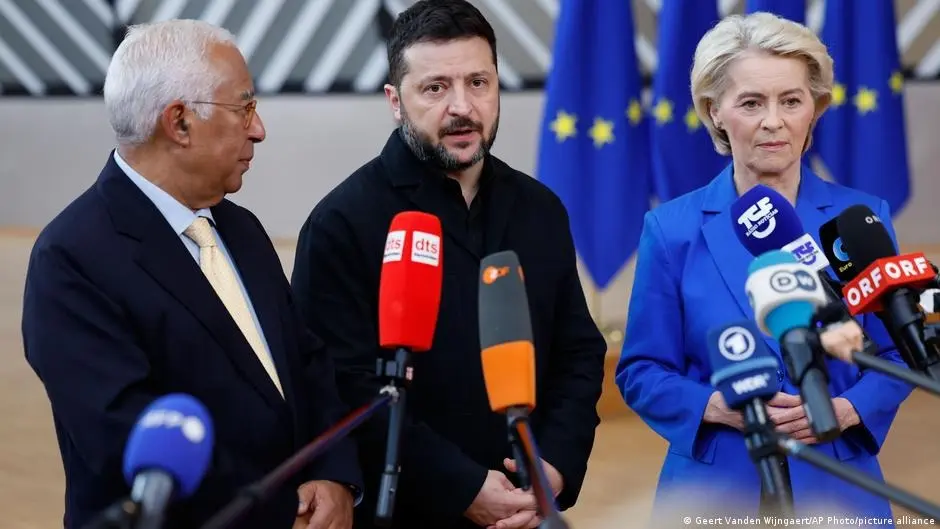
When Ukrainian President Volodymyr Zelenskyy stepped into the European Council summit in Brussels, European Union leaders greeted him with a warm standing ovation. Yet behind the ceremonial display of solidarity lies an increasingly precarious reality for Kyiv. As the Ukrainian leader sought to secure vital military, technological, and financial commitments from European partners, he confronted a diplomatic landscape fraught with friction—dominated by a deteriorating relationship with US President Donald Trump, unexpected disruptions to vital battlefield satellite communications, and an urgent push to close an enormous budgetary deficit.
Addressing reporters at the gathering, Zelenskyy delivered a sobering assessment of the situation facing his nation, warning bluntly that Russian President Vladimir Putin remains intent on the total subjugation of the country. "Putin wants to destroy us," Zelenskyy stated, underscoring that Ukraine is now bracing for an extraordinarily punishing winter season.
Independent security analysts share that grim perspective. With essential infrastructure under persistent Russian bombardment and defense logistics stretched to capacity, the coming cold months are expected to test the country’s endurance like never before.
"Ukraine is arguably entering the most difficult winter since [Russia’s] full scale invasion," Olena Prokopenko, a senior fellow at the German Marshall Fund of the United States, observed.
Against this perilous backdrop, the discussions between Zelenskyy and his European counterparts centered on three deeply sensitive and unresolved issues: the shifting posture of the United States toward Moscow, the operational vulnerabilities exposed by recent throttling of Starlink satellite services, and the immense financial support needed to keep the Ukrainian state and military afloat over the coming year.
Shifting Priorities in Washington and the Growing Rift With Trump
Zelenskyy’s arrival in Brussels underscored Ukraine’s urgent need to lean on European partners, driven largely by the deepening chill in Kyiv’s relationship with Washington. Throughout the EU and within Ukraine, anxiety has mounted over signals that the United States is adopting a more accommodating stance toward the Kremlin.
Tensions burst into the open following remarks by President Trump on the US news channel Newsmax, where he publicly expressed frustration with the Ukrainian leader. "I think I find Zelenskyy to be more difficult to deal with than [Russian President Vladimir] Putin," Trump remarked.
The diplomatic strain has been further exacerbated by policy decisions in Washington that appear to undermine the Western sanctions regime. On October 12, Trump concluded an agreement to purchase Russian diesel. For Kyiv and its European allies, the transaction marked an alarming departure from the punitive economic measures designed to starve Moscow’s war machine of revenue, delivering a direct political and psychological blow to Ukraine.
Frictions intensified when Ukrainian forces launched fresh waves of strikes against Russian oil refineries—an operational effort aimed at curtailing Moscow’s domestic fuel supplies and military logistics. The move drew an immediate and sharp rebuke from the White House, with Trump condemning the Ukrainian leader’s decision as "a disgrace."
Speaking at a press conference during the Brussels summit, Zelenskyy acknowledged the changing strategic calculations in Washington. He observed that American military assets, particularly guided missile systems, are increasingly being diverted away from Eastern Europe to other global hotspots. Zelenskyy noted that US-manufactured interceptors and missiles "are being sent to the Middle East, so it is no secret that we are not a priority."
With American strategic attention pivoting elsewhere, Zelenskyy appealed directly to Europe to bridge the critical gap, urging continental allies to provide the necessary military hardware and defensive firepower to sustain Ukrainian operations through the harsh winter months.
Since Russia launched its full-scale invasion in February 2022, the United States had served as Ukraine’s single largest provider of military assistance. However, the trajectory of bilateral cooperation has grown increasingly fraught and unpredictable since the commencement of Trump’s second presidential term, forcing European capitals to reconsider their own defense commitments and strategic capabilities.
The Starlink Disruption and Ukraine’s Communications Vulnerability
Beyond diplomatic and political hurdles, Ukraine is grappling with immediate operational obstacles on the front lines. A central topic of concern during the Brussels talks was the reliability of Starlink, the low-Earth-orbit satellite internet network operated by tech billionaire Elon Musk’s SpaceX.
Ukrainian defense forces rely heavily on Starlink and its specialized military counterpart, Starshield, to conduct high-speed tactical communications, coordinate artillery fires, pilot interceptor drones, and orchestrate precision strikes against Russian-occupied territories. While Starshield capabilities are not utilized for deep, long-range strikes inside sovereign Russian territory, the network remains the indispensable backbone of Ukraine’s tactical situational awareness and defensive maneuvering.
Zelenskyy expressed his "deep and unpleasant" surprise upon discovering that Ukrainian forces had encountered widespread slowdowns and connectivity disruptions across the network. The Ukrainian president emphasized that these service impairments had directly hobbled the military’s capacity to defend territorial positions and coordinate live battlefield responses.
Both Elon Musk and the White House have denied any deliberate involvement in the service disruptions, disavowing claims that administrative or technical curbs had been intentionally imposed on Kyiv’s forces.
Nevertheless, the incident exposed a profound technological dependency that Europe remains currently unable to resolve. Speaking to reporters ahead of the summit discussions, the EU’s high representative for foreign affairs and security policy, Kaja Kallas, delivered an unvarnished assessment of the continent’s limitations.
"Starlink is really necessary for Ukraine and unfortunately in [the] short term Europe can’t replace this capability," Kallas acknowledged.
This technological reality leaves Kyiv with limited room for maneuver. Olena Prokopenko of the German Marshall Fund pointed out that despite political frictions, maintaining access to American commercial defense platforms remains a non-negotiable imperative for Ukraine.
Prokopenko observed that this dependency explains "why Ukraine’s most credible medium-term solution here is to continue relying on the US. And the EU is critical in this context in terms of backing Ukraine’s requests for the US administration to keep those technologies on offer" for Kyiv.
During his press briefing, Zelenskyy noted that while Starlink connection speeds had not been fully restored to their prior performance levels, operational conditions had recorded measurable improvement. He added that Ukrainian authorities are actively coordinating with several foreign partners, including France, in an effort to develop complementary communications infrastructure and establish partial alternatives to lessen total reliance on a single provider.
Escalating War Costs and the €70 Billion Budget Dilemma
While battlefield communications and military hardware dominated tactical discussions, Ukraine’s solvency proved to be an equally pressing concern. With state finances under unprecedented strain, Zelenskyy presented EU leaders with a substantial funding appeal, requesting nearly $80 billion (€70 billion) in direct financial assistance for the upcoming year.
"This is a realistic amount and I ask you to find this support," Zelenskyy urged European leaders during the closed-door proceedings. "It will help us hold Russia back."
The latest funding request comes on top of substantial past commitments. The European Union previously orchestrated a massive financial support package of roughly $100 billion (€90 billion) in loans, cementing the bloc’s position as Ukraine’s largest international financial benefactor. Yet the sheer scale of modern attritional warfare, combined with the deliberate targeting of Ukraine’s industrial and energy sectors, has caused state revenue to plummet while defense spending demands skyrocket.
"The war is becoming objectively more expensive, and the Ukrainian economy is increasingly affected by the Russian strikes, leading to a drastic decline in tax and customs revenues," Prokopenko explained. "So the needs will continue growing."
European leadership acknowledged the financial urgency, even as questions persist regarding how such sums can be mobilized across member states. At the conclusion of the summit, European Council President António Costa assured that Ukraine "remains a priority" for the bloc. Costa instructed the European Commission to draft a formal proposal to structure extended financing mechanisms to support Kyiv through 2027.
European Commission President Ursula von der Leyen reaffirmed that the EU intends to "continue to lead" the international coalition assisting Ukraine. However, she paired that pledge with an explicit call for broader international burden-sharing, urging global partners outside Brussels to contribute meaningfully to the country’s fiscal stability.
Commitments Without Guarantees: Fighting On With Dignity
Zelenskyy concluded his visit to the Belgian capital without securing firm numerical commitments or newly signed financial packages from EU member states. Instead, he departs with renewed political declarations of solidarity and a European pledge to formulate future mechanisms of economic and military support.
The summit highlighted the delicate tightrope Ukraine must walk as the war grinds on. With traditional transatlantic backing clouded by political discord in Washington, commercial satellite networks subject to sudden operational vulnerabilities, and domestic state revenues battered by continuous infrastructure strikes, Kyiv finds itself increasingly reliant on an EU that is willing to offer political praise, yet deliberate and constrained in delivering decisive material solutions.
Despite the mounting strategic obstacles and the uncertain road ahead, Zelenskyy struck a resolute tone as the summit drew to a close, framing his country’s struggle not merely as a matter of geopolitical negotiations, but as an enduring fight for national survival.
"We will keep living and fighting with dignity," Zelenskyy told reporters.