
The stock market has a persistent habit of surprising everyone, leaving investors perpetually dusting off the phrase, “How about that stock market?” When equities tumble, retirement portfolios shrink, causing immediate panic. Yet even when the market surges to record-shattering valuations, anxiety follows close behind, driven by the suspicion that a massive correction is inevitable. This fear is particularly acute today, as the current economic boom is fueled by the frenzied expansion of Artificial Intelligence.

For those who have tuned out the financial melodrama to simply enjoy their lives, the detachment is commendable. However, understanding the context of the current AI wave reveals a familiar historical pattern. Investors worry that while artificial intelligence is undoubtedly a monumental technological leap, the speed and scale of the mania mirror the dot-com bubble of the early 2000s. That particular boom launched the early career of online financial commentator Mr. Money Mustache and set him on the path to early retirement, only for the subsequent crash to nearly derail his employment and citizenship application.
Addressing these recurring anxieties, the veteran financial blogger recently developed a presentation exploring the intersection of modern market tech bubbles and personal finance, delivering it first at Camp FI Midwest and preparing an updated version for the upcoming Bogleheads conference. Reflecting on more than two decades of retirement, he frequently encounters a familiar brand of skepticism from friends and followers asking how anyone can sleep at night with the state of the world.

A retrospective look at these worries reveals a striking continuity in human anxiety. Twenty years ago, in 2006, the headlines were dominated by fears of corrupt political leaders, a volatile Middle East conflict in Iraq, surging national debt, inflation, and a housing bubble threatening an overvalued stock market. There were widespread concerns about outsourcing jobs to India and China, alongside an intense debate over peak oil and the impending exhaustion of fossil fuels.
Instead of total destruction, the subsequent years brought the Great Financial Crisis—triggered by housing market irrational exuberance and excessive financial leverage—which marked the largest economic downturn since the Great Depression. Yet, viewed through the lens of a twenty-year horizon, even that severe crisis appears as a temporary dip. A $100,000 investment made back then would have grown significantly despite the turbulence of the 2008 crash and the subsequent 2020 pandemic downturn.

Simultaneously, the broader world experienced remarkable structural improvements. Global extreme poverty dropped from 20 percent in 2005 to just 8 percent over the following two decades, while infant mortality rates were cut in half. Clean energy expanded dramatically as solar panel costs plummeted by roughly 40 times, allowing solar generation to dominate new energy capacity additions globally. Pure electric vehicle sales surged from near zero to a substantial share of worldwide automotive sales, reaching complete market saturation in countries like Norway.
This historical perspective challenges the narrative of persistent doom. It raises a central question for contemporary investors facing the AI boom and soaring national debt: Is it truly different this time? While financial media thrives on sensationalizing catastrophic scenarios—ranging from systemic economic collapse to runaway artificial superintelligence—these pessimistic views often overlook a fundamental economic reality. Prosperity does not originate from the abstract numbers of the financial system or the stock market; true prosperity stems from productivity.

The underlying engine of capitalism is inherently volatile, prone to wild market swings driven by sentiment. Beneath the surface turbulence, however, real people perform tangible work and develop genuine innovations. Financial systems and economies are fundamentally human constructs. If a system experiences a severe correction, society has repeatedly demonstrated the capacity to reset the parameters and resume productive labor, much as it did following the 2008 financial crisis and prior historical downturns. Human productivity, standard of living, and economic growth rely on accumulated technological tools rather than fleeting market valuations.
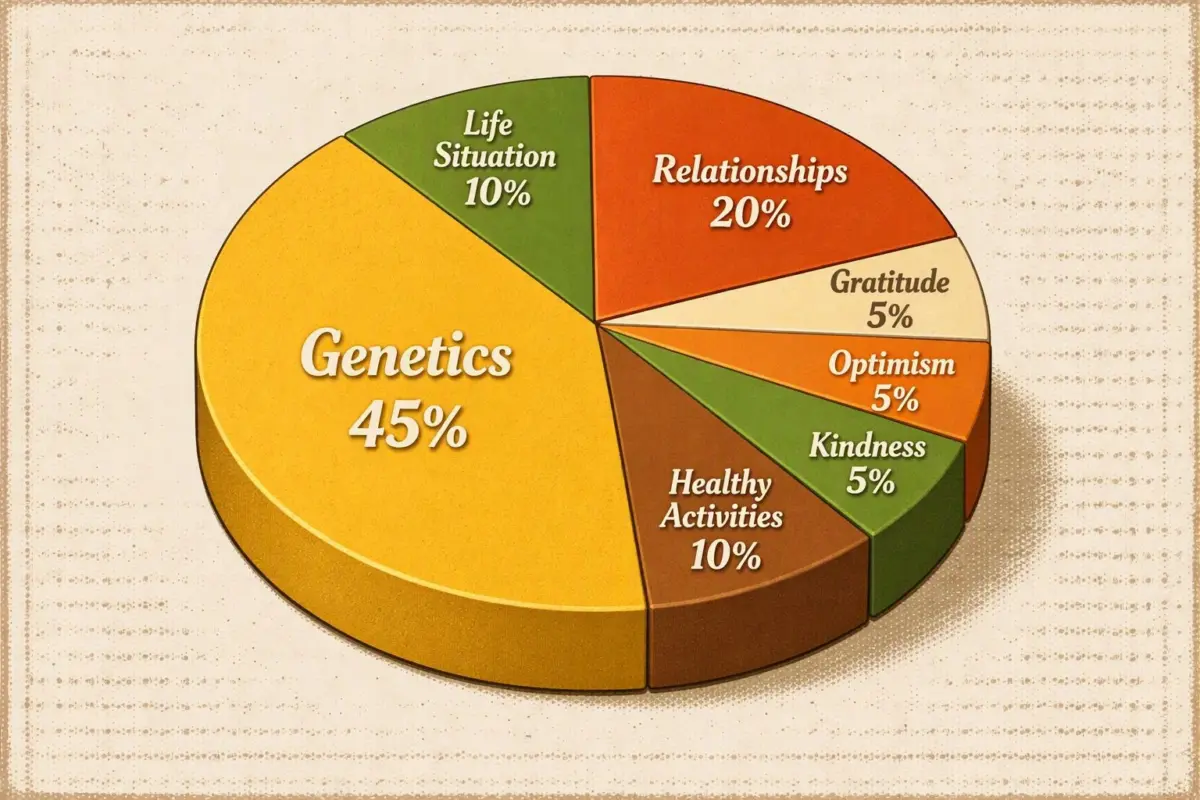
Beyond economic output, human happiness tends to plateau once a certain baseline standard of living is achieved. In developed nations, societies passed those minimum material requirements decades ago. True life satisfaction depends heavily on factors outside mere wealth accumulation, such as genetics, strong personal relationships, the practice of gratitude and optimism, and maintaining an active, outdoor lifestyle.

Despite these reassuring realities, baseline anxiety persists within financial independence communities and the general public alike. This pervasive fear is largely a product of evolutionary biology. Humans evolved as sophisticated danger-detection machines, utilizing background fear as a survival mechanism to protect against predators, disease, and scarcity. When those immediate physical threats are resolved, the brain continues searching for new targets of concern, moving the goalposts from physical survival to tribal acceptance, wealth accumulation, tax optimization, and regulatory hurdles like required minimum distributions.
Overcoming this ingrained psychological barrier requires self-awareness and rational analysis. Examining personal history often reveals that financial anxieties stem from childhood influences or past economic trauma rather than an objective assessment of current reality. Understanding that the root cause lies in personal history rather than the present day helps dismantle irrational dread. Taking proactive steps further mitigates anxiety, as action transforms the unfamiliar into the familiar, building resilience and capability.

Reducing exposure to sensationalized daily news diets also plays a crucial role in mental well-being. Modern media frequently relies on hand-picked stories designed to provoke fear and engagement rather than provide balanced information. Realigning daily habits with human biological needs—such as physical movement, outdoor activity, and constructive problem-solving—helps alleviate the psychological strain exacerbated by sedentary modern lifestyles. Surrounding oneself with positive, optimistic peers further reinforces a constructive mindset focused on living a fulfilling life rather than anticipating ruin.
Approaching major life transitions and technological shifts with an experimental mindset transforms potential sources of dread into fascinating subjects of observation. Whether evaluating a career change, a housing move, or a massive technological revolution like artificial intelligence, viewing events as experiments neutralizes panic.

Rather than succumbing to doom-scrolling, analyzing the underlying mechanics of artificial intelligence reveals its potential as a powerful cognitive tool. Much like a cognitive nail gun, AI enhances human efficiency, driving productivity and long-term prosperity. While this technological leap will inevitably displace certain entry-level office and driving roles, historical precedent suggests that it will simultaneously reduce service costs and spark entirely new industries, mirroring the transformative paths of the internet and mobile applications.
While technological revolutions tend to concentrate financial rewards among asset owners and shareholders, they remain fundamentally manageable shifts in the economic landscape. Artificial intelligence, like every economic wave before it, presents an opportunity for deliberate choice rather than blind panic. By addressing the root causes of fear and maintaining a focus on productivity, learning, and human connection, individuals can navigate the uncertainties of the modern market and embrace the potential of the future.