
By Staff Reporters
The stock market has once again proved its capacity to surprise. As valuations reach historic highs driven largely by the explosive and frenzied artificial intelligence boom, investors find themselves caught in a familiar psychological loop. When markets crash, retirement portfolios shrink and anxiety spikes. Yet, when markets climb to record highs, a different kind of worry takes hold: the creeping suspicion that an unprecedented crash is just around the corner, fueled by the breathless momentum of the current tech cycle.

For those who have tuned out the financial news cycle to focus on daily life, the underlying anxiety might seem perplexing. However, the current narrative surrounding artificial intelligence mirrors previous historical inflection points. Investors worry that while AI is undoubtedly a major technological advancement, the market mania is moving too fast and reaching too high, threatening to trigger a modern, larger-scale version of the dot-com crash of the early 2000s.
That particular boom holds a unique place in financial history, having launched the early career of prominent early-retirement advocate and internet financial commentator Mr. Money Mustache, before the subsequent crash nearly derailed his professional trajectory and citizenship application. Addressing these cyclical anxieties has become a regular fixture for veteran financial commentators, who recently debuted a new presentation on the topic at the Camp FI Midwest event, with a revised version scheduled for the upcoming Bogleheads conference in November.

Will the Artificial Intelligence Bubble Ruin Retirement?
Reflecting on more than two decades of retirement, financial commentators often encounter a recurring question from anxious observers: How can anyone remain comfortable and sleep peacefully at night given the state of global affairs?
A look back at the news headlines reveals a constant stream of existential threats. In the contemporary media landscape, anxieties center on polarizing political leaders, persistently eroding purchasing power due to inflation, the artificial intelligence bubble, towering national debt levels, and simmering geopolitical conflicts in Ukraine and the Middle East that threaten wider destruction.

Yet, these exact concerns are not entirely novel. Conversations from twenty years ago, in 2006, featured remarkably similar worries. Back then, the public fixated on controversial global leaders, ongoing military engagements in the Middle East, national debt, and inflation. The stock market was similarly viewed with suspicion, though the underlying fear was driven by the housing bubble rather than an AI mania. Instead of artificial intelligence threatening white-collar employment, the dominant fear was the outsourcing of jobs to India and China. Economists and doomsayers also debated peak oil, warning that rapidly increasing fossil fuel consumption would inevitably outstrip dwindling supplies—a prediction that ultimately reversed course entirely.
In retrospect, the twenty years following 2006 did indeed bring monumental challenges, most notably the Great Financial Crisis. Triggered by a combination of irrational exuberance over housing prices and excessive financial leverage, it became the most severe economic downturn since the Great Depression. Yet, viewed through the lens of a multi-decade horizon, even that historic crisis appears as a temporary dip. A diversified investment portfolio weathering those turbulent decades still experienced substantial long-term growth, absorbing subsequent shocks like the pandemic-era market drop of 2020.

Simultaneously, the broader world experienced remarkable human progress. Global extreme poverty rates dropped significantly over a twenty-year span, while infant mortality rates were cut in half. Clean energy adoption surged as the cost of solar panels plummeted, transforming solar generation into the primary source of newly added electrical capacity globally. Electric vehicle sales transitioned from a statistical zero to claiming a substantial share of worldwide automotive sales, reaching near-total market saturation in regions like Norway.
This historical perspective underscores a fundamental question regarding human psychology: Is it more productive to channel energy into worrying about an uncertain future, or to focus on constructive optimism?

Prosperity, Productivity, and Human Happiness
Skeptics frequently question whether the current economic environment is fundamentally different. Concerns persist that the mounting United States national debt will finally trigger systemic failure, that the artificial intelligence bubble dwarfs the housing market collapse, or that artificial intelligence could eventually evolve beyond human control. While financial media outlets thrive on crafting alarming narratives, these fear-mongering perspectives routinely overlook a core economic truth: true prosperity stems from productivity, not financial systems and stock market tickers, which are ultimately human-invented constructs.
Market economies are inherently volatile and prone to dramatic cyclical swings. Beneath the surface turbulence, however, real people engage in tangible labor and develop genuine technological innovations. Financial systems are merely conceptual frameworks; if a system fails due to unsustainable metrics, societies have historically reset the parameters and resumed productive work, as demonstrated following the 2008 financial crisis and prior historical corrections. The fundamental tools driving productivity, standard of living, and economic growth remain intact.

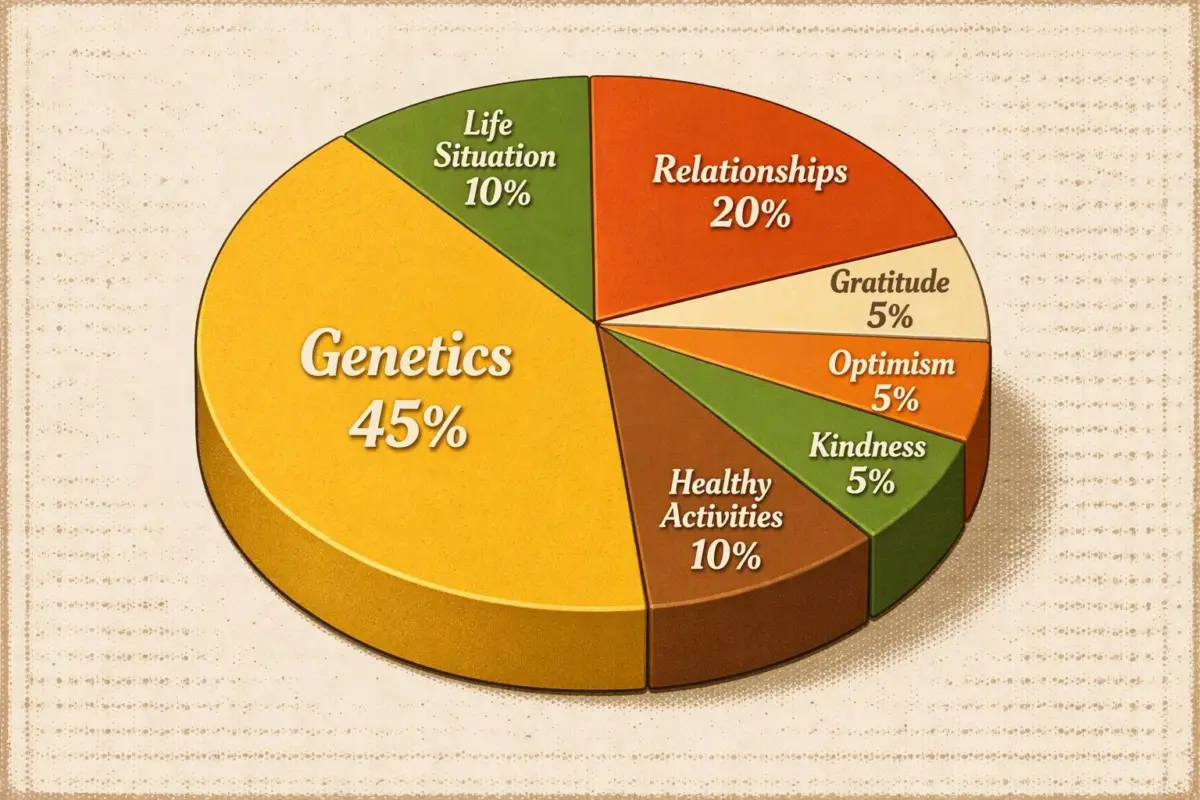
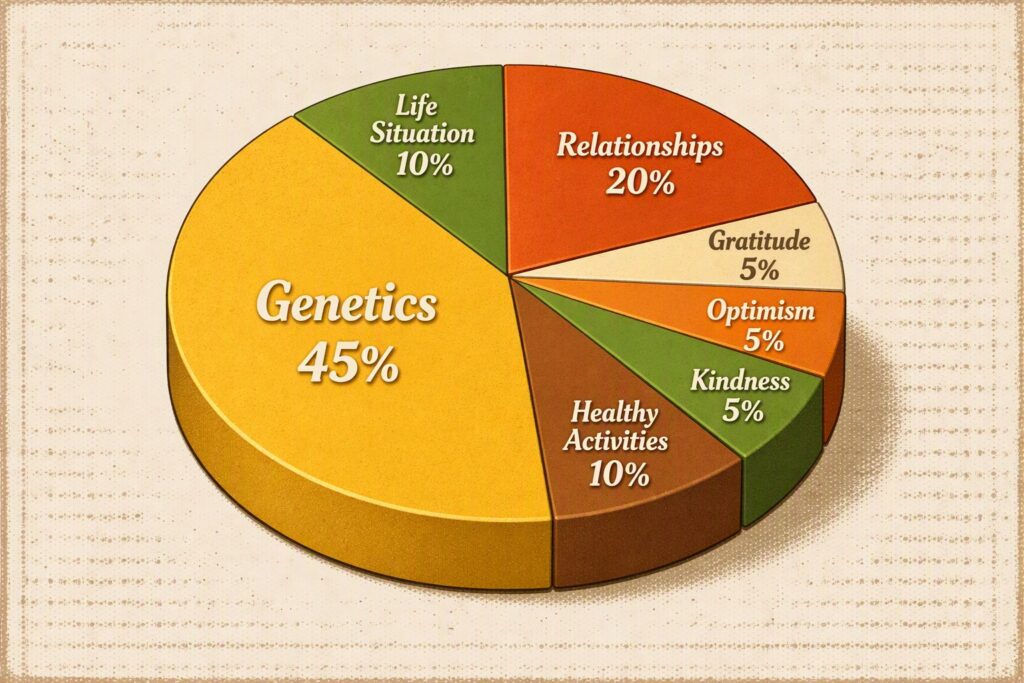
Beyond economic output and material prosperity, human well-being plateaus once basic living standards are met. Advanced industrial nations surpassed these minimum thresholds decades ago, prompting individuals to seek fulfillment through non-material dimensions. Psychological research suggests that while baseline happiness is heavily influenced by innate factors, conscious personal choices play a critical role. Cultivating strong personal relationships, practicing gratitude, maintaining an optimistic philosophy, and incorporating regular physical activity outdoors constitute the primary drivers of long-term life satisfaction.
Despite these established principles, background anxiety remains pervasive. The root cause often traces back to fundamental human biology.

Confronting Fear and the Nature of Risk
Human beings evolved as sophisticated danger-detection machines. This pervasive background anxiety served as an evolutionary survival mechanism designed to protect early humans from predators and environmental threats. However, a psychological quirk of this detection machinery is its persistence; once immediate physical threats are mitigated, the human mind continues searching for new sources of worry, effectively moving the goalposts of anxiety.
After solving challenges related to food scarcity and tribal belonging, modern anxieties often shift toward financial optimization, social status, and complex administrative concerns. Individuals who achieve comfortable upper-middle-class lifestyles may find themselves fixated on neighborhood governance, tax strategies, estate planning, or government-mandated retirement account distributions.

Combating this persistent fear requires self-awareness and rational evaluation. Understanding one’s personal history—such as childhood experiences with financial scarcity or past trauma—sheds light on why certain anxieties persist independently of objective present conditions. When specific fears are examined critically by analyzing realistic worst-case scenarios, the perceived threats frequently diminish in magnitude.
Taking deliberate action is widely recognized as an effective antidote to fear. Engaging directly with unfamiliar situations builds confidence and fosters resilience—the capacity to adapt to changing circumstances. Furthermore, curating one’s mental environment by reducing exposure to sensationalized daily news media allows individuals to shift focus from passive consumption of alarming stories to active, positive behaviors. Reconnecting with physical activity, nature, and optimistic communities reinforces a balanced perspective on life.
Viewing Artificial Intelligence Through the Lens of Experimentation
Adopting an experimental mindset toward major life changes transforms how individuals perceive uncertainty. Whether applied to minor adjustments or significant transitions like career changes, relocation, or early retirement, viewing life events as experiments neutralizes irrational panic.
Applying this perspective to the current artificial intelligence landscape reframes the technology from an existential threat into an object of intense fascination. While rapid technological shifts generate legitimate uncertainty, examining the underlying mechanics reveals significant productive potential. Artificial intelligence functions essentially as a cognitive tool designed to enhance human efficiency and productivity.

Much like previous technological revolutions—including the internet and mobile smartphones—the advent of artificial intelligence will inevitably displace certain administrative and operational roles while simultaneously lowering service costs and catalyzing entirely new industries. Historically, the economic rewards of such productivity gains tend to concentrate among technology owners and corporate shareholders, extending financial benefits to broad-market investors.
Ultimately, artificial intelligence represents another transitional opportunity requiring deliberate human choices. Rather than succumbing to speculative fear, recognizing technological shifts as catalysts for continuous learning allows individuals to navigate an evolving future with resilience, keeping in view the principle that meaningful personal growth consistently lies just beyond the boundary of fear.