
The stock market has a persistent habit of surprising investors, consistently defying expectations as the years pass. When the market undergoes a sharp downturn, anxiety naturally sets in as retirement portfolios shrink. Yet, even when stocks climb to unprecedented, record-breaking valuations, a different kind of worry emerges: the nagging dread that an even larger crash is looming just around the corner. This apprehension is particularly acute today, fueled by a market boom riding the coattails of the current, frenetic artificial intelligence wave.

For those fortunate enough to tune out the daily market drama and focus on everyday life, the sentiment is simple: keep enjoying the journey. But understanding the broad strokes of the current financial landscape helps contextualize the ongoing debate. Investors increasingly worry that while artificial intelligence is unquestionably a major technological breakthrough, the market mania surrounding it is happening too much and too fast. This has led many to fear a modern iteration of the dot-com crash of the early 2000s—a historic boom that coincidentally propelled early careers and paved the way for early retirement, even if the subsequent crash nearly derailed employment and citizenship trajectories at the time.
As long-standing financial commentators and digital gurus field numerous questions about this investment cycle, veterans of past booms and busts are stepping up to address the anxiety head-on. Discussions and presentations at gatherings like Camp FI Midwest and upcoming financial forums highlight a recurring theme: examining whether the current AI bubble poses a genuine threat to long-term retirement security.

Reflecting on decades of retirement, financial observers note that the core anxieties of investors remain remarkably consistent across generations, even if the buzzwords change. Looking back twenty years to 2006, individuals wrestled with a completely different set of worries. Back then, headlines focused on controversial political leaders, ongoing conflicts in the Middle East, escalating national debt, and rising inflation. The overvalued stock market of that era was driven by a housing bubble rather than an artificial intelligence bubble, and the existential threat to employment was job outsourcing to overseas markets rather than algorithmic automation. There was even widespread debate over peak oil and the fear that fossil fuel supplies would inevitably plummet while demand surged, though the exact opposite ultimately occurred.
What followed the widespread anxiety of 2006 was indeed the Great Financial Crisis, triggered by irrational exuberance over soaring home prices combined with overly complex financial leverage in mortgage instruments. It marked the most severe economic downturn since the Great Depression. Yet, when viewed through the lens of a decades-long horizon, even that monumental financial crisis appears as a temporary dip in a broader upward trajectory. A standard investment placed in the market decades ago still managed to multiply significantly over time, weathering both the housing crash and subsequent disruptions like the 2020 pandemic downturn.

Simultaneously, the broader world experienced remarkable structural improvements. Global extreme poverty rates dropped substantially over a twenty-year span, and infant mortality rates were cut in half. Clean energy expanded dramatically as solar panel manufacturing costs plummeted, making solar generation a dominant source of new energy capacity globally. Pure electric vehicle adoption similarly surged from negligible levels to a substantial fraction of all global car sales. This historical perspective raises a fundamental question for modern investors: should energy be channeled into worrying about an uncertain future, or into long-term optimism?
Will the AI Bubble Ruin Our Retirement?
The central question remains whether current conditions are fundamentally different. Skeptics point to towering national debt levels, the immense scale of the AI market valuation, and dystopian scenarios involving super-intelligent technology taking over the planet. Financial media outlets frequently amplify these scary narratives, yet they consistently overlook a foundational economic principle: true prosperity does not originate from financial systems or stock market tickers, which ultimately represent numerical abstractions tracked on computers.

Instead, genuine prosperity stems from productivity. The capitalist system is inherently volatile and prone to wild cyclical swings, but beneath the turbulent surface lie real people performing real labor and developing tangible innovations. The concept of an economy or a financial system is itself a human construct. If a financial system experiences a catastrophic disruption because market participants lose confidence in prevailing numerical valuations, society possesses the capacity to reset the metrics and resume productive work—a strategy deployed successfully during past financial panics.
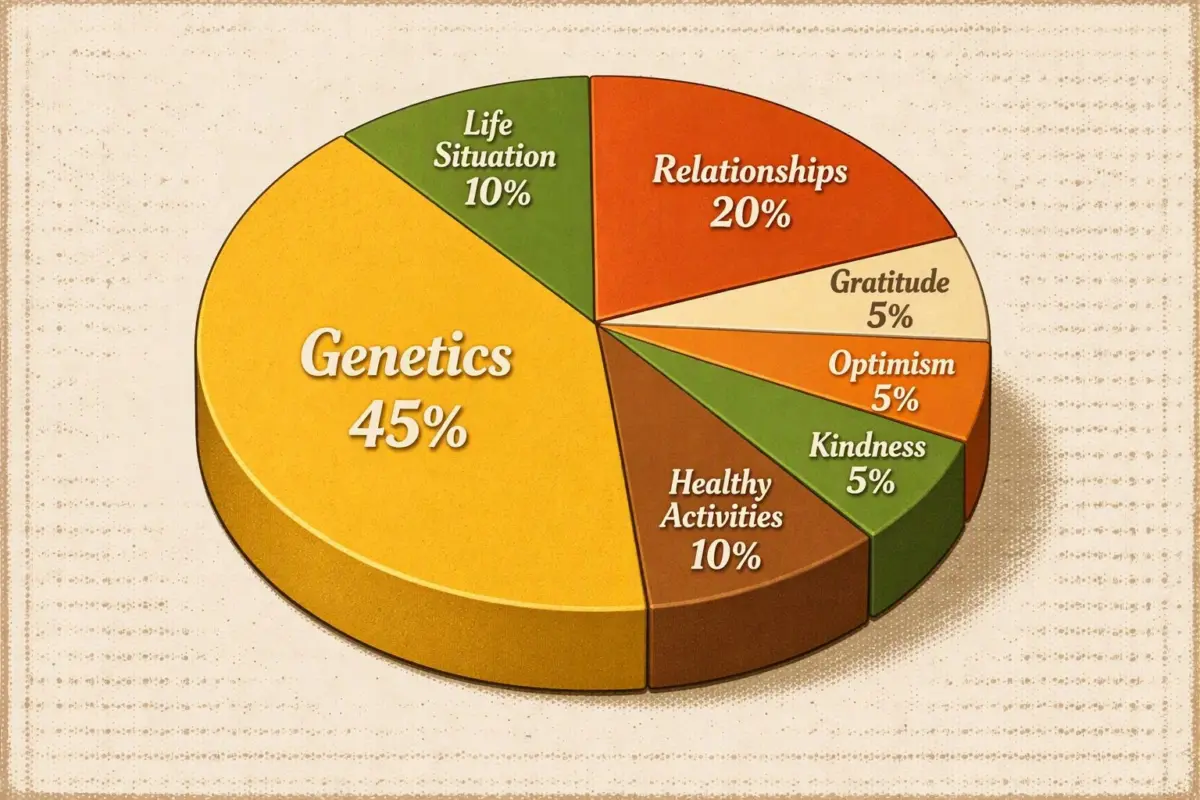
Meanwhile, society retains every historical tool designed to enhance productivity, which directly fuels standards of living, economic growth, and the viability of early retirement. However, once a baseline standard of living is achieved, human happiness tends to plateau along that specific financial dimension. Advanced economies surpassed those minimum physiological requirements decades ago, shifting the focus of human satisfaction toward non-financial factors. Wealth ultimately functions as a single component within a broader life situation, sitting alongside foundational elements like personal health, community relationships, gratitude, optimism, and outdoor physical activity.

Despite these reassuring historical lessons, pervasive anxiety persists among savers and retirees. The underlying culprit is often fear itself. As human beings, individuals operate essentially as biological danger-detection machines. This background vigilance evolved as a vital evolutionary trait to protect early humans from physical threats. However, a peculiar quirk of this psychological machinery is that when genuine physical dangers subside, the brain continues scanning the environment for new targets of concern, effectively moving the goalposts of worry.
Once basic survival, food security, and social belonging are secured, affluent societies tend to pivot toward financial anxieties, tax strategies, estate planning, or even localized bureaucratic disputes. Fortunately, individuals retain the cognitive capacity to recognize and push back against this irrational fear. The first step involves understanding personal history—recognizing whether financial anxiety stems from childhood scarcity mindsets, generational trauma passed down from families who survived the Great Depression, or past personal hardships.

Understanding and Combating Financial Anxiety
Once underlying anxieties are identified, examining the worst-case scenarios objectively often reveals that potential outcomes are far less catastrophic than perceived. Taking concrete action remains one of the most effective antidotes to fear, as it transforms the unfamiliar into the familiar and builds resilience. Developing comprehensive mental, physical, and emotional adaptability ensures that individuals can navigate unforeseen circumstances with confidence.
Another crucial step in managing anxiety involves curating one’s daily mental diet, particularly by reducing exposure to sensationalized news cycles designed to provoke panic through hand-picked tales of crisis. Human beings are biologically wired to solve problems actively through physical and mental engagement, ideally in open environments. Spending excessive time isolated indoors or operating digital devices often generates psychological strain that mirrors a mismatch with natural human habits. Prioritizing consistent learning, physical movement, constructive problem-solving, and positive social connections naturally alleviates stress.

Approaching major life transitions—whether changing careers, moving to a new home, or entering early retirement—through the lens of an ongoing experiment can similarly reframe uncertainty. Rather than viewing artificial intelligence as an existential threat, forward-thinking observers view the AI era as a fascinating technological experiment.
Rather than succumbing to doom-scrolling, analyzing the underlying mechanics of artificial intelligence reveals its primary function as a sophisticated cognitive amplifier. Much like a power tool that accelerates construction, AI enhances efficiency, productivity, and ultimately broader economic prosperity by lowering the cost of cognitive labor. Like any major technological revolution—from the industrial mechanization of the past to the rise of the internet and mobile applications—AI inevitably displaces certain traditional job categories while simultaneously giving rise to entirely new industries and services.

While productivity gains tend to concentrate rewards among enterprise owners and shareholders—a group that includes many long-term index fund investors—artificial intelligence ultimately presents individuals with a choice. It can serve as a catalyst for unwarranted fear or act as an incentive for continuous learning, adaptation, and personal growth. By recognizing that apprehension is frequently a symptom of internal psychological wiring rather than an objective reflection of external reality, individuals can better navigate market bubbles, technological shifts, and the uncertainties of the modern economy.