
The stock market has once again proved its capacity to surprise, leaving investors grappling with a familiar yet intense anxiety. As indexes push past historic milestones and valuations reach unprecedented heights, a pervasive unease has taken hold across financial circles. This modern apprehension is anchored heavily in the current artificial intelligence boom—a technological frenzy that has left many wondering whether the market is hurtling toward a systemic correction that dwarfs previous financial downturns.
For those who have managed to tune out the daily market drama, the contemporary AI narrative boils down to a few rapid developments: groundbreaking technological leaps, astronomical capital investments by major tech firms, and a widespread cultural debate over how automation will reshape global labor markets. Yet, beneath the surface of these technological milestones lies a deep-seated investor anxiety. Many fear that the current mania mirrors the dot-com bubble of the early 2000s, only scaled up for a new era.

This historical parallel carries personal resonance for early retirement advocates who navigated the technology boom of the turn of the millennium. That era served as both a catalyst for early career success and a source of severe vocational turbulence when the subsequent crash tested job security and economic stability. As questions surrounding the current investment cycle multiply, financial commentators and long-term retirees are increasingly called upon to address whether market overvaluation threatens modern retirement security.
Will the AI Bubble Ruin Our Retirement?
The psychological weight of market volatility often leads to anxious inquiries from observers watching their retirement portfolios fluctuate. Friends and financial followers frequently voice concerns about how anyone can remain retired and sleep soundly given the turbulent state of global affairs. A rolling catalog of contemporary anxieties—spanning volatile geopolitical leaders, persistent inflationary pressures, soaring national debt, and the looming threat of regional conflicts—creates a constant backdrop of perceived crisis.

However, a historical perspective reveals that such anxieties are hardly unique to the present decade. Conversations held two decades ago during the mid-2000s centered on an entirely different set of existential threats. At that time, global markets contended with geopolitical instability in the Middle East, escalating national debts, and anxieties surrounding inflation. Investors worried deeply about an overvalued housing market rather than an AI-driven boom, while workers feared the mass outsourcing of jobs to developing economies rather than automation by algorithms. Furthermore, widespread public debates centered on "peak oil" and the imminent depletion of fossil fuel reserves—an outcome that ultimately reversed as technological innovation unlocked new energy supplies.
Despite the profound dread that accompanied the mid-2000s, the subsequent decades witnessed remarkable economic and societal resilience. Even the Great Financial Crisis of 2008—triggered by housing market speculation and complex financial leverage—ultimately appeared as a temporary dip in the broader trajectory of long-term market growth. Over a twenty-year horizon, broad market indexes demonstrated significant recovery and long-term expansion, absorbing subsequent shocks such as the market downturn induced by the global pandemic in 2020.

Beyond financial charts, the broader world experienced measurable improvements across several fundamental human metrics. Global extreme poverty rates saw a significant decline over a twenty-year span, while infant mortality rates were halved. Concurrently, clean energy technologies matured rapidly, with solar energy generation costs dropping precipitously to become a dominant source of new power capacity worldwide. Electric vehicle adoption similarly transitioned from a theoretical concept to a substantial share of global automotive sales.
These developments highlight a central economic truth: human prosperity does not fundamentally originate from abstract financial systems or stock market tickers, which ultimately represent numerical expressions on computer servers. True prosperity is fundamentally rooted in productivity.

The Roots of Economic Prosperity and Human Happiness
Economic history demonstrates that while capitalism is inherently prone to cyclical volatility and market corrections, underlying productivity continues to advance through human ingenuity and real-world inventions. Financial systems and economic economies are human constructs; if a financial model breaks down due to market corrections, societies retain the capacity to restructure the framework and resume productive work, much as they did following the financial crises of the past.
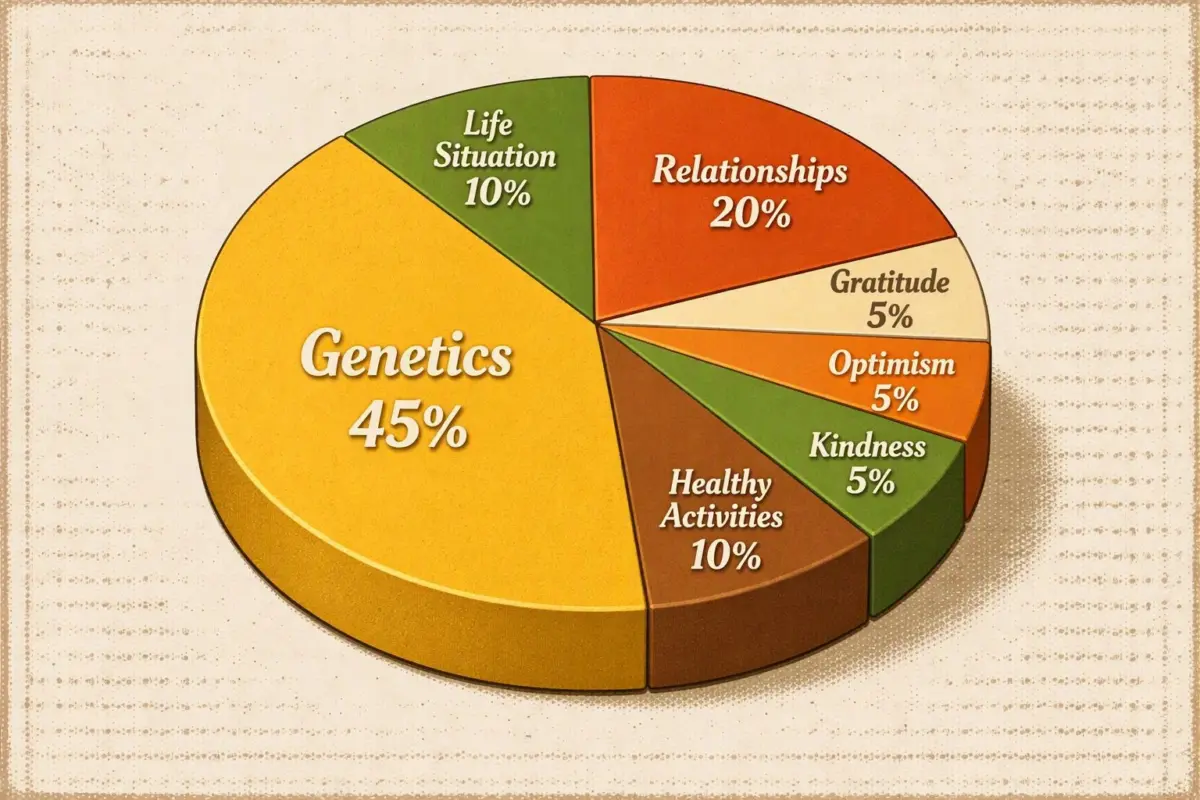
Productivity drives the standard of living, economic growth, and the feasibility of financial independence. Yet, once a society achieves a stable baseline standard of living, human happiness tends to plateau along material dimensions. Psychological and sociological research indicates that overall life satisfaction is governed heavily by factors largely independent of wealth accumulation. Genetics, strong personal relationships, the practice of gratitude, optimism, and engagement in healthy physical activities form the primary pillars of human well-being.

Despite these established insights, background anxiety persists even among experienced investors and early retirees. This phenomenon is deeply rooted in human evolutionary biology. Human beings evolved primarily as danger-detection machines, utilizing a baseline level of vigilance to protect against physical threats, scarcity, and social exclusion.
When immediate physical dangers are mitigated by modern civilization, this innate detection machinery does not simply deactivate. Instead, it shifts its focus, moving goalposts to find new subjects for worry. Once basic survival needs and financial security are met, anxiety frequently pivots toward secondary concerns, ranging from neighborhood property standards and tax strategies to wealth preservation and estate management.

Confronting Fear and Adapting to Technological Change
Overcoming this pervasive background fear requires self-awareness and a rational examination of personal history and emotional triggers. Scarcity mindsets often trace their origins to childhood experiences or generational trauma, such as the economic fallout experienced by families who lived through historical downturns like the Great Depression. Recognizing that these emotional responses are often echoes of the past rather than objective evaluations of the present is a vital step toward emotional resilience.
Identifying specific fears by examining worst-case scenarios often reveals that perceived catastrophes are statistically unlikely to materialize. Taking proactive steps to address unfamiliar situations converts uncertainty into confidence, building the psychological resilience necessary to navigate shifting environments. Furthermore, curating one’s daily informational diet by reducing exposure to sensationalized news media helps mitigate unnecessary psychological distress. Prioritizing positive behaviors, physical movement, and engagement with optimistic communities provides a healthier foundation for mental well-being.

This experimental mindset applies directly to the current technological revolution surrounding artificial intelligence. Rather than approaching AI through the lens of doom-scrolling and apprehension, analysts suggest viewing the technology as a major new experiment in human capability.
AI functions essentially as a cognitive tool designed to enhance efficiency and productivity. Much like past technological revolutions—ranging from the advent of the internet to the widespread adoption of mobile smartphones—artificial intelligence will inevitably displace certain traditional administrative and operational roles while simultaneously reducing service costs and catalyzing entirely new industries.

While productivity gains and technological efficiencies historically tend to concentrate economic rewards among capital owners and shareholders, the broader integration of artificial intelligence represents another structural evolution in the modern economy. Ultimately, how individuals perceive and respond to these shifts remains a matter of personal choice. By framing uncertainty as an opportunity for learning and adaptation, observers can move past the limitations of fear and engage constructively with the evolving economic landscape.