
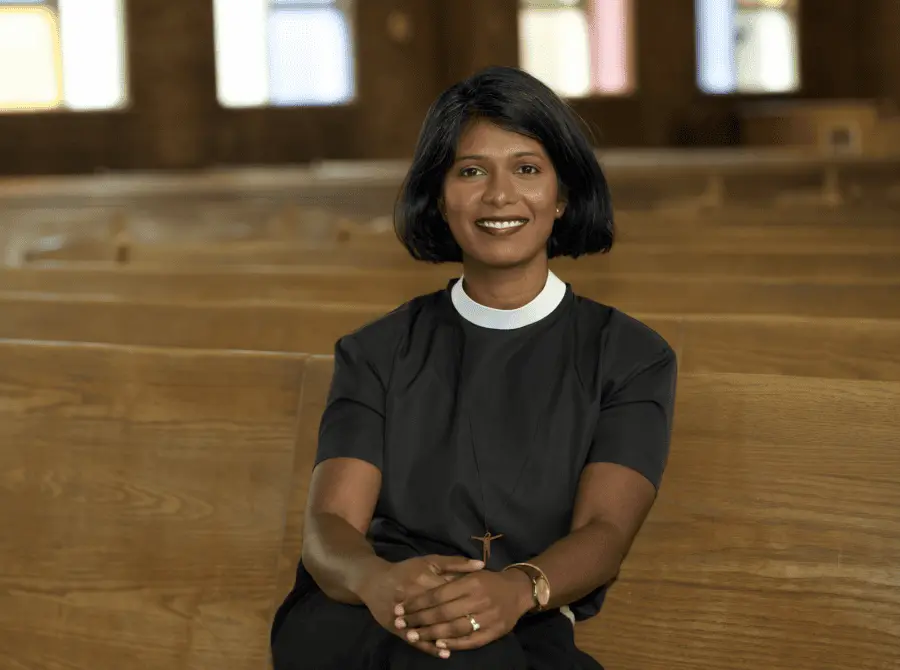
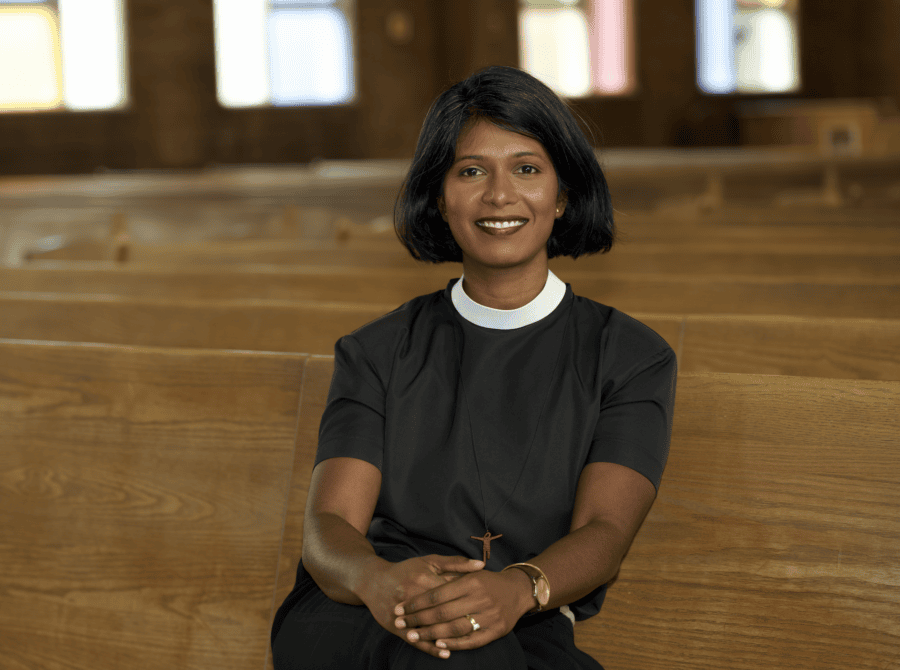
For the past six years, the Rev. Gerlyn Henry has walked a familiar path shared by clergy members for generations: she serves as an Anglican priest in Scarborough, Ontario, dedicating her days to tending to her local parish and leading her community in worship. But outside the physical walls of her church, Henry has constructed a vast, entirely different kind of congregation. More than half a million people now follow her across TikTok and Instagram, where she publishes near-daily video content exploring the intersection of politics, progressive religion, and clergy lifestyle.
To explore what it means to lead a dual life as both a parish priest and a prominent social media influencer, Broadview’s recent summer intern, James Adair, sat down with Henry for an in-depth conversation about faith in the digital age, the hurdles of online visibility, and the deep tensions of preaching a gospel of inclusion through algorithms engineered for outrage.
Demystifying the Church for a Secular Age
When asked what newcomers should expect when encountering her online videos, Henry explains that while her content touches on faith, politics, and the day-to-day reality of being a member of the clergy, its core purpose is much more fundamental. Her goal, she notes, is to demystify the church and the concept of faith for a modern audience.
For many people today, Henry observes, institutional religion appears rigid, opaque, and entirely controlled by a select few individuals holding power and privilege. Through her videos, she works to dismantle that perception by sharing personal stories, employing subtle sarcasm, acknowledging her own mistakes, and offering viewers a behind-the-scenes look at the human dynamics of Sunday morning church life. Ultimately, she aims to showcase what the church can look like at its absolute best: an institution rooted in justice, community, love, and inclusion, while helping people navigate the often-complex relationship between faith and politics.
A significant portion of Henry’s massive digital audience consists of secular individuals or people who grew up attending church but stopped going years ago. Reflecting on how she attracted such a large non-religious following, Henry notes that her content creation journey spans four and a half years. Initially, her videos focused exclusively on traditional church themes and clerical life, which drew a modest audience and kept her follower count stagnant at around 40,000 for years.
The turning point, she explains, arrived when Donald Trump came into power for a second term. While many religious creators approach digital platforms with a hidden agenda—such as pushing for conversions or using judgment to drive people back into church pews—Henry strives to offer radical hospitality without conditions. She also infuses her content with levity, balancing the profound cultural weight of modern political and theological discourse through personal storytelling and humor. This strategic approach helps disarm the defensiveness many people naturally feel when approaching topics like faith and politics.
According to Henry, the primary driver keeping secular viewers engaged is a shared pursuit of justice. In a contemporary society hungry for spaces that model systemic dignity, safety, and inclusion, secular audiences are drawn to an ordained leader in a clerical collar who passionately advocates for human rights and mental health, while remaining vulnerable enough to acknowledge the historical mistakes made by the institutional church.
Navigating the Tensions of Big Tech
Operating within the architecture of big tech naturally creates ethical and philosophical dilemmas for a spiritual leader. Addressing whether she finds it difficult to reconcile the nature of social media algorithms with the positive message she wishes to propagate, Henry readily admits that she wrestles with this tension every single day.
To maintain her personal boundaries, she has chosen never to join X, formerly Twitter, as an act of protest against Elon Musk. Yet, she recognizes a profound irony in using platforms specifically designed for outrage and fleeting attention spans to preach a gospel centered on inclusion and justice. Embracing that subversion, she argues, is deeply Christian, representing a strategic approach that the modern church has largely lost. While internet algorithms reward clickbait and rage, Henry emphasizes that the online ministry of Christians is not about driving views or enraging audiences, but rather about fostering true reconciliation—not a superficial peace between differing ideologies, but reconciliation between humanity and God.
Consequently, Henry views expressions of doubt as valuable opportunities rather than obstacles. Naming those doubts, she suggests, is inherently prophetic because doubt frequently catalyzes action, whether that action involves walking away from a broken system or standing up to reform it. Furthermore, Henry points out that progressive Christians often maintain a lower public profile globally because they have historically failed to utilize the digital platforms heavily populated by conservative voices. While substantial financial resources are routinely poured into building conservative digital ecosystems to establish their perspectives as the societal standard, Henry views social media not as a replacement for Sunday morning worship, but as a digital front porch where passersby can engage with ideas on their own terms. To participate in that broader cultural conversation, however, she believes religious leaders must have a presence on these platforms.
Managing Two Flocks: Parish Priest Versus Digital Creator
Balancing a tangible, in-person parish community with a massive digital following requires clear boundaries, a lesson Henry learned through difficult firsthand experience.
Reflecting on her early days online, Henry admits she struggled to define her identity, viewing herself simultaneously as a pastor, a prophet, and an influencer. That lack of boundary management led to a painful misstep when she responded to a comment from an older follower with playful sass online. The remark deeply hurt the user, who reached out privately before blocking her. On another occasion, a high school acquaintance commented that Henry deserved to be deported for holding affirming views. Henry responded by sharing historical context about affirming practices within the Indian context, causing the video to go viral. Consequently, internet users flooded her former classmate’s profile with hostile comments, forcing the individual to deactivate all of her accounts.
That incident served as a stark awakening regarding the distinct power dynamics of the internet—power that does not mirror the intimate pastoral relationship she holds within her physical church. Today, Henry maintains strict boundaries: she does not introduce herself as a pastor in private messages, nor does she view her online audience as her flock. Instead, she identifies simply as a digital content creator offering glimpses of faith and inviting people to visit her in person, while explicitly dropping the traditional pastor-flock dynamic online—noting, for instance, that she uses profanity online, a practice she avoids entirely within her church.
This careful separation has largely protected her in-person ministry. Out of her local congregation, Henry estimates that only about 20 percent of parishioners are even aware of her social media presence, as she rarely discusses it during services. She deeply values the normalcy of interacting with parishioners who see her strictly as a young local pastor. Nonetheless, her digital visibility has driven organic growth, bringing roughly 100 online visitors to her church over the past year to experience her ministry firsthand, where they have consistently received a warm welcome from the parish.
The Real-World Risks of Public Advocacy
Despite the positive community-building aspects of her online ministry, stepping into the digital spotlight carries severe, real-world consequences that occasionally bleed into her personal life. Henry compares the experience to minor celebrity status, noting that increased public recognition brings a profound sense of humility alongside an overwhelming weight of responsibility.
The darker side of digital visibility became starkly evident following a viral video she posted discussing women’s health, body positivity, and Planned Parenthood. The post thrust her into a wider digital sphere, resulting in a targeted doxxing campaign. An individual tracked down her physical residence, threatening to burn her home down. While online threats are a frequent occurrence, Henry expresses deep frustration that her public advocacy needlessly exposes her family and local congregation to safety risks without their consent—a dangerous variable she constantly has to manage.
Her outspoken commentary on the Israeli-Palestinian conflict has similarly generated intense backlash, with accusations of antisemitism escalating every time her videos gain traction. These complaints have even reached her diocesan leadership, prompting church officials to encourage greater caution in her public statements.
The Prophetic Imperative and the Margins
When determining whether a specific topic warrants discussion from a Christian perspective, Henry applies a rigorous theological framework. She believes that whenever an issue directly impacts human dignity, systemic power structures, or the flourishing of creation, the church is inherently implicated and must not remain silent. Choosing silence, she argues, is never a neutral stance; rather, it functions as a public endorsement of the status quo. Whether addressing the housing crisis, economic justice, migration, or geopolitical conflicts like Palestine, Henry evaluates topics using two core theological tests.
The first is the incarnational test. Rooted deeply in Anglican theology, which emphasizes the incarnation—the belief that God took human flesh and lived within real political occupation—Henry argues that when systemic issues arise, such as housing investments flourishing while local shelters remain full and underfunded, the church is morally obligated to speak out in alignment with biblical mandates to feed the hungry and clothe the naked.
The second is the power test. Drawing from the prophetic tradition spanning the Old and New Testaments, Henry emphasizes the importance of continually examining who holds systemic power and who is being crushed beneath it. When the church limits its public discourse to safe, sanitized topics, she warns, it effectively transforms into an arm of the state rather than a prophetic voice for justice. Reflecting on her time as an intern at a World Council of Churches conference themed "Mission from the Margins," Henry shares how the concept reshaped her perspective: recognizing that God is most visibly present among society’s marginalized populations, and that true spiritual mission moves inward toward those privileged with power, rather than outward from a position of centrality.
Ultimately, Henry’s journey into digital ministry began quite unexpectedly. She recalls the exact moment she realized her online presence was expanding rapidly, sparked by an interaction outside her car in Toronto. Wearing her clerical collar, a stranger approached her, expressing surprise that a woman could hold such a position and wear such attire, eventually lecturing her on modesty. Feeling playful right before heading out on vacation, Henry responded by asking if the woman would prefer she visit a nude beach instead. The astonished reaction captured in her subsequent video recounting the incident went viral, catching everyone off guard and firmly establishing her presence on the digital map.