
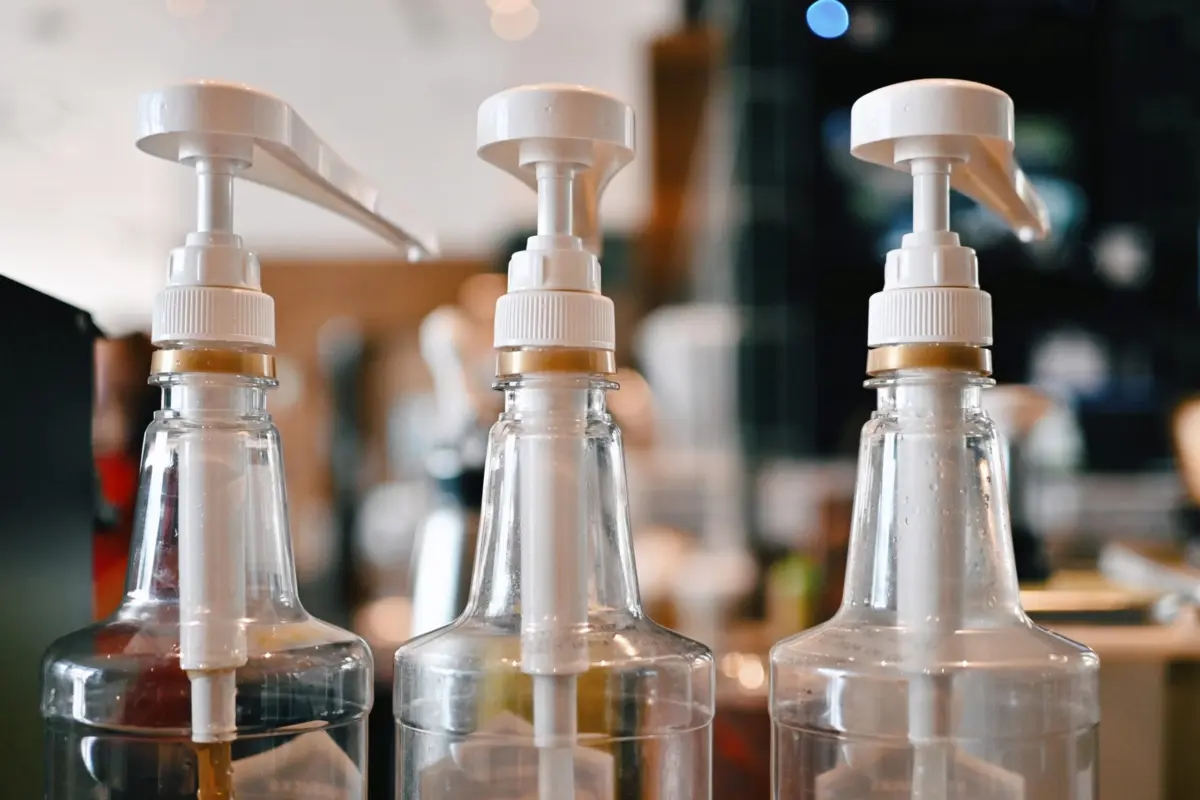
In an era where specialty coffee consumers are increasingly critical of what goes into their cups, a viral TikTok video with over 82,000 likes has captured a growing sentiment across social media. The camera zooms into the shelves of a Pennsylvania coffee shop, revealing three stacked rows of Torani syrups in familiar flavors like blueberry, brown-sugar cinnamon, English toffee, and salted caramel. “I just know my latte isn’t going to be good,” the caption reads.
This reaction is far from an isolated incident. Across platforms like TikTok and X, formerly Twitter, similar consumer sentiments have become ubiquitous. “If I see these at a cafe, I’m walking out immediately,” one widely shared tweet declares, earning a chorus of agreement from hundreds of commenters. Meanwhile, content creators are documenting their personal boycotts, such as a multi-part video series where a creator replaces every single mass-market Torani syrup in her pantry with alternatives sourced exclusively from small businesses. Last year, the niche food newsletter Unsnackable even published what it termed a “Torani tirade.”
While Torani frequently bears the brunt of this digital backlash simply due to its massive market dominance, the phenomenon extends across the entire landscape of premade coffee flavorings. Competitor brand Monin, frequently favored by operators looking for alternatives, faces similar criticisms on internet forums from consumers alleging that the products taste “like chemicals.” For a dedicated and vocal segment of specialty beverage drinkers, bottled, premade syrups have transformed into a definitive coffee shop red flag.
To these consumers, spotting rows of commercial plastic bottles behind the counter signals that a so-called specialty establishment—one asking patrons to fork over $8 plus tip for a standard latte—is cutting corners on quality and craftsmanship. Mass-market syrups have become synonymous with corporate food chains and impersonal conglomerates, representing precisely the kind of institutional uniformity that many customers are trying to escape when they support independent businesses. Conversely, for independently owned coffee shops across the country, this cultural shift has turned house-made syrups into a major commercial and branding opportunity.
When Carrie and Dennis Medina first envisioned their Ventura, California coffee shop, Room Service, they initially planned to adopt a minimalist, purist approach reminiscent of Sightglass Coffee, where they both began their careers. “Very purist, with no syrups, no specialty drinks,” Dennis recalls. They envisioned a menu featuring eight kinds of pour-over coffee and a heavy emphasis on single-origin beans, a natural extension of their work running a dedicated coffee roastery. “We said we’re never gonna do cream tops; we’re never gonna do these crazy drinks,” Carrie adds. Yet, within their very first week of business, every single customer walked through the door asking for precisely those items.

Today, Room Service maintains an ever-rotating lineup of 10 to 12 house-made syrups and six different flavored cream tops, producing elaborate specialty offerings like a cinnamon roll latte topped with a physical pastry and a honey cornbread latte finished with an ube cream top. “I hear that question all the time,” Dennis says, noting that customers regularly lean over the counter to ask if the syrups are made on-site. In his view, any independent cafe that fails to make at least the foundational staples, such as vanilla, from scratch is quickly falling behind contemporary consumer expectations.
The demand for intricate, house-made embellishments has accelerated to the point where the Medinas have hired a full-time prep person whose sole responsibility is producing the components that define the shop’s identity. Room Service’s seasonal pumpkin spice latte, for instance, begins its multi-day journey with whole kabocha squash. The squash is roasted, blended with traditional spices including cloves and cinnamon, and reduced into a syrup over a rigorous two-day process. Reflecting a sentiment shared by many modern cafe owners, Carrie describes their operational reality as “not necessarily the coffee shop we wanted, but it’s more like the coffee shop we have to be.” If the market demands creative syrups and decadent cream tops, the Medinas are determined to apply the same level of intentionality and culinary rigor to those ingredients as they do to their sourcing of specialty coffee beans.
A similar evolution played out in Ohio, where Michael Smith opened Trust Coffee Co. in Bay Village after taking over, remodeling, and rebranding an older neighborhood cafe. Like the Medinas, Smith initially envisioned a third-wave, pour-over-centric establishment. However, decades of experience running traditional restaurants and catering businesses taught him a valuable lesson about consumer behavior. “I’ve realized over the years that your customers tell you more about who you are than who you actually think you are,” Smith says. His clientele made it clear they were looking for seasonal syrups featuring complex, niche flavor profiles like maple rosemary, caramelized banana, and strawberry rhubarb.
This shift mirrors a broader cultural movement in the culinary world. Food culture has firmly entered what the New York Times has dubbed the era of “hyperflavor,” where familiar comfort foods are continually reinvented through the integration of unexpected, sophisticated flavor pairings. Just as incorporating miso into a chocolate chip cookie or peanut butter treat transitioned from a novelty to an expectation, coffee drinks have enthusiastically followed suit. The studied self-seriousness that once defined black pour-over coffee has pivoted, directing craft and precision toward sweet-treat coffee beverages that were previously dismissed as frivolous.
Today, specialty coffee shops approach these beverage creations less like traditional cafes and more like pastry kitchens or cocktail bars. While Trust Coffee Co.’s previous incarnation utilized standard commercial flavorings like Monin, Smith wanted deeper control over his menu’s flavor architecture. He enlisted two full-time pastry chefs from his other culinary ventures to oversee the cafe’s syrup production. The investment has paid off significantly; every time the shop’s social media manager introduces a new house-made syrup flavor, lines stretch out the door for days. “It sets us apart,” Smith explains.

When Sabrina Kaylor opened the first location of Bizarre Coffee in Canton, Georgia, in the pre-pandemic year of 2020, the business relied exclusively on bottled syrups. Having no prior background in the coffee industry, she viewed commercial syrups as the standard operating procedure. “It allowed us to hone our craft and learn what we were doing,” she notes. Over time, however, Kaylor observed a distinct transformation in public discourse. As consumers spent the immediate post-COVID years cooking and baking more at home, a renewed cultural pride emerged around scratch-made goods. As Bizarre Coffee built a reputation for vibrant lattes featuring flavors like blueberry, banana, and guava, Kaylor transitioned the majority of the menu to house-made alternatives, responding to a public that increasingly inquired about ingredient sourcing.
Despite her embrace of scratch-made ingredients, Kaylor maintains a balanced perspective on the intense internet backlash directed at brands like Torani and Monin. Today, roughly 90 percent of Bizarre Coffee’s menu utilizes house-made syrups, though one of their enduring best-sellers still relies on a bottled classic, pointing out that scaling up a massive menu entirely from scratch requires a tremendous labor investment. From the perspective of cafe ownership, she suggests that the heavy emphasis on house-made components functions partly as an effective marketing tool. Furthermore, she acknowledges that the viral nature of anti-Torani memes is simply a reflection of modern consumer behavior, which can occasionally prove discouraging for independent operators navigating thin margins.
Ultimately, the friction between premade and house-made syrups encapsulates a larger economic and cultural divide: the ongoing tension between independent local businesses and massive corporations. Amid current economic pressures, consumers have grown increasingly skeptical of corporate consolidation and the growing footprint of private equity across the food and beverage industry.
This environment has fostered a sense of solidarity among independent operators looking to compete against corporate giants. For instance, Minnesota-based coffee shop Little Joy gained widespread social media acclaim by publishing detailed, step-by-step DIY recipe videos for its signature drinks. The business subsequently launched a membership program allowing other independent shop owners to purchase commercially scaled recipes, access operational training videos, and sell identical specialty drinks. Participating cafes can even pin their offerings to a public "Drink Finder" map.
In interviews discussing the initiative, Little Joy owner Cody Larson emphasized that sharing these proprietary recipes builds a cooperative defense network for independent businesses. By equipping independent cafes to produce sophisticated flavor profiles that massive chains cannot easily replicate, smaller operators gain a distinct competitive advantage. Raising the bar collectively, Larson argues, benefits the entire independent coffee ecosystem.

It is difficult to examine the modern landscape of specialty coffee—where drinks arrive crowned with billowing clouds of flavored foam and emulate complex desserts like Swedish princess cake and tiramisu—without recognizing the historical shadow cast by the Starbucks Frappuccino. Through the combination of mobile app ordering and social media hack culture, major coffee chains successfully mainstreamed highly customized, elaborate beverage requests long before the current wave of hyperflavor took over independent cafes.
Reflecting on this consumer transition, Smith suggests that many patrons frequenting modern specialty shops are former corporate coffee loyalists searching for a more authentic, localized experience. “It’s a trend across everything where people want local, and we’re able to provide what Starbucks did, but in a more high-quality, more local way,” he notes.
As inflation and rising living costs continue to transform dining out into a distinct luxury, intentionality has become the core currency of the hospitality industry. When consumers choose to spend premium prices on a specialty coffee, they increasingly demand transparency and care in every component of the beverage. For independent coffee shops navigating a crowded and competitive market, proving that an offering cannot be replicated with mass-market ingredients may well be the defining factor for long-term success.