
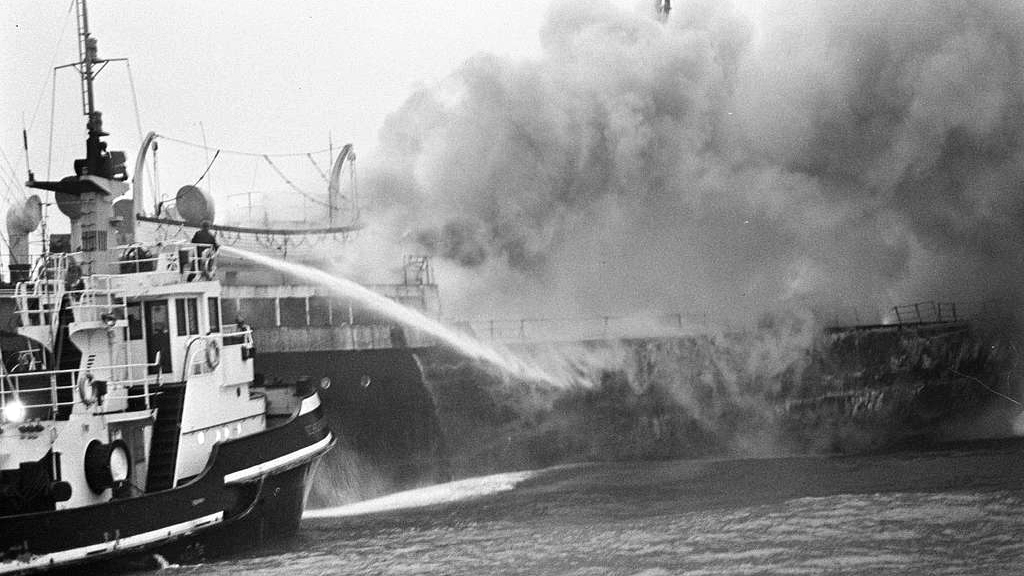
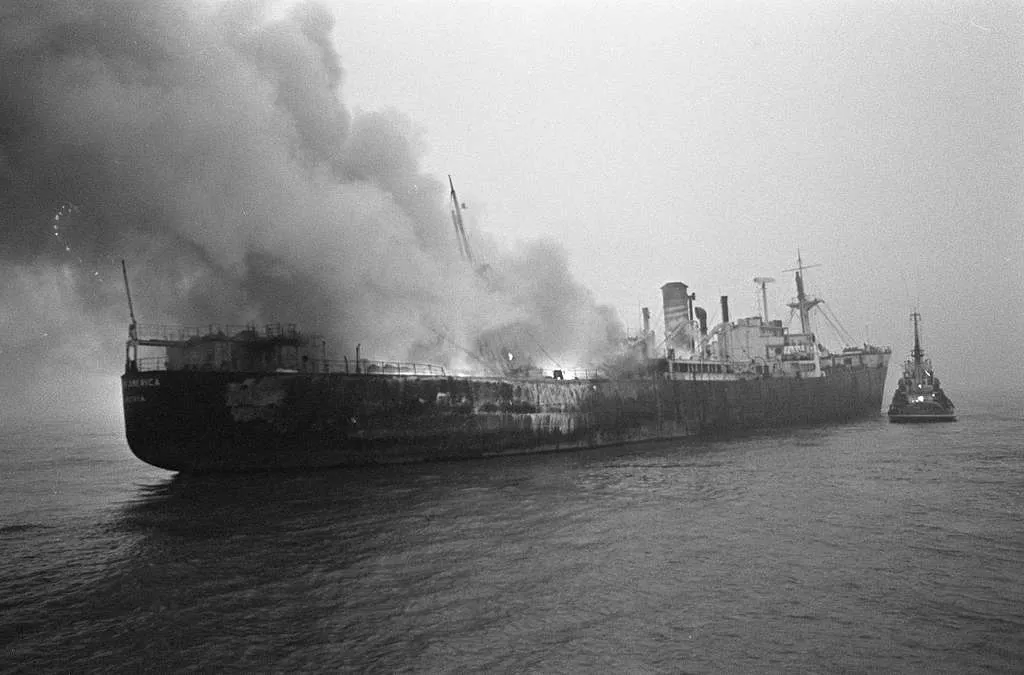
In January 1966, a South African cargo ship caught fire at sea, initiating a chain of terrifying maritime disasters that would baffle and terrify the shipping industry. When the vessel docked in Bristol, England, firefighters pried open a smoking container, accidentally feeding oxygen to the smoldering cargo and unleashing a violent conflagration that burned unchecked for five days. Just over a month later, a Liberian steamship caught fire near Rotterdam, igniting a storage area filled with barrels of petrol before eventually sinking beneath the waves. The following month, a Danish ship caught fire off the coast of Long Beach, California, resulting in three injured firefighters, the death of a dockworker, and more than a million dollars in estimated damages.
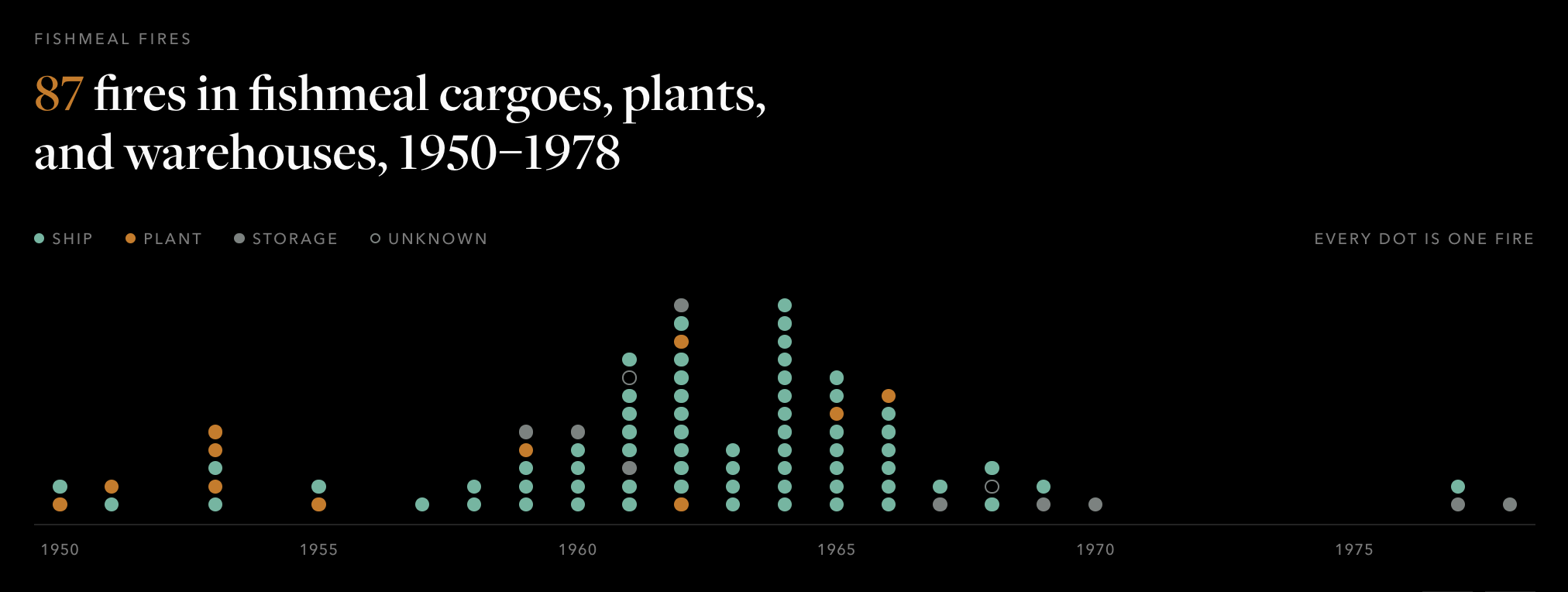
The common denominator in each of these dramatic fires was fishmeal—a dark yellow, protein-rich powder produced by drying and pulverizing fish. If left untreated, fishmeal is notoriously prone to spontaneous combustion as it decays, oxidizes, and generates intense internal heat during transit. According to a comprehensive historical sweep of news coverage by The Outlaw Ocean Project, a Washington, D.C.-based investigative news organization, this explosive instability was tied to at least 90 ship and industrial plant fires between the 1950s and the 1970s. The threat posed a persistent, costly hazard for seafarers, marine insurers, and dockworkers who handled the cargo daily.
A major breakthrough arrived in 1967 when American feed producer Cargill announced a chemical solution: ethoxyquin. Originally developed as a rubber anti-degradant to prevent tires from drying out and later utilized as a preservative on fruits and alfalfa, production of the powerful antioxidant was rapidly scaled up to meet the demands of the maritime and agricultural sectors.
"Antioxidant treatment has made bulk handling an easy matter," the director of the Canadian Department of Fisheries declared to an industry publication in 1966, passionately arguing that the chemical additive should be made a mandatory requirement for all fishmeal shipments moving across global trade routes.
The chemical proved remarkably effective at halting the thermal reactions. By the 1970s, press-reported cargo fires dropped sharply. According to data from the Liverpool Underwriters Association, the frequency of shipboard fires plummeted from a typical average of 16 per year down to just five.
The industry success led to swift regulatory adoption. By 1976, the U.S. Coast Guard imposed mandatory ethoxyquin treatment requirements for fishmeal shipments. Three years later, the United Nations body overseeing international maritime activity officially recommended that fishmeal be treated with the chemical "to prevent spontaneous combustion" during long ocean voyages.
The Toxic Trade-Off: Carcinogenic Risks Emerge
Even as ethoxyquin successfully secured the world’s shipping lanes against catastrophic fires, a darker reality was coming to light: the chemical is a known carcinogen.
"Toxic effects had been observed in laboratory animals fed high concentrations of ethoxyquin," warned a 1969 research paper published by United Nations food and agriculture authorities, signaling early red flags that would take decades to fully address.
As global usage expanded exponentially, driven by the explosive growth of the animal feed and aquaculture sectors, independent researchers continued to investigate the chemical’s safety profile. A 1987 study conducted by British researchers concluded that ethoxyquin "caused severe damage" and exhibited a potentially "carcinogenic effect" when tested on laboratory rats. Decades later, in 2015, the European Food Safety Authority warned that an impurity naturally occurring within ethoxyquin, known as p-phenetidine, was capable of causing direct mutations in genetic material.
While a distinct lack of scientific consensus has persisted regarding whether it is safe for humans to consume farmed seafood raised on feed treated with ethoxyquin, several governments decided the potential health and environmental risks justified strict regulatory action. In 2017, the European Commission took decisive steps, suspending the authorization for ethoxyquin’s use in animal feed across the entire European Union.

Today, ethoxyquin is completely banned in the United Kingdom and across all member states of the European Economic Area, including Norway, Iceland, and Liechtenstein. However, the chemical remains legally permitted within specified limits in animal feed across other major agricultural and trade nations, including Australia, Japan, South Korea, and the United States.
With more than half of the seafood consumed worldwide now originating from commercial fish farms—and with the majority of these farmed species sustained on diets rich in fishmeal and fish oil—studying the chemical additives mixed into animal feed is critical for understanding potential pathways of contamination within the global food supply.
Legal Battles and Regulatory Shortfalls
Although ethoxyquin is not banned in the United States, the additive has found itself at the center of roughly half a dozen civil lawsuits, typically centering on allegations of deceptive marketing and false advertising. Plaintiffs have targeted prominent seafood companies for labeling and marketing their packaged products as "sustainable" despite the presence of ethoxyquin, while other legal complaints have emphasized the environmental threats the chemical poses to fragile aquatic ecosystems.
In 2022, a New York resident filed a class-action lawsuit against Aldi Inc., a major German supermarket chain with extensive operations in the United States, alleging that its frozen Atlantic salmon products were deceptively labeled as "sustainable" while relying on "environmentally destructive" production practices. The legal complaint cited the European Union’s sweeping ban on ethoxyquin alongside scientific studies linking the antioxidant to mortality events and physical deformations in fish and crustaceans, asserting that the chemical "poses a risk for aquatic life." The case was ultimately resolved through an out-of-court settlement.
During the same year, residents from New York and California jointly filed a similar lawsuit against Gorton’s Inc., a prominent seafood distribution company, challenging the labeling of its frozen tilapia products as "sustainably sourced" given their exposure to ethoxyquin. Citing the same aquatic toxicity concerns and the European regulatory ban, this case also ended in an out-of-court settlement.
Regulatory oversight varies dramatically by region. In Canada, the Canadian Food Inspection Agency requires commercial feeds containing ethoxyquin to display a label certifying compliance with established legal limits. However, the agency does not specify analytical protocols for testing feed samples for the chemical residue. Furthermore, according to the agency’s latest food inspection report from 2022, inspectors do not routinely check whether ethoxyquin residues ultimately transfer into the consumable seafood itself.
Adding to these regulatory concerns, a 2024 compliance audit of the Canadian food inspection agency conducted by the European Union revealed that the agency completed only about 40 percent of its scheduled domestic inspections, pointing to "systematic and significant under-delivery" regarding seafood product testing.
Industry Shifts and the Search for Alternatives
Facing mounting regulatory pressure and shifting consumer preferences, major global agribusinesses have adapted their supply chains. Cargill stated publicly that it began assessing alternative antioxidants as early as 2005 and no longer utilizes ethoxyquin within its global salmon feed operations or in any regional market where the chemical lacks legal authorization for use in aquafeed. The company also clarified that it was never the original developer of ethoxyquin. Across the broader industry, feed manufacturers have increasingly pivoted toward alternative natural preservatives, such as rosemary extract and vitamin E compounds.
"More and more destinations are not accepting ethoxyquin, starting with our local Peruvian market," explained James Frank, managing director of the Peruvian fishmeal producer MSICeres, during an industry webinar in 2022. Frank noted that 100 percent of Peru’s fishmeal exports destined for Europe, Canada, the United States, and Australia are now completely ethoxyquin-free, reflecting a broader commercial transformation also adopted by leading producers in the United Kingdom and Norway.
Despite these shifts, the primary chemical substitute adopted by many global producers is butylated hydroxyanisole, widely known as BHA. Favored for its lower production costs and strong antioxidant performance compared to fully natural additives, BHA carries its own significant health concerns.
As early as 1991, the U.S. National Toxicology Program identified BHA as a substance "reasonably anticipated to be a human carcinogen." Later research by Japanese scientists in 2008 demonstrated that the compound induced malignant tumors in laboratory rats. Reacting to these persistent health concerns, the U.S. Food and Drug Administration announced a formal reassessment of BHA’s safety profile as a common food additive.
To sustain the world’s continuous appetite for seafood, the commercial aquaculture sector will undoubtedly continue to expand in the coming decades. While structural changes—such as a transition away from carnivorous farmed fish species or the development of entirely novel fishmeal replacements—may eventually reshape the industry, the aquaculture and fishmeal supply chains remain caught in a complex cycle: pivoting away from explosive shipboard fires to embrace a carcinogenic fire retardant, only to search for yet another temporary fix.