
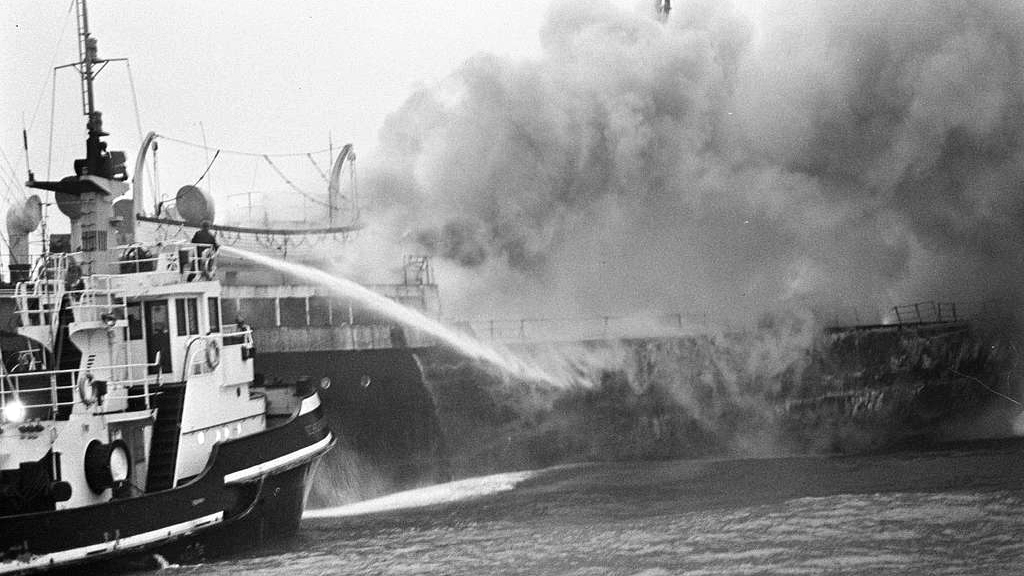
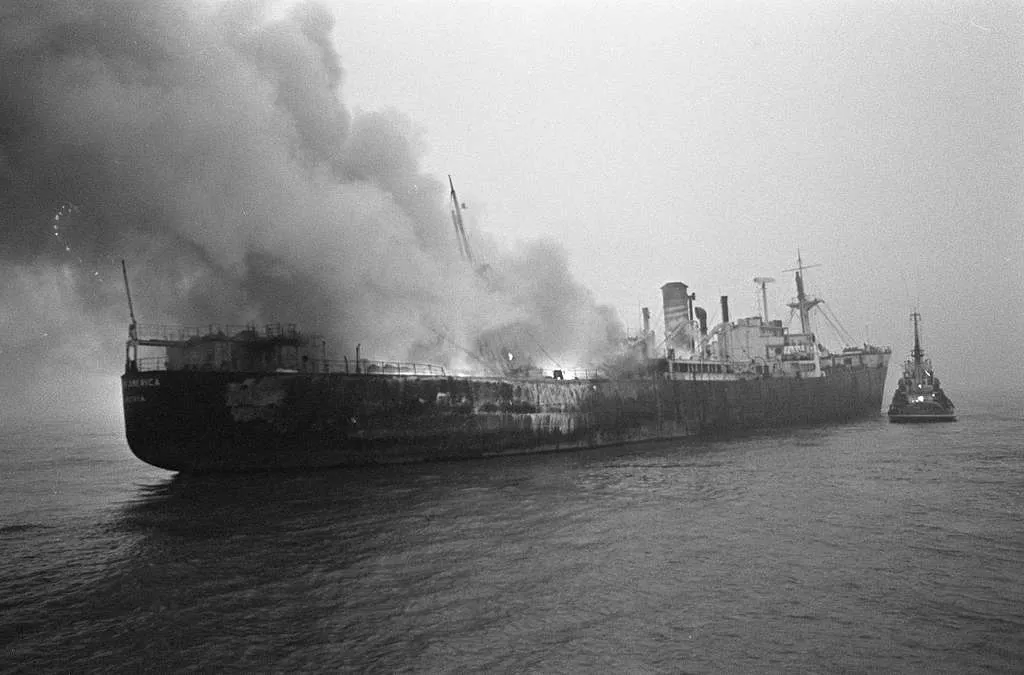
In January 1966, a routine voyage turned into a maritime disaster when a South African ship caught fire at sea. When the vessel finally reached port in Bristol, England, firefighters pried open a smoking container, accidentally feeding oxygen to the smoldering cargo. The resulting conflagration exploded outward and burned relentlessly for five days.
Just a little over a month later, a Liberian steamship caught fire near Rotterdam. The flames quickly breached a storage area filled with barrels of petrol, causing catastrophic damage and sending the ship to the bottom of the sea. The month after that, a Danish vessel caught fire off the coast of Long Beach, California. That incident injured three firefighters, killed a longshoreman, and generated over a million dollars in estimated damages.
The invisible, volatile culprit behind each of these devastating maritime fires was fishmeal—a dark yellow powder manufactured by drying and pulverizing fish. If left untreated, fishmeal is notoriously prone to spontaneous combustion as it decays, oxidizes, and generates intense internal heat.
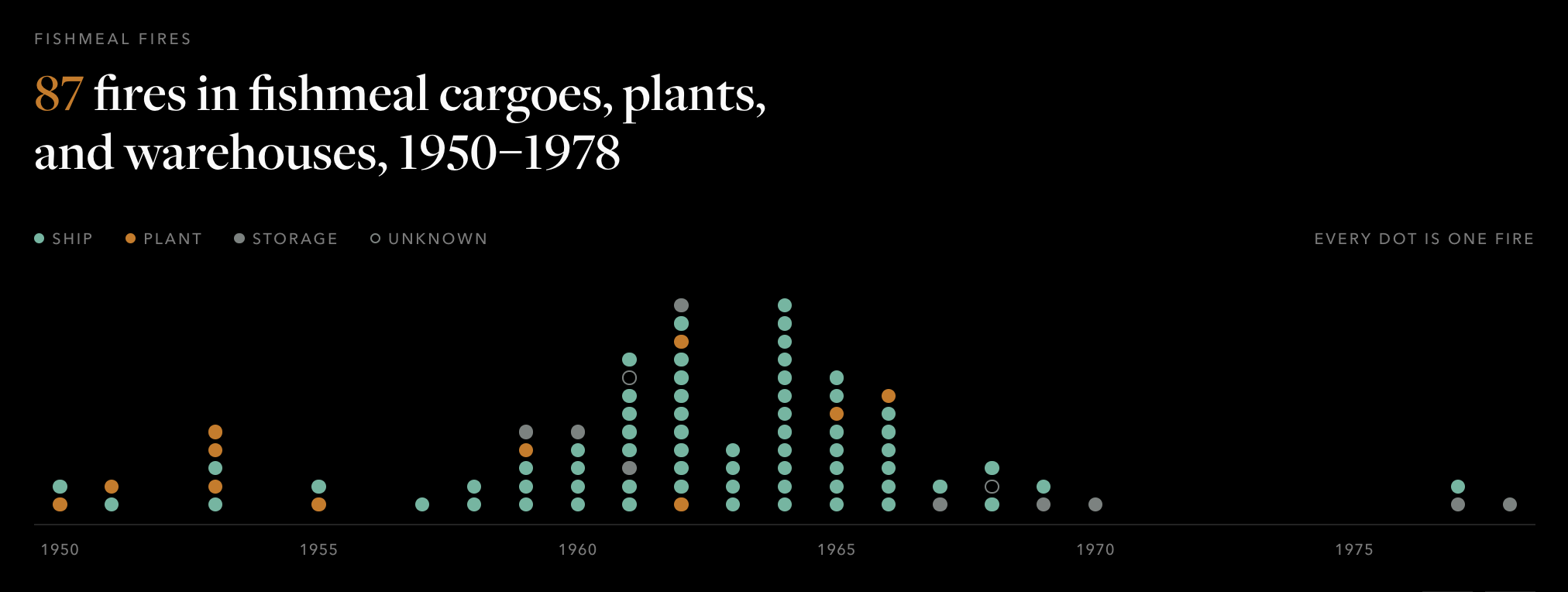
Historical media sweeps and archival research by The Outlaw Ocean Project, a Washington, D.C.-based investigative news organization, reveal that fishmeal combustibility was directly tied to at least 90 ship and plant fires from the 1950s through the 1970s. For seafarers, marine insurance underwriters, and dock workers worldwide, hauling bulk shipments of fishmeal was a constant, terrifying gamble.
Then, in 1967, American feed producer Cargill announced a promising chemical solution: ethoxyquin.
Originally developed as a rubber antiozonant to keep tires from drying out and cracking, and later applied as a preservative on fruits and alfalfa, ethoxyquin quickly found a new, massive market in the maritime and agricultural sectors. Production of the powerful antioxidant was ramped up dramatically to meet global shipping and animal feed demands.
"Antioxidant treatment has made bulk handling an easy matter," the director of the Canadian Department of Fisheries enthusiastically told an industry publication in 1966, arguing that the chemical treatment should be made mandatory for all commercial fishmeal shipments.
The chemical proved to be exceptionally effective at stabilizing the volatile powder. By the 1970s, press-reported fires dropped precipitously. According to records from the Liverpool Underwriters Association, the frequency of ship fires plummeted from a typical average of 16 per year down to just five.
The maritime industry’s relief translated quickly into regulatory mandates. By 1976, the U.S. Coast Guard imposed mandatory ethoxyquin treatment on all fishmeal shipments entering American waters. Three years later, the United Nations body overseeing global maritime activity officially recommended that fishmeal be treated with the chemical "to prevent spontaneous combustion."
The Emerging Health and Environmental Hazards of Ethoxyquin
Even as ethoxyquin was hailed as a brilliant safety innovation that rescued the shipping industry from recurring infernos, troubling scientific warnings were already beginning to surface. Ethoxyquin, researchers discovered, is a carcinogen.

"Toxic effects had been observed in laboratory animals fed high concentrations of ethoxyquin," noted a 1969 research paper published by United Nations food and agriculture authorities, signaling early concerns that were largely overshadowed by the immediate economic and safety benefits of stopping shipboard fires.
As the chemical’s use expanded rapidly across animal husbandry, livestock feed, and global aquaculture, independent scientists began looking closer at its biological impacts. A 1987 study conducted by British researchers found that the chemical "caused severe damage" and exhibited a potentially "carcinogenic effect" in laboratory rats. Decades later, in 2015, the European Food Safety Authority (EFSA) issued a stark warning: an impurity within ethoxyquin known as p-phenetidine was capable of causing direct mutations in genetic material.
While a definitive scientific consensus has remained elusive regarding whether it is safe for humans to regularly consume farmed seafood raised on feed heavily treated with ethoxyquin, several nations decided the potential health and environmental risks were simply too high to ignore. In 2017, the European Commission took decisive action, suspending authorization for the use of ethoxyquin in animal feed across the entire European Union.
Today, ethoxyquin is completely banned in the United Kingdom and across all member countries of the European Economic Area, including Norway, Iceland, and Liechtenstein. However, the chemical—subject to established regulatory limits—remains legally permitted in animal feed across other major economies, including Australia, Japan, South Korea, and the United States.
With more than half of all seafood consumed worldwide now originating from commercial fish farms, and with the vast majority of farmed carnivorous species fed diets rich in fishmeal and fish oil, scrutinizing the safety of feed additives is vital for understanding potential contamination within the global food supply.
Although ethoxyquin is not banned in the United States, its presence in imported and domestically produced seafood products has placed major food corporations at the center of a wave of consumer lawsuits. These legal actions have predominantly focused on claims of false advertising and deceptive marketing. Plaintiffs have targeted prominent seafood companies for labeling their packaged fish products as "sustainable" despite containing residues of an industrial chemical banned elsewhere over environmental and health concerns.
In 2022, a New York resident filed a class-action lawsuit against Aldi Inc., a major German supermarket chain operating stores across the United States. The complaint alleged that Aldi’s packaged Atlantic salmon products were deceptively labeled as "sustainable" while relying on "environmentally destructive" practices. Citing the European Union’s strict ban on ethoxyquin and scientific studies linking the chemical to mortality and developmental deformations in fish and crustaceans, the lawsuit argued that the additive "poses a risk for aquatic life." The legal battle was ultimately resolved out of court through a settlement.
That same year, residents from New York and California jointly filed a similar lawsuit against Gorton’s Inc., a major seafood processing company, challenging the marketing of its frozen tilapia products as "sustainably sourced." Like the Aldi complaint, the Gorton’s lawsuit highlighted the EU ban and the potential toxic risks posed to aquatic ecosystems by ethoxyquin-treated feed. That case also concluded with an out-of-court settlement.
Regulatory Lapses and the Search for Viable Alternatives
Regulatory oversight regarding how these chemicals are monitored in the supply chain remains inconsistent. In Canada, the Canadian Food Inspection Agency (CFIA) requires commercial feeds containing ethoxyquin to carry specific labeling verifying that they meet established legal limits. However, the agency does not specify how it rigorously tests bulk feed batches for the chemical. Furthermore, according to the CFIA’s latest available food inspection reports from 2022, federal inspectors do not routinely check whether ethoxyquin residues ultimately transfer into the consumable seafood tissues bought by everyday shoppers.
Adding to these regulatory concerns, a 2024 audit of the Canadian food inspection system conducted by the European Union revealed that the agency had completed only about 40 percent of its planned inspections. The EU auditors cited "systematic and significant under-delivery" regarding actual testing procedures for commercial seafood products.
Major agricultural and feed corporations maintain that they are actively adapting to changing global regulations. Cargill stated that it has actively assessed alternative antioxidants since 2005 and no longer uses ethoxyquin in its global salmon feed business, nor in any international market where the chemical is unauthorized. The company also emphasized that it never originally developed ethoxyquin. Across the broader industry, feed producers have increasingly pivoted toward natural alternatives, such as rosemary extract and various vitamin E compounds.
"More and more destinations are not accepting ethoxyquin, starting with our local Peruvian market," said James Frank, managing director of the Peruvian fishmeal company MSICeres, during a 2022 industry webinar. He noted that 100 percent of Peru’s massive fishmeal export volume destined for Europe, Canada, the United States, and Australia is now entirely ethoxyquin-free, mirroring a similar compliance shift adopted by producers in the United Kingdom and Norway.
Yet, replacing ethoxyquin has created a secondary chemical dilemma. The current most popular commercial alternative is butylated hydroxyanisole, widely known as BHA. Favored by feed manufacturers for its lower cost and strong antioxidant performance compared to fully natural additives, BHA brings its own significant health concerns.
As early as 1991, the U.S. National Toxicology Program identified BHA as "reasonably anticipated to be a human carcinogen." Later, in 2008, Japanese researchers published findings showing that BHA caused malignant tumors in laboratory rats. Recognizing these enduring safety questions, the U.S. Food and Drug Administration announced a formal reassessment of BHA’s safety profile as a common food additive.
To meet the global population’s insatiable appetite for seafood, the aquaculture industry will inevitably continue to expand in the coming decades. While the sector may eventually see a systemic shift away from carnivorous farmed species or the development of entirely novel replacements for fishmeal, the industry remains caught in a perilous cycle. For decades, producers have pivoted from deadly, spontaneous shipboard fires to a carcinogenic fire retardant, and now toward substitute chemicals that carry their own unresolved health and environmental risks.