
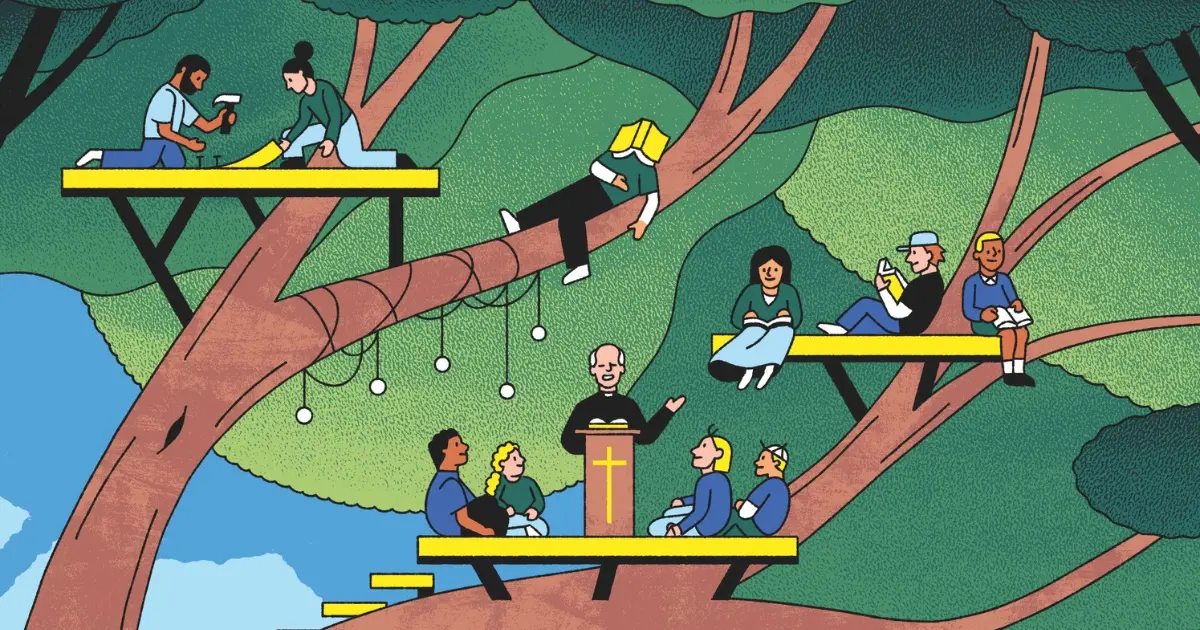
After dedicating 37 years of his life to pastoral ministry, Rev. Christopher White reached a point of deep emotional exhaustion and burnout. He decided to retire, stepping away from the demands of church leadership and intentionally avoiding religious communities after relocating to his new home in Hamilton. For a time, retirement meant rest and distance from the institution he had served for decades.
However, as the broader world grew increasingly threatening, polarized, and confusing, White found himself experiencing an unexpected yearning. He missed congregational life—the steady rhythm of community, shared purpose, and spiritual grounding. By February, he felt pulled back into service, taking on a part-time pastoral position at Faith United.
Around the same time he re-entered ministry, White began hearing whispers and reports of a surprising trend: new people were arriving in worship services across the country. Initially, he was skeptical. Much of his professional career had involved managing and adapting to the steady, seemingly inexorable decline of the United Church of Canada. With national statistics showing an average Sunday attendance of just 47 people across the denomination in 2024, it had become impossible to deny that the United Church is a much smaller entity today than it was in decades past.
Yet, beyond the sobering statistics, White sensed a shift in the wind. Walking through the doors of Faith United, he was delighted to discover numerous recent arrivals filling the pews. When the congregation announced a dedicated new-member Sunday, White admits he was genuinely shocked when 15 individuals stepped forward to join the church community.
This experience led him to a profound realization: the Spirit may be actively reconstituting the church. Rather than signaling an absolute end, the denominational transformation from large to small actually presents a unique and timely opportunity. Stripped of the massive infrastructure and institutional weight of the past, the modern church finally has the chance to write a new story—one it so desperately needs. Small congregations can experiment freely with what it means to be a vibrant community of faith in the 21st century, and in doing so, they are discovering an unexpected capacity to attract new members.
To understand this phenomenon, White emphasizes that church leaders must look closely at the people who are currently joining small churches. It is vital to understand what these newcomers are searching for when they first walk through church doors, and what modern small congregations have to offer that mainstream contemporary culture simply cannot provide.
Among the diverse newcomers White has encountered at Faith United, the demographic makeup is varied. Some are young adults navigating the complexities of early career and adult life, while others are older adults seeking deeper connection. Some arrive with backgrounds in other Christian denominations, while others have no prior church affiliation whatsoever. The congregation includes members of the 2SLGBTQ+ community, as well as refugees who have recently arrived from Africa.
Crucially, these individuals are not searching for a massive, anonymous religious institution where they can blend into the crowd. Furthermore, traditional denominational labels, such as belonging to the United Church, are largely irrelevant to them.
Instead, what modern newcomers want is an intimate, grounded church community where they are genuinely seen and heard. They are looking for a place where they can develop authentic relationships and quickly integrate into the daily life and work of the congregation. Above all, they want to understand and experience the divine within a community that actively lives out its faith through tangible actions rather than empty words.
This raises a fundamental question for modern religious leaders: What do small churches offer that people cannot easily find elsewhere in society? According to White’s observations and the broader experiences of small-scale ministries, several distinct qualities set these congregations apart.
Small Churches Are Countercultural
Newcomers frequently arrive at church seeking a safe harbor through the turbulence and exhaustion of modern life. Across society, people are experiencing an economic system explicitly designed to extract maximum productivity while offering precarious work, unaffordable housing, and steadily rising costs of living. Citizens face relentless cultural forces that dehumanize, commodify, and marginalize them. The pervasive belief that free markets and radical privatization are the universal answer to every human problem has become so deeply embedded in daily life that people barely register its grip, even though it operates with the controlling intensity of an authoritarian regime.
In stark contrast, the church offers a radical alternative by inviting people to follow the teachings of Jesus, who led individuals away from self-destructive and selfish behaviors and transformed their communities in the process. For newcomers searching for meaning, the Gospels offer a refreshing set of countercultural values. Small churches provide the relational intimacy required to explore these ancient stories, ask difficult questions, and construct intentional, meaningful values for daily living.
Small Churches Treat People as Beloved Members of a Community
Modern advertising, commercial media, and digital platforms thrive on a fundamental psychological premise: telling individuals that they are never quite enough. For-profit corporations and social media algorithms will never assure a person that they are unconditionally loved and that they truly belong. Instead, the prevailing cultural message insists that every individual is entirely on their own and that genuine, unconditional community does not exist.
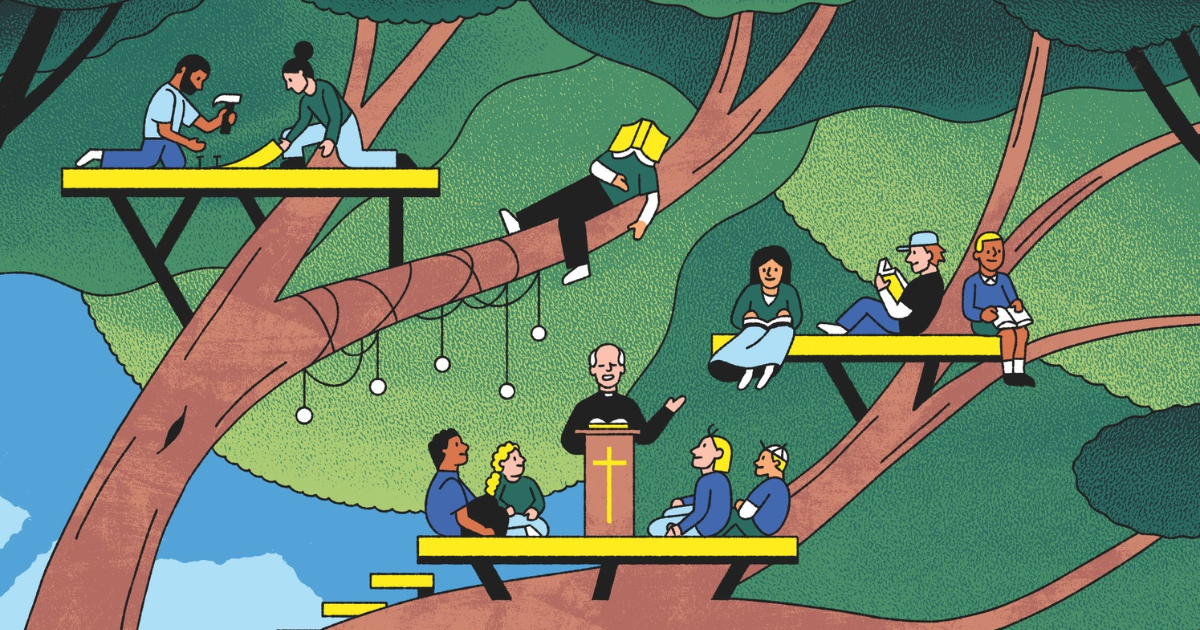
In a small church, however, participants experience a radically different reality. Here, individuals are seen, loved, and accepted exactly as they are. They are reminded that they are created not in the image of curated digital profiles on TikTok or Instagram, but in the image of the divine. Every person is viewed as sacred and of immense, inherent value to God and to the local faith community.
These affirming messages serve as powerful antidotes to the pervasive isolation, chronic loneliness, and deep-seated sense of inadequacy that characterize contemporary life. In a small church, the community acts as a support system, carrying individuals when life’s unexpected blows become too heavy to bear alone.
Small Churches Turn Despair Into Repair
It is remarkably easy for modern citizens to feel completely overwhelmed by the sheer magnitude of global challenges. From rising economic inequality and the escalating climate crisis to ongoing wars and systemic injustices—phenomena increasingly referred to by experts as the "polycrisis"—the sheer scale of suffering can induce an all-encompassing sense of helplessness.
Small churches offer a vital antidote to this paralysis by providing concrete opportunities to reshape the world through tangible local action. A small congregation might run a specialized ministry working alongside Indigenous Peoples toward genuine reconciliation, support local families struggling to make ends meet in a brutal economy, or offer a welcoming sanctuary for the 2SLGBTQ+ community. By participating in even modest, localized actions aimed at repairing the fractured world, individuals discover that they are simultaneously helping to heal their own souls.
Small Churches Offer Sacred Practices
Whenever people gather to offer communal prayer, they collectively acknowledge that there is a reality far greater than themselves, reminding them of their gratitude and accountability to a Creator while keeping the needs of others at the forefront.
In a small church setting, communal prayer takes on a deeply intimate character because the participants actually know the people for whom they are praying. They are friends, neighbors, and familiar faces rather than distant names on a bulletin. Those who find themselves lifted up in prayer experience a profound sense of being enveloped by the genuine love and care of a community that knows them intimately.
In addition to prayer, communal singing remains a cornerstone of the small church experience. Listening to a small congregation belt out a beloved hymn with imperfect, beautifully human voices creates a moving, visceral atmosphere. The physical walls of historic sanctuaries seem to reflect the generations of worshippers who have raised their voices in the exact same space, Sunday after Sunday, inspiring deep emotion and a powerful sense of historical continuity. In a culture where few public spaces remain where people can gather simply to sing without the pressure of performance, the small church offers this gift freely each week.
Small Churches Are Nimble and Resilient
Small churches possess an inherent structural advantage: they can be remarkably nimble, deeply relational, and creatively resilient. Unburdened by heavy layers of bureaucracy or cumbersome institutional hierarchies, small congregations can make decisions rapidly and respond immediately to the evolving needs of their members and local neighborhoods. Many small communities of faith carry a long history of enduring and even thriving despite smaller numbers and persistent financial constraints, teaching them essential lessons in adaptation.
Rev. Daniel Reed, the associate director of mission, property, and finance for the Toronto United Church Council, understands this dynamic well. As a minister in his 30s who has only ever known a denominational landscape shaped by decline, Reed functions comfortably in an environment focused on re-creation and innovation. In his regional role, he frequently collaborates with small communities of faith that he characterizes as "scrappy and innovative," noting that they are consistently "doing really cool things."
As examples, Reed points to Sprucedale United Church in Ontario, a tiny congregation that successfully established a community café to serve its rural area. Similarly, Mount Zion United in London, Ontario, undertook the construction of a new building specifically designed to house an EarlyON Centre, a provincial support service dedicated to families with small children. Furthermore, four separate churches in London have joined forces to collectively employ three ministers, pioneering a collaborative, shared approach to pastoral leadership.
"I am seeing churches prayerfully moving outside their comfort zone and letting themselves be open to both failure and transformation through the movement of the Spirit," Reed observes, reflecting on his administrative and pastoral experiences. "In my work, I see that resurrection is real."
After decades of prolonged decline—what church historians might liken to a long spiritual Good Friday—the Easter hope for small contemporary churches may not look like a return to the massive institutional strength of previous generations. Instead, it may manifest as something humbler, yet far more surprising: a genuine willingness to loosen institutional grips on outdated operational models and discover a revitalized purpose. By truly welcoming newcomers and allowing their presence, difficult questions, and unique personal gifts to help shape what comes next, small churches across the country are quietly writing a brand-new chapter.